


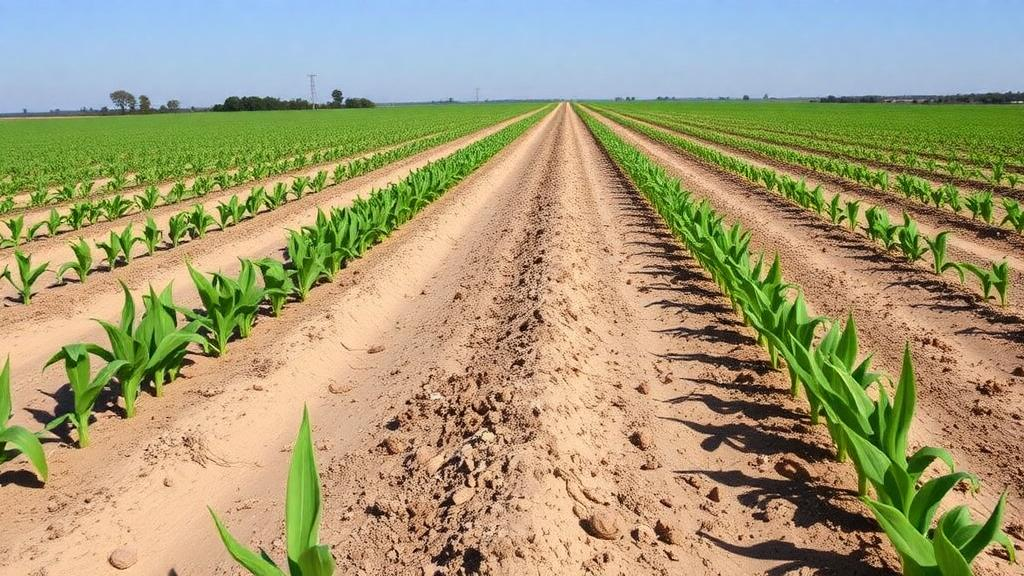
Drought is one of the most punishing forces in global agriculture, and few crops feel its bite more acutely than soybean. Roughly 43 percent of the world’s land area is affected by drought to some degree, and water scarcity can strip more than half of the potential soybean harvest in a bad season. Now, a team of researchers at Gazipur Agricultural University in Bangladesh has carried out a detailed field experiment to identify which physiological and biochemical traits allow certain soybean genotypes to keep growing, photosynthesizing, and filling seeds when water becomes scarce. Their findings, published in Discover Agriculture, point to one genotype in particular, AGS 383, as a standout performer that could anchor future breeding programs for drought-prone regions.
The study was conducted during the rabi season of 2020 at the university’s research field in Gazipur, a subtropical site in the Madhupur Tract where average temperatures ranged between 19 and 27 degrees Celsius during the experiment. The researchers grew three soybean genotypes, AGS 383, NCS 1, and the released variety BU Soybean-1, under four moisture regimes: a fully irrigated control, moderate drought maintained at 60 percent of field capacity, severe drought at 40 percent, and extreme drought at just 20 percent of field capacity. Because the soil at field capacity held 30 percent moisture, these treatments corresponded to soil moisture contents of roughly 18, 12, and 6 percent. Drought was imposed after the trifoliate stage, and the team used a soil moisture meter and a calculated irrigation formula to hold each plot at its target level throughout the growing period, applying water every three to six days as wilting symptoms appeared.
The results painted a stark picture of what water scarcity does to a soybean crop. Across all genotypes, increasing drought severity significantly reduced plant height, leaf production, nodulation, dry matter accumulation, leaf area index, crop growth rate, and net assimilation rate. Extreme drought cut pod numbers by 39 percent in AGS 383 and 29 percent in both NCS 1 and BU Soybean-1 relative to their irrigated controls. Yet the three genotypes responded in strikingly different ways, revealing considerable genetic variation in drought adaptation. AGS 383 consistently produced the tallest plants, reaching 62.3 centimeters under control conditions at pod formation, while BU Soybean-1 remained the shortest throughout the crop cycle.
Nodulation, the symbiotic partnership with root bacteria that fixes atmospheric nitrogen and enriches the soil, proved especially sensitive to water deficit. AGS 383 produced the most nodules under control conditions at flowering, 17.44 per plant, and remarkably maintained high nodulation even under severe drought, peaking at 22.67 nodules per plant at pod formation. Extreme drought reduced nodulation sharply in all genotypes, dropping NCS 1 to just 0.78 nodules per plant at flowering. The researchers note that tolerant varieties can supply photosynthates to roots and nodules under stress, sustaining the nitrogen-fixing machinery that drought-susceptible plants lose. Nodule weight followed a similar pattern, with AGS 383 achieving the highest value under moderate drought and BU Soybean-1 the lowest under extreme drought.
Water relations told a more nuanced story. BU Soybean-1 held onto its leaf water better than its competitors: under extreme drought its relative water content declined by only 3.5 percent, compared with reductions of 7.8 percent in AGS 383 and 8.9 percent in NCS 1. BU Soybean-1 also maintained the lowest water saturation deficit, which fluctuated only between 23.40 and 27.40 percent across treatments. On paper, this looked like superior drought tolerance. But the physiology of water conservation came at a cost, because BU Soybean-1 consistently recorded the lowest photosynthetic rate, ranging from 26.04 micromoles of carbon dioxide per square meter per second under control conditions down to 23.39 under extreme drought, and it translated its stable leaf water status into neither biomass nor grain.
AGS 383 took the opposite approach. Rather than hoarding water, it kept photosynthesizing. Its photosynthetic rate under control conditions reached 37.74 micromoles per square meter per second, and, remarkably, drought treatments did not significantly reduce it, with values of 35.49, 32.49, and 35.92 micromoles under moderate, severe, and extreme drought respectively. Stomatal conductance and transpiration did decline with stress, as falling leaf water content triggers stomatal closure, the primary mechanism limiting photosynthesis during drought. But AGS 383’s carbon assimilation engine kept running at near-full capacity, and it maintained the highest total chlorophyll content under every moisture regime, from 5.63 micrograms per milliliter under control to 3.29 under extreme drought. Chlorophyll degradation under drought is driven largely by reactive oxygen species damaging chloroplasts, and the genotype that protects its pigments protects its yield.
Biochemical defenses added another layer of differentiation. Proline, an amino acid that acts as an osmoprotectant helping cells maintain turgor under dehydration, accumulated in all genotypes as stress intensified. NCS 1 accumulated the highest proline content under extreme drought, indicating effective osmotic adjustment, while AGS 383 accumulated the least. Carotenoid content, which protects the photosynthetic apparatus from oxidative damage, was highest in BU Soybean-1 under control conditions at 4.07 micrograms per milliliter and remained stable across stress levels. These findings underscore that drought tolerance is not a single trait but a suite of overlapping strategies, and no one biochemical marker tells the whole story.
When the harvest came, the yield data settled the question of which strategy pays. AGS 383 delivered the highest grain yield under every treatment, falling from 2.21 tonnes per hectare under control to 1.30 tonnes under extreme drought, a reduction of about 41 percent. NCS 1 dropped from 2.01 to 1.32 tonnes per hectare, a 53 percent decline, while BU Soybean-1 fell from 1.43 to 0.87 tonnes, a 38 percent reduction from a much lower baseline. AGS 383 also produced the heaviest seeds, with 100-seed weight declining only about 9 percent under extreme drought, from 15.17 to 13.76 grams, compared with reductions of up to 20 percent in the other genotypes. Correlation analysis based on drought tolerance indices showed that grain yield was strongly and positively associated with photosynthetic rate, chlorophyll content, plant height, water uptake, seed number, and 100-seed weight, confirming that the traits AGS 383 excelled at are precisely the ones that drive yield under stress.
The deeper lesson of the study is that drought tolerance in soybean is a complex, multi-trait characteristic that no single measurement can capture. BU Soybean-1’s superior leaf water conservation, an adaptive trait often associated with drought resilience, did not translate into higher photosynthetic capacity, biomass accumulation, or yield. AGS 383’s advantage lay instead in efficient carbon assimilation and biomass partitioning, sustained nodulation, and genetic capacity for bold seeds, suggesting that maintaining productivity matters more than merely surviving. The researchers conclude that AGS 383 is the most drought-tolerant of the three genotypes tested and a promising genetic resource for breeding programs targeting water-scarce environments, a finding with immediate relevance for Bangladesh, where soybean cultivation is expanding rapidly on sandy charlands with low moisture-holding capacity, and where average yields of 1.8 tonnes per hectare still lag well behind the world average of 2.76 tonnes.
Subject of Research: Eco-physiological and biochemical mechanisms of drought tolerance and yield stability in soybean genotypes
Article Title: Eco-physiological and biochemical traits underpin drought tolerance and yield stability in soybean (Glycine max L.)
Article References: Khatun, M. S., Miah, S., Mannan, M. A., Ghosh, T. K., Baset Mia, M. A., Sayeed, M. S., & Al Mamun, M. A. (2026). Eco-physiological and biochemical traits underpin drought tolerance and yield stability in soybean (Glycine max L.). Discover Agriculture, 4(1), Article 313. https://doi.org/10.1007/s44279-026-00785-z
Image Credits: AI Generated
DOI: 10.1007/s44279-026-00785-z
Keywords: soybean, drought stress, photosynthesis, chlorophyll, proline, nodulation, yield stability, plant breeding, water relations, Glycine max, osmotic adjustment, crop physiology
Cite Scienmag News
Alan Morgan. (October 5, 2026). Soybean Genotype Shows Remarkable Drought Tolerance in Field Trial. Scienmag. https://scienmag.com/soybean-genotype-shows-remarkable-drought-tolerance-in-field-trial/
Alan Morgan. "Soybean Genotype Shows Remarkable Drought Tolerance in Field Trial." Scienmag, 5 October 2026, https://scienmag.com/soybean-genotype-shows-remarkable-drought-tolerance-in-field-trial/. Accessed 5 October 2026.
Alan Morgan. "Soybean Genotype Shows Remarkable Drought Tolerance in Field Trial." Scienmag. October 5, 2026. https://scienmag.com/soybean-genotype-shows-remarkable-drought-tolerance-in-field-trial/


