


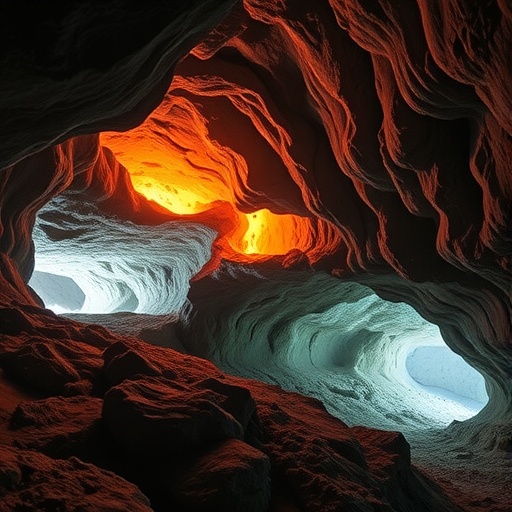
A hidden archive beneath the glaciers of the Alps is offering scientists a new way to investigate some of Earth’s most dramatic climate upheavals. In a study published in Communications Earth & Environment, J.L. Baker, A. Honiat, G.E. Moseley and colleagues examine subglacial speleothems—mineral deposits formed in caves beneath or beside glacial ice—to reconstruct climatic transitions spanning Marine Isotope Stages 10 to 12. The interval, covering roughly 340,000 to 480,000 years ago, includes major advances and retreats of Northern Hemisphere ice sheets and some of the most important natural climate shifts of the Middle Pleistocene.
The research focuses on a geological setting where ice, groundwater and bedrock interact in extraordinary ways. Speleothems are cave formations such as stalagmites, stalactites and flowstones, created when mineral-rich water enters a cave and releases dissolved compounds, commonly calcium carbonate. Their layers can preserve chemical clues about the environment at the time of formation. Under glacial conditions, however, caves may be sealed, flooded or cut off from the surface by hundreds of metres of ice. Deposits formed in such environments are therefore exceptionally valuable: they can record periods when glaciers occupied a cave system, when meltwater circulated beneath the ice and when changing temperatures altered the movement of water through the Alpine landscape.
Marine Isotope Stages, or MIS, provide the chronological framework for studying long-term climate cycles. These stages are identified primarily through variations in the ratio of oxygen isotopes preserved in marine sediments. During colder periods, large volumes of water become locked in continental ice sheets, changing the balance between oxygen-16 and oxygen-18 in the global ocean. The resulting isotope signal allows scientists to divide the Quaternary Ice Age into alternating glacial and interglacial stages. MIS 12 represents a severe glacial phase, MIS 11 a notably warm interglacial, and MIS 10 another glacial interval. Together, they capture repeated transitions between extensive ice coverage and substantially warmer conditions.
The Alpine region is particularly important because it sits at the crossroads of atmospheric circulation, European climate and the growth of mountain glaciers. Ice in the Alps responds not only to temperature but also to snowfall, precipitation seasonality and the geometry of valleys. A modest shift in climate can change whether water reaches the bedrock, whether a cave remains open to infiltration and whether minerals precipitate underground. These processes create a complicated but potentially high-resolution record. By examining subglacial speleothems, researchers can investigate climatic changes that may be invisible in conventional ice-core records, especially for periods far older than the oldest continuous Alpine ice.
The mineral deposits can be studied using a combination of geological observation, geochemical analysis and geochronology. Their internal layers may reveal alternating phases of growth, interruption, dissolution or burial. Uranium-thorium dating is commonly used for carbonate speleothems because uranium enters the crystal structure when the mineral forms, while thorium accumulates gradually through radioactive decay. Measuring the changing proportions of these elements can provide an estimate of the time elapsed since deposition. Oxygen and carbon isotope measurements can then offer additional information about water sources, temperature, vegetation and the interaction between groundwater and bedrock, although interpreting those signals requires careful consideration of local cave conditions.
The importance of the Alpine evidence lies in its ability to connect climate change with the behaviour of glaciers at the scale of individual mountain systems. Marine sediments reveal the global rhythm of glacial cycles, while ice cores provide exceptionally detailed atmospheric records but generally cover only the most recent hundreds of thousands of years. Cave deposits occupy a different position in the climate archive. They are fixed in place, potentially dateable over hundreds of millennia and sensitive to the presence or absence of ice above them. A subglacial speleothem may therefore act as a geological timestamp, indicating that meltwater was able to move through a frozen landscape during a particular period.
The transition from MIS 12 into MIS 11 is especially significant to climate researchers because it involved a major shift from severe glacial conditions to one of the longest and warmest interglacials of the Middle Pleistocene. The subsequent transition into MIS 10 records the return of colder conditions and expanding ice. Studying these changes in the Alps can help scientists assess whether mountain glaciers responded gradually or abruptly, and whether their history matched the timing inferred from ocean sediments and other continental archives. Such comparisons are essential for identifying how regional climate systems respond to global forcing.
Subglacial speleothems also illuminate the hidden hydrology of glaciers. Water beneath an ice sheet or mountain glacier can originate from surface melting, precipitation, geothermal sources or the pressure-driven drainage of the ice itself. It may travel through fractures in bedrock, enlarge underground passages and transport dissolved minerals before depositing them in a cave. When the glacier thickens or advances, the water pathways can be blocked; when it thins or retreats, new routes may open. The presence, age and chemical composition of cave deposits can consequently reveal not only temperature changes but also how the plumbing system beneath ancient ice evolved.
By placing Alpine cave evidence within the MIS 10–12 framework, Baker and colleagues expand the network of natural archives used to understand past climate transitions. Their work underscores that the history of glaciers is not written solely on mountain surfaces or in distant ocean sediments. It is also preserved in dark cavities beneath the ice, where groundwater quietly recorded the changing state of the climate system. As modern glaciers shrink in response to rising temperatures, these deposits offer a long-term perspective that can help distinguish ordinary fluctuations from larger transformations in the Alpine environment. The study highlights the scientific value of investigating fragile, hidden archives before changing ice conditions and underground hydrology erase the clues they contain.
Cite Scienmag News
Violet Maxwell. (August 21, 2026). Alpine Subglacial Speleothems Reveal Climate Transitions During Marine Isotope Stages 10–12. Scienmag. https://scienmag.com/alpine-subglacial-speleothems-reveal-climate-transitions-during-marine-isotope-stages-10-12/
Violet Maxwell. "Alpine Subglacial Speleothems Reveal Climate Transitions During Marine Isotope Stages 10–12." Scienmag, 21 August 2026, https://scienmag.com/alpine-subglacial-speleothems-reveal-climate-transitions-during-marine-isotope-stages-10-12/. Accessed 4 September 2026.
Violet Maxwell. "Alpine Subglacial Speleothems Reveal Climate Transitions During Marine Isotope Stages 10–12." Scienmag. August 21, 2026. https://scienmag.com/alpine-subglacial-speleothems-reveal-climate-transitions-during-marine-isotope-stages-10-12/


