


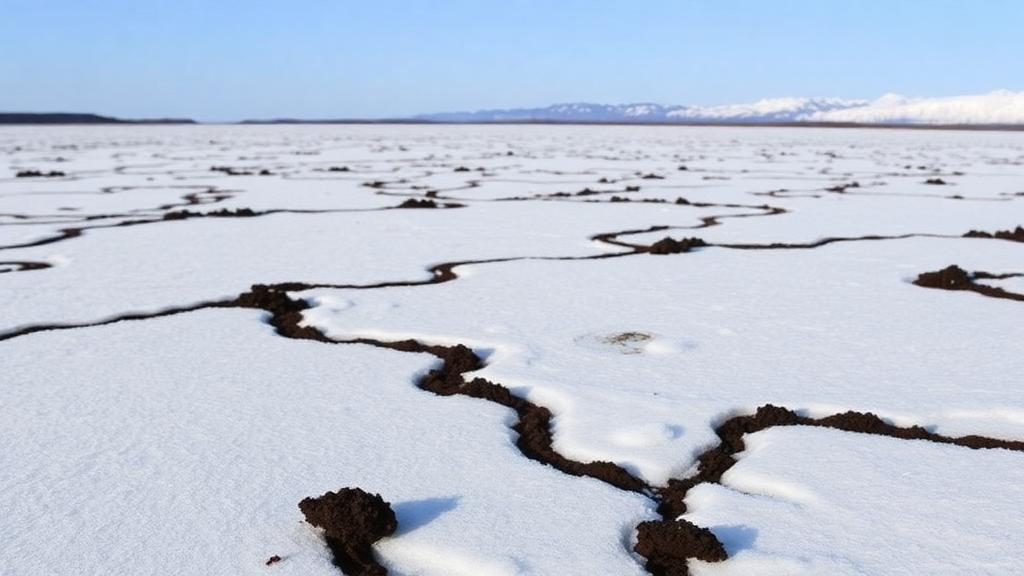
Across Alaska, the ground itself is quietly keeping score of climate change, and a new analysis of nearly three decades of measurements shows that the soil is warming quickly, deeply, and fastest of all in the state’s permafrost regions. The finding, published in the journal Frontiers in Climate by researchers at Washington State University, draws on air and soil temperature records from 43 weather stations spanning 1997 to 2023, one of the most comprehensive portraits yet of how a warming atmosphere is translating into warming earth across America’s largest and coldest state. The stakes are considerable: thawing permafrost can release carbon dioxide and methane that accelerate warming further, while the loss of continuously frozen ground threatens the roads, buildings, pipelines and other infrastructure that millions of dollars of Arctic development rest upon.
Alaska occupies a special place in the climate system. Its air temperatures are rising at roughly twice the pace of the contiguous United States, a hallmark of what scientists call polar amplification, the tendency of high latitudes to warm faster than the rest of the planet as melting snow and ice expose darker surfaces that absorb more sunlight and as atmospheric and oceanic circulation patterns shift heat poleward. What the new research demonstrates is that this amplification is not confined to the air. Soil temperatures in the permafrost region are rising too, and while they lag behind the pace of atmospheric warming, they are climbing at a rate that has surprised even the researchers who documented it.
Lead author Erin Oliver, a post-doctoral research associate in Washington State University’s Department of Crop and Soil Science who is based in Alaska, explains that the relationship between air and soil temperature is anything but straightforward in the far north. In more temperate latitudes, one would expect soils and air to warm at roughly the same rate, because the atmosphere directly heats the ground. But in Alaska, soils are buried under snow for more than half the year, and that snow blanket acts as an insulating layer, mediating how much of the atmospheric signal ever reaches the ground. Understanding how this seasonal insulation shapes regional differences in soil warming was a central motivation of the study.
The answer, it turns out, varies sharply across the state. Oliver and her co-author Claire Phillips, a research soil scientist at Washington State University, divided Alaska into three zones: one underlain by continuous permafrost, one with only scattered areas of permafrost, and one with no permafrost at all. In the two southern categories, soil temperatures rose at roughly half the rate observed in the permafrost region, a pattern the researchers attribute largely to snow cover. Snow tends to be deeper at lower latitudes, and a thicker winter blanket buffers the ground against swings in air temperature, slowing the pace of soil warming. In the high-latitude permafrost region, shallower snow offers less protection, and the ground absorbs more of the atmospheric trend.
The numbers are striking. Over the 27-year record, air temperatures in the permafrost region rose at a rate of 1.15 degrees Celsius per decade, while soil temperatures there climbed at 0.64 degrees Celsius per decade. In the rest of the state, soil warming proceeded at roughly half the permafrost-region pace. Soil warming was nearly keeping pace with air warming in the central and maritime parts of Alaska, but in the permafrost zone it lagged behind, even as it displayed its own version of polar amplification. In other words, the same latitudinal gradient that concentrates warming in the Arctic atmosphere is also concentrating warming in the Arctic ground.
Perhaps the most consequential discovery lies underground, literally. Conventional wisdom holds that soil temperatures become more stable with depth, because seasonal fluctuations damp out below the surface. The seasonal swings did indeed disappear in the deeper measurements, but the long-term warming trend did not. Instead, it became more obvious. In the permafrost region, every single weather station in the dataset showed a warming trend at a depth of four feet, while only 65 percent showed warming at two inches, where year-to-year variability masks the underlying signal. The deep soil, in effect, is integrating the warming signal over time and storing it.
Some of the winter figures are particularly sobering. In the permafrost region, Phillips notes, soils at four-foot depth warmed at rates of two to three degrees Celsius per decade during the winter months. Winter warming is especially significant for permafrost because it shortens the season during which the ground can refreeze, allowing thawed layers to persist and deepen year after year. Yet Phillips frames the deep soil’s heat storage in a dual light: the trend is upsetting, but it also represents one of the ways the planet is buffering the climate system, holding in the ground a substantial amount of heat that would otherwise remain in the atmosphere.
The scientific payoff of the study comes despite formidable logistical obstacles. Alaska is vast, remote, and expensive to instrument, and systematic weather stations that measure soil temperatures were only installed beginning in the late 1990s, leaving researchers with a comparatively short record relative to better-monitored regions. By synthesizing data from 43 stations and tracking soil temperatures at several depths across 27 years, the team assembled a dataset that few other studies of the air-soil temperature relationship in Alaska can match. The work relied on statistical analysis of these observational records rather than modeling, grounding its conclusions directly in what the ground and the air have actually done.
Why does deep soil warming matter so much? Permafrost, ground that remains frozen for two or more consecutive years, holds enormous quantities of organic carbon accumulated over millennia of slow decomposition in cold conditions. When permafrost thaws, microbes decompose that organic matter and release carbon dioxide and methane, both potent greenhouse gases, creating a feedback loop in which warming causes thaw, thaw causes emissions, and emissions cause more warming. The fact that warming is most pronounced precisely in the permafrost region, and that it penetrates to depths of four feet and beyond, means the zone of active carbon release is expanding downward and inland. At the same time, thawing ground loses the mechanical strength that frozen soil provides, undermining the stability of buildings, roads, and other infrastructure across the Arctic.
The researchers emphasize that the seasonal pattern of warming carries practical implications for adaptation. In the permafrost region, most of the warming occurred in winter, which will have pronounced effects on infrastructure that depends on frozen ground for stability. At lower latitudes, by contrast, most of the soil warming occurred in summer, which could extend Alaska’s growing season and reshape agricultural possibilities in a state where farming has historically been marginal. Knowing not just how much the soil is warming but when it is warming, Oliver argues, can help Alaskans plan for the changes ahead, from engineering decisions in permafrost towns to planting calendars in the south. As the Arctic continues to warm faster than the rest of the planet, the ground beneath Alaska is no longer a passive record of climate change but an active participant in it, and the measurements gathered from 43 remote stations now offer one of the clearest views yet of how quickly that transformation is unfolding.
Subject of Research: Long-term soil temperature warming across Alaskan permafrost and non-permafrost regions from 1997 to 2023
Article Title: In Alaska, soil in permafrost regions is warming the fastest
Article References: In Alaska, soil in permafrost regions is warming the fastest. (n.d.). Original publication
Image Credits: AI Generated
DOI: Not provided
Keywords: permafrost, Alaska, soil warming, climate change, polar amplification, snow cover, greenhouse gases, carbon feedback, Arctic infrastructure, soil temperature, Frontiers in Climate, Washington State University
Cite Scienmag News
Russell Cooper. (October 1, 2026). Alaska’s Permafrost Soils Are Warming Faster Than Anywhere Else in the State. Scienmag. https://scienmag.com/alaskas-permafrost-soils-are-warming-faster-than-anywhere-else-in-the-state/
Russell Cooper. "Alaska’s Permafrost Soils Are Warming Faster Than Anywhere Else in the State." Scienmag, 1 October 2026, https://scienmag.com/alaskas-permafrost-soils-are-warming-faster-than-anywhere-else-in-the-state/. Accessed 4 October 2026.
Russell Cooper. "Alaska’s Permafrost Soils Are Warming Faster Than Anywhere Else in the State." Scienmag. October 1, 2026. https://scienmag.com/alaskas-permafrost-soils-are-warming-faster-than-anywhere-else-in-the-state/


