


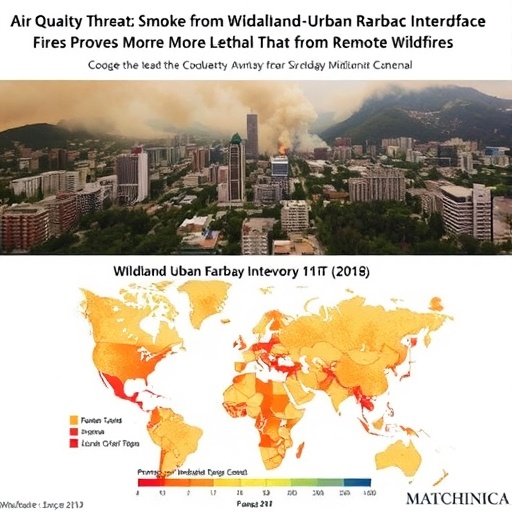
The alarming results from new research conducted by an international team of scientists, spearheaded by the U.S. National Science Foundation’s National Center for Atmospheric Research (NSF NCAR), shed light on a critical public health issue that is often overlooked: smoke emissions from wildland-urban interface (WUI) fires have a significantly greater impact on human health compared to smoke from wildfires located in remote regions. The findings published in Science Advances estimate that emissions arising from WUI fires are approximately threefold more likely to cause annual premature deaths when compared to general wildfire emissions. This increased risk is primarily attributed to the geographical proximity of WUI fires to human populations.
WUI fires occur in areas where wildland vegetation meets developed urban land, a scenario that has been increasingly common globally. With roughly 5% of the world’s land area falling into the WUI category, this unsettling trend presents serious implications for public health, as these fires lead to pollutant emissions that have more detrimental health effects due to their concentration near populous areas. According to Wenfu Tang, a scientist at NSF NCAR and the lead author of the study, the pollutants emitted from WUI fires, including fine particulate matter and ozone precursors, have heightened harmful effects due to their limited dispersion distance, resulting in higher localized exposure among residents.
This research comes as WUI areas continue to expand across every populated continent, bringing with them a surge in devastating fires. History records some of the most catastrophic WUI fires, including the 2009 Black Saturday bushfires in Australia that claimed 173 lives, the 2018 Attica fires in Greece resulting in 104 fatalities, and the recent 2023 Lahaina Fire in Hawaii, which took the lives of 100 individuals. Additionally, the onset of this year saw an outbreak of fires in Southern California that destroyed an estimated 16,000 homes and businesses, leading to financial losses projected at $250 billion or more.
Earlier investigations spearheaded by Tang revealed a notable increase in global WUI fires over the last two decades, indicating an urgent need to examine their health effects beyond immediate fatalities. The study’s researchers explored the broader implications of the emitted pollutants. Fine particulate matter and ground-level ozone, specifically, are known to pose serious risks to cardiovascular and respiratory health, exacerbating pre-existing conditions and leading to increased healthcare burdens in affected communities.
To conduct their analysis, the research team utilized an advanced computer modeling framework developed by NSF NCAR called the Multi-Scale Infrastructure for Chemistry and Aerosols (MUSICA). This powerful tool enabled scientists to simulate how pollutants from different types of fires spread across various geographical areas. By incorporating carbon monoxide chemical tracers, they could determine the sources of emissions, thereby differentiating WUI fire emissions from general wildland fire emissions.
The study utilized a dataset of WUI fires compiled over the last twenty years to ensure a robust analysis. To quantify the health impacts, the team simulated four different scenarios, which allowed them to effectively compare emissions from WUI fires against those from traditional wildland fires. The resultant findings revealed that in 2020, WUI fire emissions accounted for 3.1% of overall fire emissions across six populated continents, yet they contributed to a staggering 8.8% of premature deaths from fire emissions. This stark contrast clearly illustrates the disproportionate health risk posed by WUI fire emissions.
Regional differences also emerged from the study’s findings. In North America, for instance, WUI fires constituted 6% of all fires, linked to 9.3% of the deaths from emissions. Conversely, in Europe, WUI fire emissions accounted for a larger share, representing 11.4% of all fires and contributing to 13.7% of premature deaths attributed to emissions from fires. These differences highlight the need for tailored mitigation strategies depending on regional WUI fire risks and population densities.
A crucial line of inquiry for Tang and her colleagues moving forward is the differentiation in emissions between wildland fires, which predominantly burn natural vegetation, and WUI fires, which often engulf man-made structures containing various toxic materials. Smoke from WUI fires can introduce an array of hazardous chemicals that significantly deviate from the emissions produced by natural wildland fires. To appropriately assess and manage these implications, Tang emphasizes the necessity of a comprehensive emission inventory that explicitly considers structural fires in conjunction with vegetation fires.
The imperative to fully understand the health impacts and risk factors associated with WUI fires cannot be overstated. As WUI areas expand and population densities increase in these regions, proactive measures rooted in accurate health assessments and emission inventories will be crucial in guiding public policy decisions. These measures will ensure that communities are better prepared to respond to the escalating threat posed by WUI fires, which, as the research suggests, are likely to have far more serious public health implications than previously appreciated.
In conclusion, the revelations from this significant study mark an essential step toward enhancing our understanding of the complex dynamics between fire emissions and public health. Researchers and policymakers alike can utilize this vital information to promote more effective environmental health strategies aimed at safeguarding communities in wildfire-prone areas. Continued research into the emissions from WUI fires and their health effects will undoubtedly be instrumental in shaping future initiatives and interventions designed to mitigate risks to human health resulting from these increasingly common wildfire events.
Cite Scienmag News
Russell Cooper. (March 14, 2025). Air Quality Threat: Smoke from Wildland-Urban Interface Fires Proves More Lethal than That from Remote Wildfires. Scienmag. https://scienmag.com/air-quality-threat-smoke-from-wildland-urban-interface-fires-proves-more-lethal-than-that-from-remote-wildfires/
Russell Cooper. "Air Quality Threat: Smoke from Wildland-Urban Interface Fires Proves More Lethal than That from Remote Wildfires." Scienmag, 14 March 2025, https://scienmag.com/air-quality-threat-smoke-from-wildland-urban-interface-fires-proves-more-lethal-than-that-from-remote-wildfires/. Accessed 3 September 2026.
Russell Cooper. "Air Quality Threat: Smoke from Wildland-Urban Interface Fires Proves More Lethal than That from Remote Wildfires." Scienmag. March 14, 2025. https://scienmag.com/air-quality-threat-smoke-from-wildland-urban-interface-fires-proves-more-lethal-than-that-from-remote-wildfires/


