


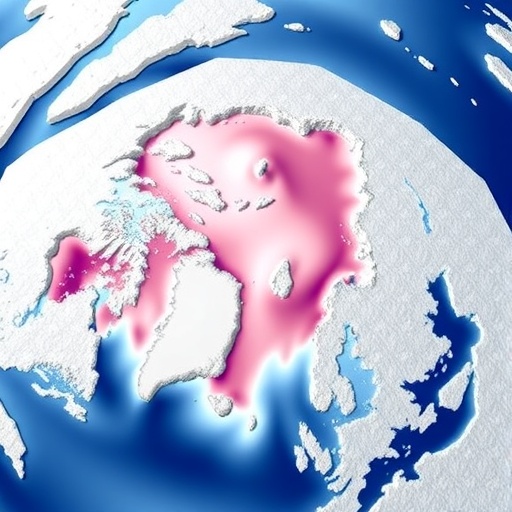
In a groundbreaking study that expands our understanding of the polar carbon cycle, researchers have unveiled the crucial role of air-ice CO₂ fluxes in shaping the carbon budgets of both Arctic and Antarctic oceans. This pioneering research, led by Crabeck, Nomura, Djeutchouang, and their colleagues, leverages an unprecedented bipolar data compilation aiming to deepen the scientific community’s grasp of the complex interactions between sea ice and atmospheric carbon dioxide exchange. The implications of their findings extend far beyond polar ecology, touching global climate models and carbon cycle predictions.
The polar regions have long been recognized as vital components of the Earth’s climate system due to their capacity to store and exchange greenhouse gases. While the ocean’s role as a vast carbon reservoir has been studied extensively, the interface where air meets ocean via the seasonal and multi-year ice remains a largely underexplored frontier. This study bridges a critical knowledge gap, assessing how sea ice modulates CO₂ fluxes and influences carbon sequestration in polar marine environments.
Crabeck and colleagues’ approach involved meticulous gathering of data from both poles, spanning multiple years, to capture seasonal variations and episodic events that influence CO₂ dynamics. Their bipolar dataset is notable not only for its scale but for its integrative methodology, combining direct flux measurements, chemical analyses of sea ice samples, and oceanographic observations. This layered dataset enables a comprehensive characterization of how frozen interfaces act as both barriers and conduits for CO₂ exchange.
One of the study’s key insights is the identification of air-ice interfaces as dynamic and heterogenous zones where CO₂ fluxes are highly variable and sensitive to environmental conditions. Unlike open water areas, sea ice can either impede or promote the exchange of CO₂ depending on its physicochemical properties, biological activity within or beneath the ice, and changing atmospheric conditions. For instance, micro-porosity within sea ice creates microscale environments that can trap or release CO₂, influencing local partial pressure gradients critical for gas exchange.
The researchers describe how brine channels—networks of saline liquid within the frozen matrix—play a pivotal role in moderating the movement of CO₂ molecules. These channels provide pathways that facilitate diffusion and biochemical interactions, such as microbial respiration and photosynthesis, both of which have direct impacts on carbon fluxes. Variability in brine salinity and connectivity throughout the ice’s life cycle, from formation to melt, was shown to govern how efficiently CO₂ is transferred from the ocean to the atmosphere or vice versa.
Importantly, the study differentiates between the behaviors observed in the Arctic versus the Antarctic, revealing distinct patterns shaped by regional differences in ice thickness, temperature regimes, and biological communities. In the Arctic, thinner and more dynamic seasonal sea ice tends to allow episodic bursts of CO₂ exchange, often modulated by biological blooms beneath the ice. Conversely, the Antarctic’s thicker, multi-year ice exhibits more stable but slower gas flux dynamics, influenced heavily by physical ice structure and prolonged isolation from atmospheric interaction.
Moreover, the impact of climate change on these fluxes was a focal point of the investigation. The findings suggest that diminishing sea ice extent and altered freeze-thaw cycles could substantially modify polar carbon budgets, potentially enhancing CO₂ outgassing in some areas while increasing oceanic uptake in others. This adds a layer of complexity to current climate models, highlighting the need to account for nuanced sea-ice-atmosphere-ocean coupling processes to predict future carbon cycle feedbacks accurately.
The study’s modeling components integrate observed fluxes into regional carbon budget assessments, quantifying how air-ice CO₂ exchanges influence overall carbon sequestration capacities. It appears that sea ice interfaces act as transient reservoirs, capable of storing and releasing carbon over seasonal timescales, thus acting as buffers and amplifiers within the broader oceanic carbon system. These mechanisms underscore the fluidity and responsiveness of polar carbon cycles to environmental perturbations.
Furthermore, this work illuminates the interplay between physical processes such as ice permeability and biological drivers including microbial ecology under sea ice. Microbial communities residing within sea ice and brine channels engage in carbon cycling activities, affecting CO₂ dynamics at scales previously underestimated. The metabolic activities of these microorganisms modulate the partial pressure gradients of dissolved inorganic carbon, influencing flux directionality and intensity.
A major takeaway from this bipolar compilation is the critical role played by comprehensive and coordinated measurements across hemispheres. The synergistic data acquired from Arctic and Antarctic sites enable comparative analyses that unravel shared mechanisms yet underscore unique regional adaptations and responses. This bipolar perspective represents a transformative methodological advance in polar environmental science.
The implications of this research extend to global policy frameworks aimed at mitigating climate change. The polar oceans act as a tremendous sink for anthropogenic CO₂, and improved understanding of the feedback mechanisms involving sea ice is essential to refining natural carbon budget estimates embedded in international climate agreements. Policymakers and stakeholders need to incorporate these complex findings to inform sustainable environmental management of polar regions.
In addition to advancing fundamental science, this work sets the stage for improved ocean-atmosphere interaction models that can be integrated into Earth System Models. The nuanced representation of air-ice CO₂ exchange dynamics will enhance predictability of future atmospheric CO₂ trajectories, providing greater certainty in climate projections. It also supports the development of targeted observational campaigns to monitor evolving polar carbon fluxes in a warming world.
Looking ahead, the authors advocate for higher-resolution temporal and spatial monitoring, employing new sensor technologies capable of continuous in situ analysis of CO₂ and related variables within sea ice. Such advancements are crucial for capturing transient events and episodic fluxes that exert outsized influence on polar carbon budgets. Collaborations across disciplines, from biogeochemistry to cryosphere physics, will be essential to unpack the multifaceted nature of these processes.
In summary, this landmark study by Crabeck and collaborators exposes the intricate and vital influence of air-ice CO₂ fluxes on polar ocean carbon budgets. By harnessing a rich bipolar dataset, the researchers have revealed critical mechanisms governing carbon exchange at the frozen frontiers of the Earth, highlighting the dynamic interplay between physical ice properties, microbial processes, and atmospheric forcing. This new understanding is poised to refine climate science paradigms and enhance predictive capabilities for our planet’s rapidly changing polar regions.
As global temperatures continue to rise and sea ice undergoes unprecedented transformation, the insights from this research serve as a clarion call for integrative, multidimensional investigations into polar carbon cycles. The convergence of field data, laboratory experimentation, and modeling presented in this work charts a promising path forward in decoding the complexities of Earth’s climate system at its most vulnerable edges.
Cite Scienmag News
Violet Maxwell. (May 29, 2026). Air-Ice CO2 Fluxes Shape Polar Ocean Carbon. Scienmag. https://scienmag.com/air-ice-co2-fluxes-shape-polar-ocean-carbon/
Violet Maxwell. "Air-Ice CO2 Fluxes Shape Polar Ocean Carbon." Scienmag, 29 May 2026, https://scienmag.com/air-ice-co2-fluxes-shape-polar-ocean-carbon/. Accessed 3 September 2026.
Violet Maxwell. "Air-Ice CO2 Fluxes Shape Polar Ocean Carbon." Scienmag. May 29, 2026. https://scienmag.com/air-ice-co2-fluxes-shape-polar-ocean-carbon/


