


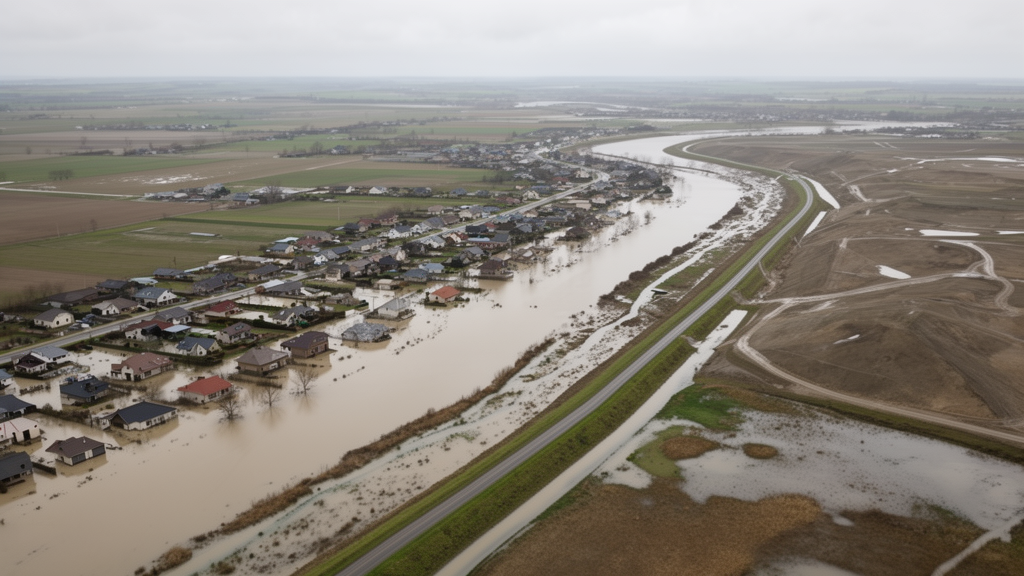
A systematic review of 185 peer-reviewed studies found that nature-based solutions are becoming central to flood management, but the evidence base remains dominated by short-term models rather than long-term field observation. Researchers searched Web of Science and Scopus for articles published from 2016 through 2025, using an AI-assisted workflow to screen records, extract information from full texts, cluster studies into themes and synthesize results, with researchers manually verifying eligibility and reviewing machine-generated outputs. The resulting evidence map shows growing scientific interest, a concentration of work in a few countries and persistent gaps in long-term performance, maintenance, equity and public acceptance.
The literature grew from two qualifying papers in 2016 to 45 in 2025, although part of that increase may reflect the wider adoption of the umbrella term “nature-based solutions.” Older approaches to sustainable drainage, low-impact development, ecosystem-based adaptation and blue-green infrastructure were increasingly described using NbS language. Of the 185 studies, 147, or 79.5%, appeared from 2021 to 2025. This rapid growth coincided with broader interest in climate resilience and sustainable water management, but the review authors cautioned that the publication curve cannot by itself distinguish a genuine expansion of research from a change in terminology.
Unsupervised analysis divided the evidence into nine themes. The largest was urban green infrastructure for runoff mitigation, with 35 papers, followed by spatial planning and decision support with 28 and catchment and hydraulic modeling for flood-risk reduction with 25. Together, these three themes represented 47.6% of the corpus, demonstrating the field’s strong orientation toward the design, placement and hydraulic evaluation of urban interventions. Ecological and hydro-geomorphic processes accounted for 22 studies, while governance, stakeholder engagement and societal uptake comprised 19. Floodplains, wetlands and agricultural landscapes accounted for 11, and 34 studies remained in an “emerging approaches” group. Coastal flood risk and shoreline protection was the smallest theme, with four papers, while systems for urban water services and climate adaptation had seven.
Research was geographically uneven. The United Kingdom, China and the United States were the leading national contributors, followed by Italy and Australia. Europe represented 41.6% of the studies, Asia 29.7%, North America 10.8%, Oceania 5.4%, South America 4.9% and Africa 2.7%; some studies covered several continents or provided no location. The concentration partly reflects different policy environments. Much U.S. research concerns engineered green stormwater infrastructure and regulatory goals, while China’s Sponge City program has driven evaluation and planning studies. European research more often treats green infrastructure as a multifunctional system intended to provide flood mitigation, biodiversity, cooling, recreation and other ecosystem services. Africa, Latin America and parts of South and Southeast Asia, despite substantial flood exposure, were markedly underrepresented.
The review’s implementation analysis indicates that successful deployment depends on more than the performance of an individual measure. Recurrent enablers include strategic siting, hydrological connectivity, coordination with gray and blue infrastructure, institutional support and early stakeholder involvement. Barriers include high costs, limited urban space, competition for land, fragmented governance, uncertain data and difficulties integrating nature-based systems with existing drainage networks. Most research remains local: 69.7% of the included studies operated at the local scale, compared with 16.2% regionally and 14.1% nationally or internationally. The authors describe a gradual move from isolated site-scale projects toward connected blue-green networks, but noted that a systems approach has not yet become firmly established across the field.
Social distribution is another persistent weakness. Upstream landowners, farmers and rural communities may bear the costs of measures whose flood-protection benefits accrue downstream, while vulnerable populations can be disproportionately affected by measures such as managed retreat. Equity considerations appeared in only 30.8% of the studies, community engagement in 44.9% and public acceptance in 30.8%. Public support was generally greater when benefits were visible and communities participated in planning. Conversely, concerns about expense, maintenance and uncertain performance could reduce acceptance, and some coastal respondents viewed nature-based coastal measures as less reliable than conventional infrastructure. The review therefore treats equity, trust and participation as core design conditions rather than optional additions to technically effective projects.
Long-term management emerged as the clearest gap between planning and operational evidence. Modeling studies accounted for 40% of the literature, and only two papers followed implemented interventions for more than five years: a 70-month assessment of blue-green roofs in Hamburg and a ten-year assessment of riverbank bioengineering in Brazil. Monetary implementation costs were reported in only 23.2% of studies, and 50.3% did not report maintenance requirements at all. Where maintenance was discussed, common needs included sediment removal, outlet cleaning, control of clogging, vegetation management and component replacement. These are not incidental details: the hydrological and ecological performance of nature-based systems can change as sediments accumulate, plants develop and watershed conditions shift.
The evidence consistently indicates benefits beyond flood reduction. Reported ecosystem services include runoff retention, infiltration, groundwater recharge, water storage, pollutant reduction, sediment retention, nutrient control, habitat provision and, in floodplains and wetlands, carbon storage. Social co-benefits included recreation, aesthetics, improved public space, walkability, education, community cohesion, protection of livelihoods and greater perceived well-being. Urban cooling and lower building-cooling demand were also reported in some green-infrastructure studies, while gravity-based systems could reduce pumping requirements. These outcomes are usually documented qualitatively or indirectly, however, and the review found little systematic quantification of energy and climate co-benefits. The specific value of a nature-based solution also varies with the flood process and landscape: coastal studies emphasize wave attenuation, erosion control and sediment regulation, whereas agricultural floodplain studies focus more on storage, attenuation and water quality.
Technical gaps converge across nearly every theme. Studies frequently rely on scenario simulations, simplified hydrological assumptions, short observation periods, coarse rainfall and topographic data, and incomplete calibration against observed floods. Governance research uses a different but equally limiting design profile, relying on case studies, expert opinion and perception surveys with small samples and little longitudinal follow-up. Standardized performance metrics are scarce across both technical and social domains, making results difficult to compare across climates, scales and intervention types. The authors identify long-term field validation under extreme and changing conditions, links between local interventions and basin processes, uncertainty-aware decision support, and better treatment of climate, socioeconomic and governance variability as the main research priorities.
AI-assisted methods did not replace the systematic review process, and they carry limitations of their own. The researchers used the OpenAI GPT-5.4 model through an API for screening, extraction, cluster labeling and qualitative synthesis. Prompts instructed the model to report only information explicitly stated in each paper and to return null values for missing details rather than infer them. Team members reviewed full texts, checked every flagged field and all medium-confidence records, and refined prompts after identifying unsupported interpretations or inconsistent categories. In the final extraction dataset, 171 records, or 92.4%, received high confidence, 14 received medium confidence and none received low confidence. Even so, the model extracted clearly reported technical information more consistently than nuanced themes such as equity and institutional conditions, while keyword-driven clustering may have assigned interdisciplinary work to engineering categories or the unclassified group. Combined with the review’s reliance on English-language Web of Science and Scopus records, these limitations mean the map is best understood as a reproducible snapshot of the accessible literature, rather than a complete picture of nature-based flood management worldwide.
Subject of Research: Systematic review of nature-based solutions for flood management and AI-assisted evidence synthesis
Article Title: Water management in flood-prone areas using nature-based solutions: an AI-assisted systematic review and thematic analysis
Article References: Arabi, S., Yaméogo, D. D. S., Rahman, M., Bereded, B., Shibeshi, T., Kwak, N., Eason, M., & Smith, V. (2026). Water management in flood-prone areas using nature-based solutions: an AI-assisted systematic review and thematic analysis. Frontiers in Sustainability, 7, 1966241. https://doi.org/10.3389/frsus.2026.1966241
Image Credits: AI Generated
DOI: 10.3389/frsus.2026.1966241
Keywords: nature-based solutions, flood management, artificial intelligence, systematic review, thematic analysis, green infrastructure, flood risk, evidence gaps, environmental research, Water, management, flood-prone
Cite Scienmag News
Violet Maxwell. (October 21, 2026). AI review maps flood solutions and exposes evidence gaps. Scienmag. https://scienmag.com/ai-review-maps-flood-solutions-and-exposes-evidence-gaps/
Violet Maxwell. "AI review maps flood solutions and exposes evidence gaps." Scienmag, 21 October 2026, https://scienmag.com/ai-review-maps-flood-solutions-and-exposes-evidence-gaps/. Accessed 21 October 2026.
Violet Maxwell. "AI review maps flood solutions and exposes evidence gaps." Scienmag. October 21, 2026. https://scienmag.com/ai-review-maps-flood-solutions-and-exposes-evidence-gaps/


