


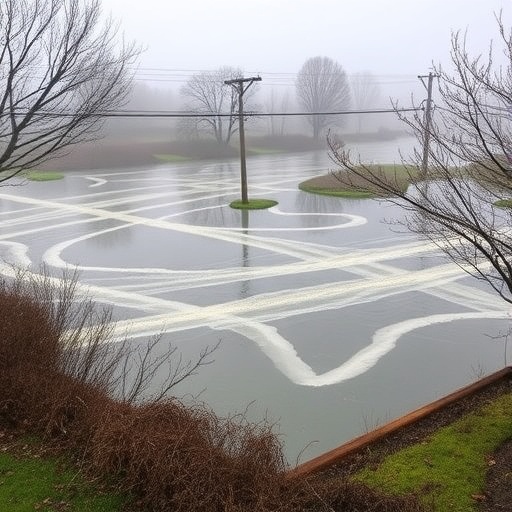
In the face of escalating climate disturbances and an increase in extreme weather events, predicting floods with precision has become paramount. Researchers at the University of Minnesota Twin Cities have introduced a groundbreaking hybrid modeling approach that integrates traditional physics-based methods with advanced machine-learning techniques. Their studies reveal how this knowledge-guided artificial intelligence (AI) method can revolutionize flood forecasting, potentially saving lives and safeguarding critical infrastructure across the globe.
Conventional flood forecasting relies heavily on physics-based hydrological models that simulate river systems by applying fundamental laws of water movement and watershed dynamics. These models, while scientifically rigorous, demand continual real-time adjustments by expert forecasters during unfolding weather events. Such manual calibrations are labor-intensive and limited in their scalability, particularly during severe weather emergencies when timely, reliable forecasts are critical.
The new research presents a hybrid model that fuses classical hydrological theories with machine learning algorithms capable of dynamically learning from observed watershed data without human intervention. This knowledge-guided machine learning (KGML) framework respects the underlying physical constraints of hydrology while benefiting from the adaptability and pattern-recognition prowess of AI. This dual fidelity enables the model to more accurately simulate streamflow and predict flood events, outperforming existing methodologies used in the United States.
Vipin Kumar, Regents Professor of Computer Science and Engineering and senior author of the study, emphasized that the approach is transformative not simply because it delivers better statistical predictions, but because it engenders trustworthiness in forecasts. This reliability allows emergency managers and flood forecasters to make critical high-stakes decisions with greater confidence, which is vital in mitigating the socio-economic impacts of floods.
Previous efforts to exclusively apply machine learning to hydrological forecasting have often faltered due to their inability to properly incorporate domain knowledge or physical constraints, resulting in models that fail to generalize beyond training datasets. The University of Minnesota team’s use of KGML bridges this divide by embedding hydrological principles into the AI architecture. This ensures that predictions are both data-driven and scientifically plausible.
Zac McEachran, a research hydrologist involved in the project, noted the urgent regional necessity for such innovations. Minnesota has witnessed increasing flood frequencies and new flood records over recent decades, underscoring the urgency of advancing flood prediction technologies. Improved forecasting capabilities can directly contribute to the protection of human lives and the resilience of built environments in flood-prone areas.
Technically, the KGML model functions by hierarchically disentangling complex watershed system dynamics across multiple temporal and spatial scales. Through a recurrent network design, it factorizes these dynamics to isolate key hydrological processes while integrating observed environmental data streams. This hierarchical disentanglement fosters better interpretability of the model’s behavior, a step forward in making AI systems transparent to hydrologists and decision-makers.
This pioneering research was a collaborative effort involving interdisciplinary teams from the University of Minnesota’s departments of Computer Science and Engineering, Bioproducts and Biosystems Engineering, and the College of Food, Agricultural, and Natural Resource Sciences, along with experts from Pennsylvania State University. This cross-domain collaboration was essential to ensure the holistic integration of AI techniques with hydrological expertise.
Moreover, the research has direct support from prominent funding agencies, including the National Science Foundation, the State of Minnesota Weather Ready Extension, and the Minnesota Pollution Control Agency. Additionally, it leverages resources from University of Minnesota’s Data Science Initiative and the National AI Research Institute for Land, Economy, Agriculture & Forestry (AI-LEAF), positioning the research at the forefront of applied AI in environmental sciences.
Looking towards the future, the team is committed to refining this model further and operationalizing it to be used by forecast agencies in real-time environments. Their aim is to embed KGML within existing National Weather Service workflows, transforming flood risk assessment from reactive to proactive measures, better equipping communities to prepare for and respond to flooding disasters.
This research marks a crucial advancement in how artificial intelligence can be harmonized with physical knowledge to handle complex environmental systems. It exemplifies the potential for AI not merely to automate tasks, but to augment scientific understanding and predictive accuracy in high-impact domains. As climate change accelerates, these innovations will be indispensable tools for resilience and adaptation.
In sum, the University of Minnesota’s integration of knowledge-guided machine learning into flood forecasting represents a methodological leap that elevates predictive performance and operational feasibility. It offers a path towards more timely, accurate, and actionable flood warnings, directly addressing the growing challenge of managing water systems under unpredictable climatic pressures. Such hybrid models are poised to become an essential element of disaster risk management in the 21st century.
Keywords
Floods, Artificial Intelligence, Knowledge-Guided Machine Learning, Hydrological Systems, Climate Adaptation, Disaster Risk Management, Streamflow Prediction, Recurrent Neural Networks, Environmental Data Science
Cite Scienmag News
Violet Maxwell. (March 17, 2026). AI Model Set to Transform Flood Forecasting: A Breakthrough in Predictive Science. Scienmag. https://scienmag.com/ai-model-set-to-transform-flood-forecasting-a-breakthrough-in-predictive-science/
Violet Maxwell. "AI Model Set to Transform Flood Forecasting: A Breakthrough in Predictive Science." Scienmag, 17 March 2026, https://scienmag.com/ai-model-set-to-transform-flood-forecasting-a-breakthrough-in-predictive-science/. Accessed 3 September 2026.
Violet Maxwell. "AI Model Set to Transform Flood Forecasting: A Breakthrough in Predictive Science." Scienmag. March 17, 2026. https://scienmag.com/ai-model-set-to-transform-flood-forecasting-a-breakthrough-in-predictive-science/


