


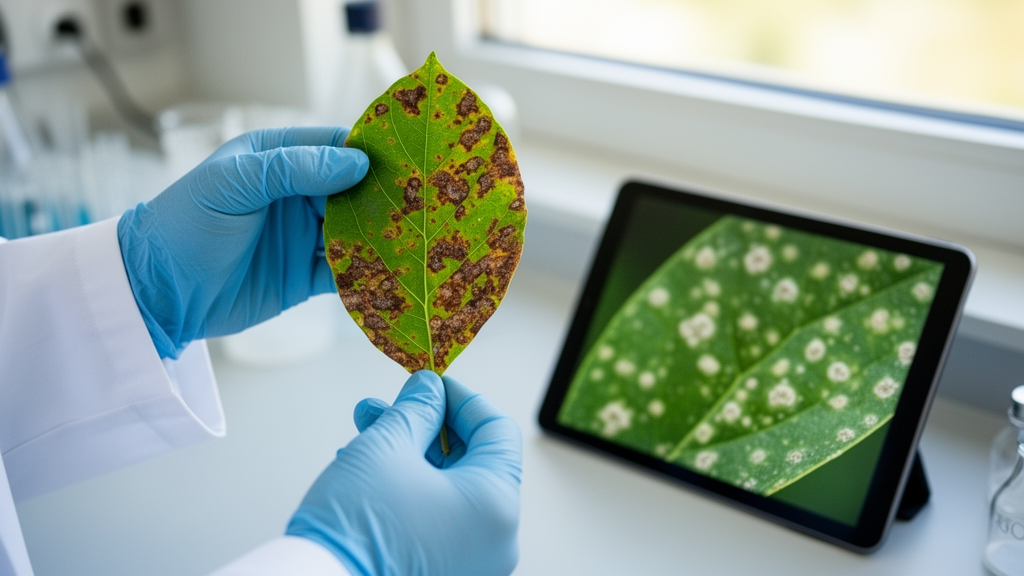
Bacterial and fungal leaf diseases often look frustratingly alike on a leaf, and that visual overlap has become one of the biggest obstacles to automated plant diagnosis. A new systematic review published in Discover Artificial Intelligence examines how artificial intelligence methods have been applied to the morphology-based detection and differentiation of these two disease classes, and it arrives at a clear verdict: deep learning dominates the literature, particularly for fungal diseases, while bacterial disease detection and generative AI applications remain comparatively underexplored. The review, led by Ruchita R. Patil, Annamalai Muthusamy and Shwetha V., followed a PRISMA-based selection process that identified 95 records published between 2017 and 2026, of which 59 eligible studies made it into the final analysis.
The screening process was deliberately strict. After removing 10 duplicate records, the authors screened 85 unique articles by title and abstract, excluding 18 that were not directly related to bacterial or fungal leaf disease detection or did not use artificial intelligence approaches. A further 8 studies were dropped during full-text assessment for reasons including insufficient methodological detail, being reviews or book chapters rather than original research, or having unavailable full texts. The 59 surviving studies were evaluated on dataset description, model development, evaluation metrics, reproducibility and relevance. Publication activity remained limited between 2017 and 2020, then rose noticeably from 2021 onwards, with 2025 producing the highest number of studies, a signal of rapid adoption of machine learning, deep learning and generative AI techniques in plant pathology.
The distribution of research effort across disease types and techniques is striking. Deep learning applied to fungal diseases accounts for 52.5 percent of the reviewed literature, making it by far the largest category. Machine learning and deep learning approaches for bacterial diseases each represent 15.3 percent of studies, machine learning for fungal diseases contributes 10.2 percent, and generative AI remains an emerging niche, with only 3.4 percent of studies each for bacterial and fungal diseases. This imbalance matters because bacterial and fungal infections can produce overlapping symptoms, including necrotic lesions, chlorosis, irregular margins and yellow halos, and symptoms also vary with infection stage, crop variety, pathogen strain and environmental conditions, all of which can cause misclassification, particularly during early infection.
On the machine learning side, the review documents a range of approaches that pair classical algorithms with specialized imaging. Variable chlorophyll fluorescence, multi-color fluorescence and thermographic imaging enabled highly accurate classification of bacterial infections, while hyperspectral imaging combined with support vector machines detected bacterial wilt in tomatoes, and genetic-algorithm-optimized SVMs improved bacterial spot detection. Adaptive neuro-fuzzy inference systems provided robust detection under varying environmental conditions, and UAV-based multispectral imaging with SVMs supported field-scale monitoring. For fungal diseases, artificial neural networks enabled early detection of rice blast, principal component analysis with linear SVMs reduced feature dimensionality for classification, and k-means clustering combined with SVMs detected Cercospora leaf spot. Random Forest and XGBoost models even outperformed quantum machine learning approaches in one comparison, and Random Forest combined with colour, texture and shape features improved potato disease classification.
Deep learning, however, has become the dominant paradigm, and the review catalogs an impressive array of architectures. ResNet18 supported robust potato disease detection under varying environmental conditions, CNN-based segmentation discriminated bacterial-infected peach leaves, and YOLOv5 and YOLOv3 enabled real-time detection of multiple leaf diseases with early symptom identification. Deep learning combined with visible-near-infrared hyperspectral imaging improved bacterial blight severity estimation and disease-resistant cultivar screening in rice. Lightweight CNN architectures such as WLNet achieved high accuracy with reduced computational complexity, transfer learning with Inception-V3 and MobileNet-V2 enhanced bacterial spot detection, and U-Net with a ResNet-101 backbone enabled accurate UAV-based mapping of disease extent and severity. An enhanced YOLOv8 attained higher accuracy for real-time detection and severity classification of Huanglongbing disease in citrus leaves.
For fungal diseases, the deep learning literature is even richer. Transfer learning with VGG-16 reduced training time while improving disease recognition, fine-tuned ResNet models enhanced feature extraction, and Mask R-CNN facilitated precise severity assessment through lesion segmentation. Vision Transformers and Inception-based architectures advanced automated recognition, hybrid CNN-Transformer models improved disease localization and classification, and a CNN-ViT framework integrating gray-level co-occurrence matrix features achieved fungal mango leaf disease classification. Purpose-built systems such as PotatoGuardNet, based on Inception-ResNet-V2 and Faster R-CNN, enhanced potato leaf disease classification, while attention-enhanced CNN ensembles with Grad-CAM improved interpretability. Semi-supervised and contrastive learning approaches addressed limited labelled data, and few-shot learning with attention mechanisms tackled the same scarcity problem from another angle.
The review also grounds the discussion in the underlying biology. Bacterial infections typically cause water-soaked lesions, chlorosis and necrotic spots with irregular margins encircled by yellow halos, along with wilting, yellow or black spots and premature leaf drop. Fungal infections more often produce circular spots, concentric rings, premature defoliation, yellowing, brown to black lesions and powdery or downy growth. Fungal spores thrive on water droplets and infiltrate plants through epidermal layers, whereas bacterial cells gain entry through natural openings or wounds. To illustrate how these differences translate into quantitative features, the authors present box plots comparing lesion area and circularity: fungal infections generally exhibited larger lesion areas, with extreme outliers exceeding 20,000 units, while bacterial infections showed smaller and more consistent lesion areas. Bacterial lesions displayed lower median circularity, suggesting more irregular shapes, whereas fungal lesions showed a wider range of circularity values with some more rounded forms.
Despite the impressive accuracy figures reported across the literature, the review is notably cautious about what they mean. Many high-performing models were trained and tested on publicly available benchmark datasets captured under controlled conditions, and direct comparison among studies is difficult because different datasets, evaluation protocols and performance metrics were used. Classification accuracy, the most commonly reported metric, may provide an incomplete assessment, particularly for imbalanced datasets, so the authors argue for complementary metrics such as precision, recall, F1-score, specificity, sensitivity and mean average precision, along with cross-dataset validation and external testing. Performance may decline under field conditions due to variations in illumination, occlusion, background complexity and disease severity, and higher predictive performance is often achieved at the expense of model complexity that limits deployment on resource-constrained devices.
Generative AI emerges as both a promising and a risky direction. Generative adversarial networks combined with deep neural networks achieved classification accuracies as high as 99 percent in one reviewed application, and Cycle-GAN integrated with ensemble learning was applied to early detection of bacterial blight in pomegranate with improved accuracy over conventional methods. A fine-grained GAN-based method augmenting grape leaf spot image data, integrating Faster R-CNN for local spot detection and ResNet-50 for classification, achieved 96.27 percent accuracy, and GAN-based augmentation with a lightweight MobileNetV2 classifier supported tomato disease severity detection. But the authors warn that synthetic images may introduce artifacts or bias if they do not accurately represent real disease characteristics, and they recommend rigorous validation using quantitative metrics such as FID and SSIM alongside expert visual assessment. Diffusion models offer superior image quality and training stability compared with conventional GANs but demand substantially higher computational resources.
The review closes with a roadmap for moving from dataset-specific experimental models to field-ready systems. The authors call for large, multicrop and geographically diverse datasets with adequate representation of bacterial and fungal diseases, rare classes, early infection stages, severity levels and mixed infections, with labels confirmed by plant pathology experts or laboratory tests where possible. They urge standardized benchmarking, cross-dataset and prospective field validation, explicit integration of lesion characteristics such as shape, colour, texture, margins and halos, and multimodal fusion of RGB images with hyperspectral, multispectral, weather and crop history data. Domain adaptation, federated learning, validated generative augmentation, explainable AI that indicates which lesion regions influenced each prediction with calibrated confidence estimates, and lightweight architectures deployable on smartphones, drones and edge devices round out the priorities. Until those pieces come together, the review suggests, the impressive numbers reported in controlled experiments should be read as a ceiling of possibility rather than a promise of field performance.
Subject of Research: A systematic review of artificial intelligence methods for morphological analysis and diagnosis of bacterial and fungal leaf diseases
Article Title: Artificial intelligence methods for morphological analysis and diagnosis of bacterial and fungal leaf diseases
Article References: Patil, R. R., Muthusamy, A., & V, S. (2026). Artificial intelligence methods for morphological analysis and diagnosis of bacterial and fungal leaf diseases. Discover Artificial Intelligence, 6(1), Article 1587. https://doi.org/10.1007/s44163-026-02495-3
Image Credits: AI Generated
DOI: 10.1007/s44163-026-02495-3
Keywords: plant disease detection, deep learning, machine learning, generative AI, bacterial leaf disease, fungal leaf disease, computer vision, convolutional neural networks, data augmentation, hyperspectral imaging, explainable AI, systematic review
Cite Scienmag News
Blake Davidson. (October 27, 2026). AI Learns to Read the Fine Print of Bacterial and Fungal Leaf Disease. Scienmag. https://scienmag.com/ai-learns-to-read-the-fine-print-of-bacterial-and-fungal-leaf-disease/
Blake Davidson. "AI Learns to Read the Fine Print of Bacterial and Fungal Leaf Disease." Scienmag, 27 October 2026, https://scienmag.com/ai-learns-to-read-the-fine-print-of-bacterial-and-fungal-leaf-disease/. Accessed 27 October 2026.
Blake Davidson. "AI Learns to Read the Fine Print of Bacterial and Fungal Leaf Disease." Scienmag. October 27, 2026. https://scienmag.com/ai-learns-to-read-the-fine-print-of-bacterial-and-fungal-leaf-disease/


