


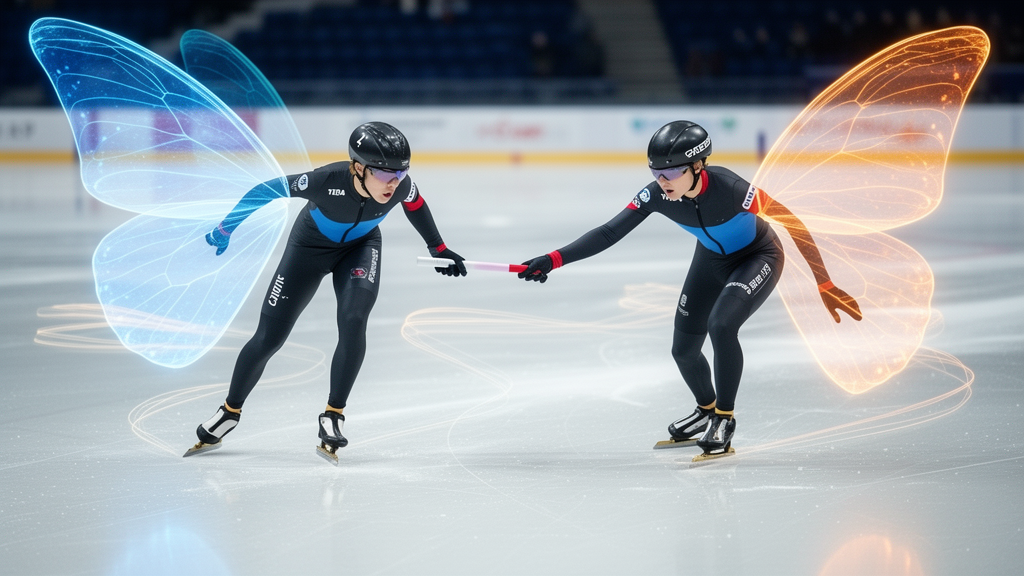
A study published in Discover Artificial Intelligence on 23 October 2026 reports that a deep learning upgrade to the SIMI-Motion motion analysis system cut the feature extraction error for relay baton handover movements from 13.2 percent to 3.1 percent. The optimized system, built by Lu Huang, achieved an average joint angle error of 0.36 degrees and an angular velocity error of 0.47 degrees per second. When applied to competition data from short track speed skating relays, it revealed quantitative correlations between the hand movements of the baton-passing athlete and the speed of the athlete receiving the baton, correlations the study reports as the first of their kind in the short track speed skating relay scenario.
Relay performance depends on both the individual speed of athletes and the quality of the baton exchange, and the smoothness of the handover directly affects race results. According to the study, a mistake of 0.1 seconds during an exchange may lead to a drop in ranking or even elimination. The SIMI-Motion system, a three-dimensional motion analysis platform widely used in biomechanics research, captures high-speed video through industrial cameras and tracks marked or unmarked points on athletes’ bodies to compute joint positions, velocities, accelerations, angles and angular velocities. But when athletes move at racing speed, the system’s image tracking algorithm becomes vulnerable to motion blur, limb occlusion and sudden lighting changes. Under these conditions, marker recognition accuracy drops and keyframe data can be lost, undermining the analyses that inform training.
Earlier work had already exposed these limits. When N. J. Cronin’s team and Köklü Ö and colleagues used SIMI-Motion for track and field analysis, blurring and sudden lighting changes exceeded the processing capabilities of the system’s image analysis algorithm, resulting in low accuracy. Rudnik D and colleagues found similarly poor accuracy when analyzing swimmers. In 2023, W. Bao’s team introduced deep learning algorithms into SIMI-Motion and raised action analysis accuracy to 86.4 percent, though the error remained relatively large, and H. Li’s team achieved similar results using CNN algorithms. Meanwhile, the Butterfly Optimization Algorithm, a metaheuristic with strong global search capability and fast convergence, had proven effective for tuning CNNs: Wahengham M’s team reached 91 percent accuracy after BOA optimization, N. J. Bommagani and colleagues exceeded an F1 value of 96 percent on human activity recognition datasets, and C. Han and colleagues reached an accuracy of 0.98 for adolescent running motion analysis. Combined CNN-LSTM models had also achieved F1 values of 0.96 in volleyball movement recognition and in adolescents’ daily physical activities, and an accuracy of 0.956 in analyzing athletes’ lower limb training movements.
The new study embeds a three-part algorithm into the image processing module of SIMI-Motion. A Convolutional Neural Network extracts hierarchical spatial features from video frames: convolutional layers slide their kernels across input frames to detect edges and textures, pooling layers downsample the resulting feature maps, and fully connected layers map deep features to predicted marker coordinates. Because CNN performance depends on the number of convolutional kernels and the learning rate, the Butterfly Optimization Algorithm searches for the optimal configuration. Through a fragrance mechanism and a switching probability, the BOA balances global search in early iterations against local fine search later on, requiring only a small number of parameters such as population size and switching probability to be adjusted. A two-layer Long Short-Term Memory network then captures temporal dependencies that a purely spatial CNN cannot represent, using input, output and forget gates and a cell state to identify long-term patterns in the handover action sequence.
The resulting framework, abbreviated BCLSM, follows five steps: participant labeling, data acquisition, image processing, kinematic calculation and data output. Markers are placed at athletes’ center of gravity, hip, knee and ankle joints, cameras record the handover motion, the BOA-optimized CNN-LSTM extracts image features, and kinematic calculations yield indicators such as handover distance, relative speed, handover time and energy transfer efficiency. For the short track speed skating application, two cameras were positioned on both sides of the slide at the end and start of the straight section, set at a 75-degree angle and sampling at 250 frames per second. That angle falls within the 60 to 90 degree range associated with high-accuracy binocular reconstruction, ensuring a sufficient shared field of view within the limited handover area. Each athlete wore a red foam hemisphere marker with a diameter of 0.12 meters at the first lumbar vertebra on the back, so the marker remained visible to at least two cameras even when arm swings and limbs created occlusion, reducing line-of-sight ambiguity during three-dimensional coordinate estimation.
Performance was first tested on the FS-Jump3D open-source dataset, a 9.4-gigabyte collection of 250 three-dimensional pose sequences designed for complex figure skating movements, used here for ablation testing and algorithm comparison. The data were divided evenly into five parts, with one part serving as the test fold and the remaining four as training folds, a process repeated over five rounds with all indicators averaged. BOA hyperparameter optimization was performed independently within each training fold, using 90 percent of the fold’s training data for training and 10 percent for validation, with the average detection accuracy of marker points as the fitness function. Test fold data did not participate in any parameter adjustment. Temporal interpolation raised the frame rate to 250 frames per second in preprocessing. The BOA used a population size of 30, a maximum of 100 iterations, a search space dimension of 5, a switching probability of 0.8 and a fragrance coefficient of 0.01, with Adam as the optimizer. The LSTM layers used 300 and 150 hidden neurons respectively, and the fully connected layer output a dimension of 10.
The ablation experiments quantified each algorithmic addition. The traditional SIMI-Motion system alone produced a feature extraction error of 13.2 percent with noisy data. Adding the CNN reduced that error to 9.1 percent. Introducing the LSTM further lowered it to 7.2 percent. With the BOA optimizing the CNN, the full BCLSM system achieved a feature extraction error of 3.1 percent, a 10.1 percentage point improvement over the original system. The computational cost was modest: BCLSM averaged 2.0 milliseconds per extraction compared with 1.1 milliseconds for SIMI-Motion alone, a difference of only 0.9 milliseconds, which the study judged acceptable given the accuracy gains.
BCLSM also outperformed three comparison methods under the same data partitioning and ground truth benchmark. Its average joint angle error was 0.36 degrees, compared with 0.51 degrees for PPO-LSTM, 0.63 degrees for CBAM-GAN and 0.74 degrees for CNN-AFS. In angular velocity analysis, BCLSM recorded 0.47 degrees per second, ahead of PPO-LSTM at 0.81, CBAM-GAN at 0.86 and CNN-AFS at 0.91 degrees per second, and its reconstructed motion trajectories showed the highest overlap with the original trajectories. Against methods designed specifically for SIMI-Motion, the SVM-SIMI baseline showed a feature extraction error of 10.8 percent, joint angle and angular velocity errors of 0.94 degrees and 1.12 degrees per second, and a trajectory coincidence of only 81.5 percent. DeepLabCut-SIMI reduced the feature extraction error to 4.6 percent and the joint angle error to 0.45 degrees, while the Evolved Parallel Recurrent Network reached an angular velocity error of 0.68 degrees per second. BCLSM achieved the best results across all four accuracy indicators, with a computation time of 2.0 milliseconds, only 1.0 milliseconds more than SVM-SIMI.
The real-world test used competition data from 80 short track speed skating team athletes in the 1000-meter relay. Each athlete completed an average of 45 handover actions, yielding 3600 raw samples. After excluding samples compromised by marker occlusion, motion blur or joint angles exceeding physiological limits, 2880 valid samples remained, an average of 36 per participant, all used for model training, testing and validation under outer five-fold cross-validation. The analysis showed that the vertical displacement of the passing athlete’s hands rose and then fell, peaking at 0.5 seconds, while both elbow joint angles decreased slightly before 0.5 seconds and then increased between 0.5 and 0.8 seconds, indicating a brief raising and lowering of the hands at the moment of exchange. The hip joint angle changed markedly, fluctuating between 10 and 80 degrees at 0 seconds in four tests, rising to 100 to 120 degrees at 0.5 seconds and then decreasing, while the knee joint angles first rose and then stabilized. The receiving athlete’s center of gravity reached a maximum vertical displacement of 0.31 meters at 0.5 seconds.
Correlation analysis linked these movements to baton reception speed. The hand speed of the passing athlete was significantly positively correlated with the receiving athlete’s speed, with correlation coefficients of 0.86 for the left hand and 0.72 for the right hand, both at p less than 0.01. The vertical displacement of the passing hand was significantly negatively correlated with baton-taking speed, while the elbow joint angle, elbow angular velocity and hip joint angle were all significantly positively correlated with reception speed at p less than 0.01. Hip joint angular velocity showed a negative correlation, and the correlation between knee joint angular velocity and reception speed was extremely weak. From these findings, the study derives benchmark ranges for optimal handover technique under 250 frames per second conditions: the vertical displacement of the passing hand should peak at approximately 0.5 seconds within 0.15 to 0.31 meters, the elbow joint angle should fall within 120 to 160 degrees at the moment of handover with angular velocity in the same direction as hand speed, the hip joint angle should sit between 100 and 120 degrees at 0.5 seconds, the knee joint angle should stabilize in the later stages, and the peak vertical displacement of the center of gravity should approximate 0.31 meters with minimal fluctuation. Huang notes that the study did not include physiological and biomechanical indicators such as electromyography, force platform or inertial sensor data, and future work could integrate these sources to build a more comprehensive analysis system. For now, the results demonstrate that the BCLSM framework can accurately extract biomechanical parameters for baton exchange, providing a data-driven foundation for optimizing relay training.
Subject of Research: Scientific handover motion analysis in relay races using the SIMI-Motion system
Article Title: Scientific handover motion analysis in relay races using the SIMI-Motion system
Article References: Huang, L. (2026). Scientific handover motion analysis in relay races using the SIMI-Motion system. Discover Artificial Intelligence, 6(1), Article 1602. https://doi.org/10.1007/s44163-026-02509-0
Image Credits: AI Generated
DOI: 10.1007/s44163-026-02509-0
Keywords: relay races, baton exchange, SIMI-Motion, motion analysis, deep learning, convolutional neural network, LSTM, butterfly optimization algorithm, short track speed skating, biomechanics, feature extraction, sports technology
Cite Scienmag News
Blake Davidson. (October 27, 2026). Butterfly-Inspired AI Sharpens Relay Baton Handover Analysis in Speed Skating. Scienmag. https://scienmag.com/butterfly-inspired-ai-sharpens-relay-baton-handover-analysis-in-speed-skating/
Blake Davidson. "Butterfly-Inspired AI Sharpens Relay Baton Handover Analysis in Speed Skating." Scienmag, 27 October 2026, https://scienmag.com/butterfly-inspired-ai-sharpens-relay-baton-handover-analysis-in-speed-skating/. Accessed 27 October 2026.
Blake Davidson. "Butterfly-Inspired AI Sharpens Relay Baton Handover Analysis in Speed Skating." Scienmag. October 27, 2026. https://scienmag.com/butterfly-inspired-ai-sharpens-relay-baton-handover-analysis-in-speed-skating/


