


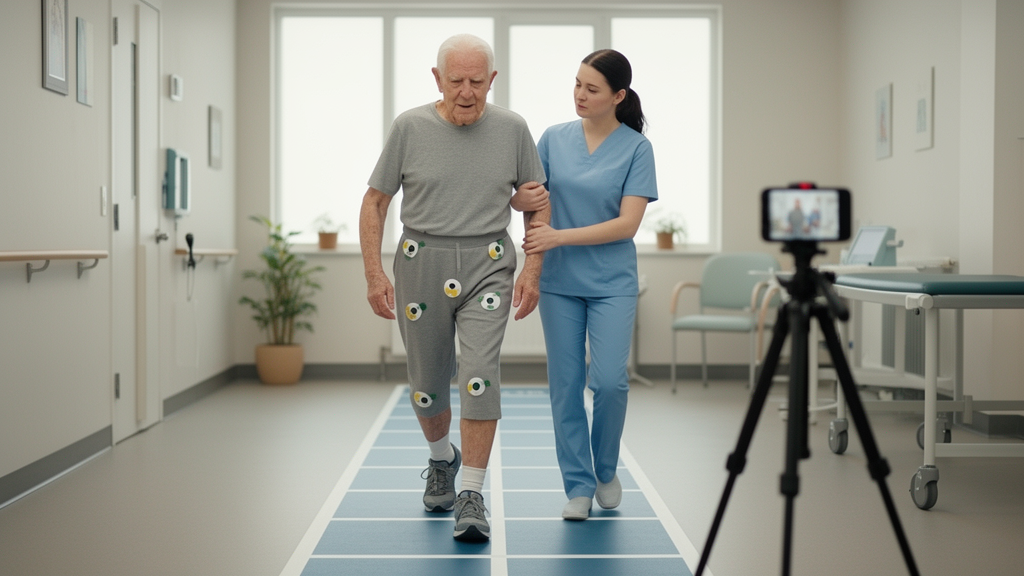
For millions of stroke survivors, walking again is the single most consequential milestone on the long road back to independence. Robotic exoskeletons promise to accelerate that journey, but the machines face a deceptively hard problem: to assist a leg safely, they must know, in real time, exactly which phase of the gait cycle that leg is in. A new study published in the International Journal of Intelligent Robotics and Applications by Rajib Kumar Rana, Anish Pandey and Suchismita Satapathy of KIIT Deemed to Be University in Bhubaneswar, India, reports a deep learning framework that cracks this problem with striking efficiency, achieving 93.79% accuracy in classifying four gait phases while requiring only ten percent of its training data to be labeled by humans.
The four phases in question, stance, push-off, swing and heel-strike, form the rhythmic vocabulary of human walking. For a healthy person, transitions between them follow a predictable template. For a person with hemiparetic gait after stroke, the template is broken: compensations, muscle weakness and fatigue reshape every stride, often differently from one patient to the next and from one hour to the next. This variability is precisely where conventional control approaches stumble. Heuristic threshold-based methods, which rely on fixed rules about sensor signals, simply cannot cope with inter-subject variation or the drift in gait patterns that comes with tiredness and compensation strategies.
Fully supervised deep learning models, the default answer in modern machine learning, carry their own burden. According to the researchers, such models need more than ninety percent pathological data in their training sets to push accuracy above ninety percent for stroke patients. That requirement is brutal in practice, because labeled pathological gait data is scarce, expensive and slow to collect, with every stride needing expert annotation of ground-truth phase boundaries. Models trained predominantly on healthy subjects, meanwhile, generalize poorly to pathological movement patterns. The result has been a persistent gap between laboratory demonstrations of exoskeleton control and dependable real-world rehabilitation devices.
The team’s answer is a Semi-Supervised Adversarial Autoencoder, or SS-AAE, an architecture that borrows ideas from generative adversarial networks, first introduced by Goodfellow and colleagues, and from the adversarial autoencoder framework of Makhzani and colleagues. An autoencoder compresses high-dimensional sensor streams into a compact latent representation and then reconstructs them; the adversarial twist adds a discriminator network that forces the latent space to conform to a chosen prior distribution. The upshot is a smooth, well-structured latent space learned entirely from unlabeled data, into which a small amount of labeled data can then be projected to train a classifier. In this scheme, the expensive resource, expert labels, is decoupled from the abundant resource, raw sensor readings, and only the latter is needed in quantity.
The sensory apparatus feeding the network is deliberately multi-modal. Inertial measurement units mounted on the thigh, shank and foot of each leg sample motion at 200 Hz, capturing the kinematic signature of each segment through the stride. Surface electromyography electrodes record the electrical activity of three key muscles, the rectus femoris, biceps femoris and gastrocnemius, at 1 kHz, providing a direct window into the neural drive that propels the limb. Four-zone plantar pressure insoles under each foot, sampled at 200 Hz, register the rolling pattern of ground contact that defines stance and push-off. Fusing these complementary streams gives the model a rich, redundant picture of the gait cycle that no single sensor type could supply.
Training data came from twenty healthy subjects and ten stroke patients walking with a powered exoskeleton, with the vast majority of it left unlabeled. Only ten percent of the data, drawn from stroke patients and amounting to roughly five minutes of walking per subject, carried ground-truth labels for the classifier. On top of this semi-supervised foundation, the researchers layered an online domain adaptation mechanism: an entropy thresholding scheme with a threshold of 0.3 flags predictions the model is uncertain about, and a buffer-based re-labeling procedure uses confident predictions to continually update the classifier every 500 time steps. In effect, the system keeps learning from its own most trustworthy outputs as the patient’s gait evolves.
The computational architecture is as notable as the statistical one. The entire deep learning pipeline runs on a Google Colab instance equipped with a Tesla T4 GPU and 16 GB of VRAM, while a lightweight edge client on the exoskeleton streams sensor data to the cloud over WebSocket. This split design keeps the wearable hardware minimal and offloads the heavy inference to the cloud, a configuration the authors describe as cloud-based inference. The evaluation protocol was deliberately stringent: leave-one-subject-out cross-validation on the ten post-stroke hemiparetic patients, meaning the model was always tested on a person it had never seen during training.
The numbers tell a clear story. The SS-AAE achieved an average accuracy of 93.79%, with a 95% confidence interval of 92.8 to 95.6, and a phase transition error of just 14 milliseconds. A fully supervised long short-term memory network, the natural deep learning baseline, managed 91.4% accuracy with a 21 millisecond error, while a traditional autoencoder paired with a support vector machine reached only 82.3% with a 44 millisecond error. The margins matter clinically as well as statistically: a 14 millisecond phase transition error means the exoskeleton can time its assistance to the patient’s actual biomechanics with a precision well below the duration of any single gait phase, reducing the risk of mistimed torque application.
Perhaps the most striking demonstration concerns adaptability. When the researchers induced a new fatigue-like gait pattern in one of the subjects, the online domain adaptation mechanism recovered and locked onto the new pattern within 2.1 seconds on the Colab-hosted system. For a rehabilitation context, where a patient’s stride can degrade noticeably over the course of a therapy session, that kind of rapid self-correction could mean the difference between an exoskeleton that supports recovery and one that fights it. It also suggests a path toward truly personalized assistance that does not require recalibration sessions with clinicians every time the patient’s condition changes.
The broader significance of the work lies in what it says about data hunger in medical robotics. By showing that a semi-supervised adversarial autoencoder can match and beat fully supervised models on pathological gait while using a small fraction of the labeled data, the KIIT team points toward rehabilitation systems that can be deployed to new patient populations without exhaustive annotation campaigns. The authors report no funding for the research and declare no competing interests. Challenges remain, including the reliance on a cloud connection for inference and the modest size of the patient cohort, but the framework offers a compelling template: learn the structure of movement from abundant unlabeled signals, spend human expertise sparingly, and keep adapting as the patient does. For stroke survivors hoping to walk again with robotic help, that combination of accuracy, speed and adaptability may prove to be exactly the stride forward the field has been waiting for.
Subject of Research: Semi-supervised adversarial autoencoder for real-time gait phase detection in lower-limb exoskeletons for post-stroke rehabilitation
Article Title: Semi-supervised adversarial autoencoder for real-time gait phase detection in lower-limb exoskeletons for post-stroke rehabilitation
Article References: Semi-supervised adversarial autoencoder for real-time gait phase detection in lower-limb exoskeletons for post-stroke rehabilitation. (n.d.). https://doi.org/10.1007/s41315-026-00605-z
Image Credits: AI Generated
DOI: 10.1007/s41315-026-00605-z
Keywords: semi-supervised learning, adversarial autoencoder, gait phase detection, lower-limb exoskeleton, post-stroke rehabilitation, multi-modal sensor fusion, sEMG, domain adaptation, cloud-based inference, machine learning, neuroengineering, Semi-supervised
Cite Scienmag News
Cassandra Pierce. (October 16, 2026). AI Learns to Read Stroke Patients’ Strides with Just Minutes of Labeled Data. Scienmag. https://scienmag.com/ai-learns-to-read-stroke-patients-strides-with-just-minutes-of-labeled-data/
Cassandra Pierce. "AI Learns to Read Stroke Patients’ Strides with Just Minutes of Labeled Data." Scienmag, 16 October 2026, https://scienmag.com/ai-learns-to-read-stroke-patients-strides-with-just-minutes-of-labeled-data/. Accessed 16 October 2026.
Cassandra Pierce. "AI Learns to Read Stroke Patients’ Strides with Just Minutes of Labeled Data." Scienmag. October 16, 2026. https://scienmag.com/ai-learns-to-read-stroke-patients-strides-with-just-minutes-of-labeled-data/


