


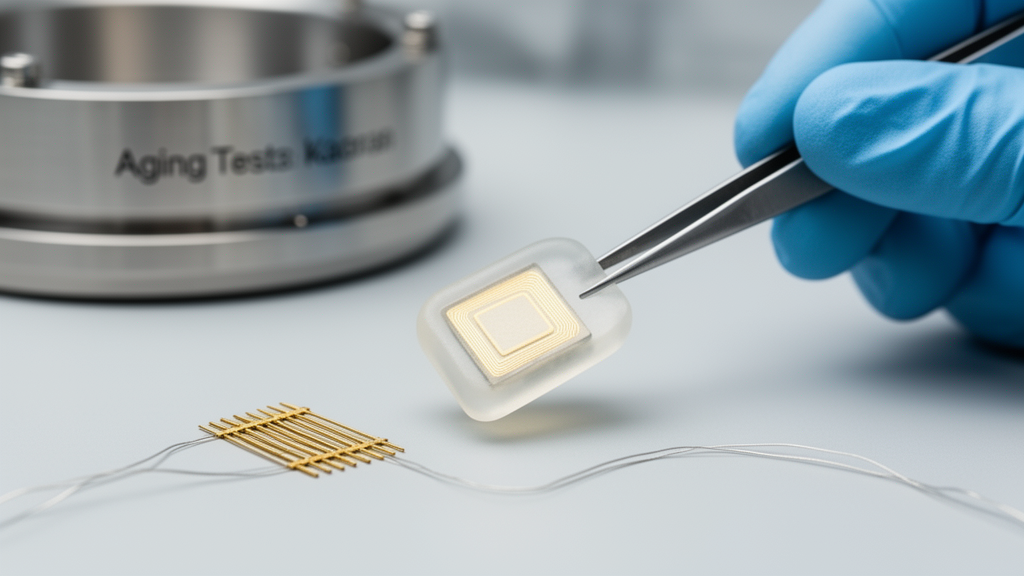
Miniature electronic implants that read and stimulate the nervous system are moving steadily toward the size of a grain of rice, but a stubborn packaging problem has kept most of them bulky. For decades, the electronics inside pacemakers, deep brain stimulators and cochlear implants have lived inside rigid titanium capsules, because any polymer coating was assumed to let water in and doom the delicate circuitry. A research team from University College London, Imperial College London, TU Delft, Fraunhofer IZM and King’s College London now reports the longest accelerated life test ever performed on polymer-encapsulated integrated circuits, and the results challenge that assumption in a striking way: chips dipped in medical-grade silicone showed no electrical insulation failures after up to 4.3 years of continuous hot saline immersion under bias.
The study, published in Frontiers in Electronics, is the culmination of a testing campaign that began in the CANDO project, an effort to implant micro-LEDs in the brain for optogenetic control of neural activity. That application demanded a transparent, biocompatible encapsulant, which ruled out metal cans and pointed toward silicone rubber. But the team, led by first author Ahmad Shah Idil, was pessimistic at the outset. Silicone is famously permeable to water vapor, and the group expected that moisture would reach the chip surface, hydrate the thin protective passivation layers, and cause insulation breakdown within months. Instead, the passivation and the silicone together proved essentially flawless over thousands of days of brutal aging.
The test vehicles were interdigitated comb capacitors fabricated in a standard AMS 0.35 micrometer CMOS process, the same foundry technology used for countless commercial chips. Each comb consisted of 1,450 aluminum fingers just 1 micrometer wide, separated by half-micrometer gaps, covered by 1.6 micrometers of silicon oxide and silicon nitride passivation. Two deliberate design additions were baked into the layout: a perforated metal shield layer in the top metallization above the combs, connected to the substrate, and a double-layer wall of vias forming a reinforced seal ring around the active area. The shield would buy time if the passivation ever dissolved, while the dense via wall was intended to block lateral water penetration and stop cracks propagating from the diced chip edge.
Encapsulation followed a deceptively simple but carefully controlled recipe. Chips were wire-bonded to ceramic adaptors, ultrasonically cleaned, then treated with air plasma for ten minutes to generate a high density of hydroxyl groups on every exposed surface. Within five minutes of plasma activation, the samples were cast in NuSil MED-6015, a platinum-cured, optically clear, two-part medical silicone, degassed in a vacuum centrifuge and cured at 150 degrees Celsius. The plasma step is critical: it creates chemical anchoring sites so the silicone bonds to the chip rather than merely sitting on it. Because liquid water cannot condense in a void-free, well-bonded silicone layer, even a water-vapor-saturated encapsulant prevents the ionic conduction that drives corrosion.
Forty-five samples were then sealed in test tubes of phosphate-buffered saline and loaded into the team’s custom Accelerated Life Testing Apparatus, which monitored every sample by electrochemical impedance spectroscopy. Four batches ran at 47, 67 and 87 degrees Celsius, roughly two to three times physiological temperature, under either a continuous 5-volt DC bias, representing a worst-case always-on implant power supply, or a biphasic plus-minus 5-volt waveform typical of stimulator outputs. Spectra were recorded daily at first, then weekly and finally monthly for up to 1,587 days. A failure was defined as a 10 percent drop in impedance magnitude at the lowest measured frequency, 10 millihertz, where any water bridging the combs would betray itself as a shunt path.
Not one of the 45 samples failed that way. The characteristic signature of an insulation failure, a broad collapse of impedance across the spectrum as the dielectric hydrates, never appeared in any batch. About 84 percent of the samples remained electrically stable for the entire run, and many looked pristine under the microscope, with no corrosion, no delamination and no measurable change in their impedance or phase. Even at 87 degrees Celsius, where degradation accelerated dramatically, the changes were confined to the interconnects and the encapsulant itself, not the protected active area. The authors attribute this to three factors working together: the redundant shield metal, the near-insolubility of modern oxide-nitride passivation, and the exceptional adhesion of plasma-treated MED-6015, which companion work suggests also blocks the reactive oxygen species produced by the body’s foreign-body response.
The failures that did occur tell their own story. Eleven samples developed faults, nearly all of them open circuits at the gold wire bonds on the aluminum bond pads, including two infant failures on day zero and day two that pointed to sub-optimal manual bonding rather than aging. Two samples leaked at the test apparatus bung, and one delaminated at the ceramic adaptor, producing a 1-megaohm leakage path. Visible corrosion appeared on aluminum pads and lead-tin solder joints in a majority of samples, worsening sharply with temperature, yet crucially, corrosion never correlated with electrical degradation. Twenty-one samples showed visual corrosion with perfectly stable impedance, and no sample showed impedance changes without visible corrosion, indicating that pad corrosion precedes any functional decline, if decline comes at all.
Weibull survival analysis of the two DC-biased batches at 67 and 87 degrees yielded characteristic lives of roughly 51.5 and 12.5 years respectively, though the authors caution against naive extrapolation, because the shape parameters below one reflect the scarcity of failures and the Arrhenius acceleration model could not be verified with only two usable temperature points. Most telling were the failure modes that never emerged even in the harshest batch: cracks and shear voids in the silicone, blistering at anodic pads driven by local acidification and oxygen evolution, and yellowing of the rubber appeared only at 87 degrees, suggesting artifacts of the extreme test conditions rather than realistic threats at body temperature.
The team’s conclusions reshape how chip-scale implants should be designed. If the active area is this robust, future failure will likely come from interconnects, so replacing the gold-on-aluminum ball bond, the acknowledged weak point, with gold-bumped pads, aluminum wire, or under-bump metallization stacks becomes the priority. The double wall-of-vias, which apparently prevented any edge-driven water ingress at negligible silicon area cost, should become standard in implant designs. The group deliberately avoided projecting a specific lifetime at 37 degrees Celsius, but the evidence points in one direction: a thoroughly cleaned, plasma-treated chip in well-bonded medical silicone can survive years of hostile soak testing that vastly exceeds anything the body will deliver.
Open questions remain before these findings translate into clinical devices. Phosphate-buffered saline does not replicate the hydrophobic constituents of interstitial fluid, and silicones are known to absorb lipids over long periods, potentially altering their mechanics and adhesion in ways this test could not capture. There is also a practical tension: if validation takes five years, the chip technology tested may already be obsolete, meaning implant designers must pin down which passivation, metallization and layout features actually matter and carry those across process generations. Still, as the longest and most comprehensive study of its kind, and the first to demonstrate a scalable, foundry-compatible route to encapsulated CMOS implants, this work makes a soft, silicone-armored brain chip look less like a lab curiosity and more like the default architecture for the next generation of neurotechnology.
Subject of Research: Long-term accelerated aging of plasma-enhanced silicone-encapsulated CMOS integrated circuits for active implantable neurotechnology
Article Title: On the stability of CMOS ICs with plasma-enhanced silicone encapsulation for active implantable neurotechnology: 4.3 years of accelerated life testing
Article References: On the stability of CMOS ICs with plasma-enhanced silicone encapsulation for active implantable neurotechnology: 4.3 years of accelerated life testing. (n.d.). https://doi.org/10.3389/felec.2026.1788559
Image Credits: AI Generated
DOI: 10.3389/felec.2026.1788559
Keywords: CMOS, silicone encapsulation, implantable devices, neurotechnology, accelerated life testing, PDMS, wire bonds, passivation, biocompatibility, bioelectronics, electrochemical impedance spectroscopy, hermetic packaging
Cite Scienmag News
Cassandra Pierce. (October 16, 2026). Silicone-Coated Brain Chips Survive Four Years of Simulated Implant Aging. Scienmag. https://scienmag.com/silicone-coated-brain-chips-survive-four-years-of-simulated-implant-aging/
Cassandra Pierce. "Silicone-Coated Brain Chips Survive Four Years of Simulated Implant Aging." Scienmag, 16 October 2026, https://scienmag.com/silicone-coated-brain-chips-survive-four-years-of-simulated-implant-aging/. Accessed 16 October 2026.
Cassandra Pierce. "Silicone-Coated Brain Chips Survive Four Years of Simulated Implant Aging." Scienmag. October 16, 2026. https://scienmag.com/silicone-coated-brain-chips-survive-four-years-of-simulated-implant-aging/


