


Defining Multi-Level Autonomy Models for Brain-Computer Interfaces
Researchers propose a three-level model of autonomy—operational, strategic, and moral—to help resolve the ethical challenges inherent in brain-computer interfaces.
Researchers propose a three-level model of autonomy—operational, strategic, and moral—to help resolve the ethical challenges inherent in brain-computer interfaces.

The Dana Foundation has awarded Jennifer French and Eric H. Chudler the 2026 Neuroscience and Society Champion Awards, each featuring ...

A qualitative study in Argentina and Mexico reveals that structural underinvestment, regulatory uncertainty, and distinct sociocultural traditions shape the uneven ...

A review in Alzheimer's Research & Therapy proposes an AI-driven brain-computer interface framework to enhance diagnosis and therapeutic intervention for ...

An international research consortium co-led by KAIST has received an ERC Synergy Grant to investigate how the brain processes sensory ...

Researchers tracking synchronous eye, brain, and muscle signals in subacute stroke survivors revealed a widened sensorimotor preparation window that can ...

Biomedical engineers and otolaryngologists have introduced a novel auditory nerve implant system that directly penetrates cranial nerve fibers to overcome ...

A multiregional neural sensing framework using machine learning predicted Parkinson's disease motor fluctuations with nearly ninety percent accuracy across animal ...

A new Frontiers in Nanotechnology Research Topic highlights nano-enabled neural interfaces, from bioresorbable implants and monolithic dopamine-sensing chips to memristive ...
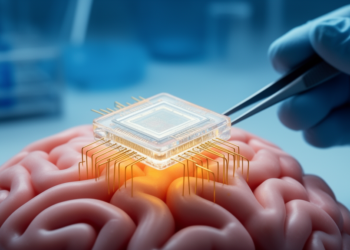
EPFL researchers have built a low-power implantable chip, LogSync, that extracts synchrony biomarkers across brain regions and decodes cognitive and ...


Embark on a thrilling journey of discovery with Scienmag.com—your ultimate source for cutting-edge breakthroughs. Immerse yourself in a world where curiosity knows no limits and tomorrow’s possibilities become today’s reality!