


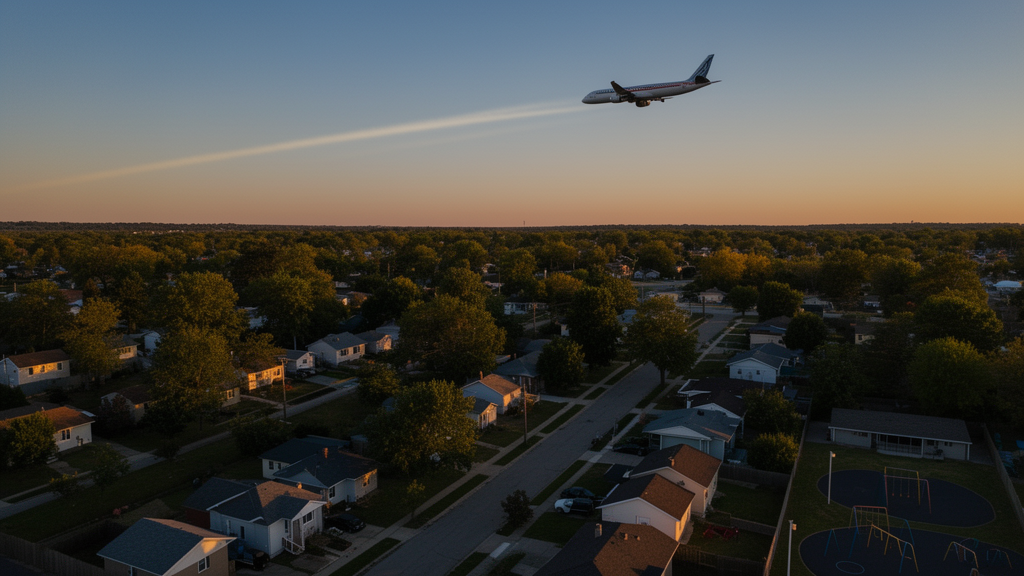
Aircraft noise is one of the most contested side effects of modern aviation, and for decades the dominant question has been a blunt one: how loud is too loud? A new study from researchers at the University of Salford, City St George’s University of London and the Noise Abatement Society argues that this framing misses the point. In work published in Frontiers in Acoustics, the team presents the first study of its kind in the United Kingdom designed to define what it actually means for air traffic to be distributed fairly and equitably around an airport — and the answer, they find, cannot be expressed in decibels alone. Instead, the researchers propose a transdisciplinary Sound, Noise and Health Conceptual Framework that weaves together acoustics, psychoacoustics, epidemiology and the psychology of perceived fairness into a staged process for stakeholder decision-making.
The stakes are far from abstract. Environmental noise is widely accepted as a public health issue, and in Europe more than 20% of the population is exposed to long-term noise levels deemed unhealthy under the Environmental Noise Directive, a figure that rises to roughly 30% under the stricter limits recommended by the World Health Organization. Noise acts as a nonspecific stressor, triggering biological responses such as elevated stress hormones and shifts in blood pressure, blood sugar and blood fats. Over sustained periods, these responses are linked to poorer mental health and to diseases including diabetes, heart attacks and strokes. Two decades of evidence have tied aircraft noise specifically to annoyance, sleep disturbance, cardiometabolic disorders, children’s learning difficulties and mental health effects.
Annoyance, the most prevalent community response to environmental noise, is particularly revealing because it resists simple acoustic explanation. Studies indicate that acoustic and non-acoustic factors each account for roughly a third of the human response to sound, with the remainder distributed between them. Non-acoustic factors — defined in UK Civil Aviation Authority guidance as everything beyond noise level that contributes to annoyance — include trust in authorities, perceived fairness of decisions, fear of the noise source, coping capacity, cultural norms and local environmental quality. A new international standard, ISO/TS 16755-1:2025, now formalises these into four dimensions: personal, social, physical and situational factors. Crucially, reported annoyance around airports has not fallen in proportion to substantial reductions in noise contour areas achieved through quieter aircraft and improved procedures, suggesting that engineering progress alone cannot solve the problem.
The study was commissioned by London Gatwick Airport’s noise management engagement body — which includes industry partners, communities, policymakers and regulators — after the aspirational goal of Fair and Equitable Distribution (FED) of aircraft was raised by noise-affected communities. Running from September 2021 to March 2022, the independent project used a mix of descriptive and exploratory qualitative research techniques, combining reviews of aviation noise metrics, policy and technology options; an updated evidence review of the health effects of aircraft noise; and an assessment of non-acoustic factors. A workshop with community representatives revealed a striking consensus in principle: dispersal of air traffic is preferred to concentration so that noise can be shared as fairly as possible. But the agreement fractured on implementation. Some participants wanted traffic dispersed as widely as possible so no one is overflown more frequently than others, while others favoured dispersal only within historically overflown areas, arguing that new communities should not be exposed unless currently impacted populations faced noise above WHO-recommended limits.
The technical heart of the study lies in its analysis of what modern airspace technology can and cannot deliver. Performance Based Navigation (PBN) routes use satellite technology, ground systems and onboard avionics to fly precisely defined tracks, offering designers unprecedented control over where aircraft go. Yet that very precision tends to concentrate noise: the natural dispersion that characterises conventional flight paths disappears, and communities under a PBN route may experience more frequent, intense overflight. The geometry of relief is unforgiving. According to CAA analysis, at 3,000 feet a relief route must be roughly one kilometre away to be just perceptibly quieter, about two kilometres away to sound half as loud, and around four kilometres away to feel ‘much quieter’; at 7,000 feet or higher, the required separations stretch well beyond five kilometres. Concentrating traffic away from densely populated areas can be optimal in one setting, while multiple routes offering predictable respite may serve communities better in another.
The study also dissected the acoustic metrics on which policy currently rests. Time-averaged indicators such as the A-weighted equivalent continuous level (LAeq) compress hours of noise into a single energy figure, but two areas with identical averages can feel utterly different — one with many gentle flyovers, another with a few punishing ones. Number Above metrics (N60, N65), which count events exceeding a threshold, and maximum sound levels (LAmax) capture the frequency and intensity of individual disturbances that averages conceal. The intermittency ratio, developed by Swiss researchers, quantifies how much of total sound energy comes from discrete events, and correlates with noise-induced sleep disturbances that average metrics fail to predict. The study recommends research into acoustic and psychoacoustic metrics — including Zwicker loudness — that better account for short-term exposure, respite and dispersal schemes, building on a perception-based engineering approach.
On health, the evidence review mapped exposure-response functions from the WHO Environmental Noise Guidelines, the UK Survey of Noise Attitudes 2014 and the 2002 EU curve, highlighting wide uncertainty: the WHO relationship predicts 10% of people highly annoyed at 45 dB Lden, while the UK survey places the same response at 55 dB LAeq,16h. The review also flagged excess annoyance responses following changes in exposure — communities react more strongly than steady-state curves predict when noise increases or decreases, an effect that can persist for years. Beyond annoyance, the team catalogued evidence on sleep disturbance, cardiometabolic disease, depression, children’s reading comprehension and emerging outcomes such as dementia and birth effects, and identified gaps in the UK’s Transport Analysis Guidance (TAG), which omits mental health, children’s learning and populations exposed below 51 dB LAeq,16h. The study proposes a Health Dashboard of agreed environmental and health metrics, alongside a ‘TAG+’ approach and sensitivity analyses using multiple exposure-response functions.
The resulting Sound, Noise and Health Conceptual Framework unfolds in four stages. Stage one maps locally salient non-acoustic factors — personal, social, physical and situational — through stakeholder engagement, establishing what fairness actually means to the affected community. Stage two selects the combined suite of acoustic, psychoacoustic, health, wellbeing and operational metrics that best respond to those local factors, with no ‘one size fits all’ formula. Stage three agrees performance indicators, incentives and objectives, along with how they will be monitored, reported, enforced and reviewed. Stage four links everything to the airport’s Noise Action Planning cycle, with periodic stakeholder review to ensure the metrics remain locally relevant. Perceived fairness sits at the centre: research applying social justice theory to aircraft noise suggests that improving residents’ perceived cost-benefit ratio increases their sense of fairness and, with it, their capacity to cope.
The findings are already shaping practice. A follow-up study, published by the UK Civil Aviation Authority as CAP2971, applied the framework’s recommendations to explore how airspace design options influence perceptions of fairness and the risk of socially unacceptable outcomes. The implications extend beyond conventional aviation: with forecast growth in air transport and the arrival of Advanced Air Mobility — drones and electric vertical take-off and landing aircraft — the question of who gets overflown, how often, and with what health consequences will only intensify. The researchers argue that managing this future demands more than quieter engines and tighter flight tracks. It requires airports to treat sound, noise and health as a single integrated system, and to give communities a genuine seat at the table where fairness is defined, measured and enforced. In aviation noise, it turns out, the hardest engineering problem may be human perception itself.
Subject of Research: A conceptual framework for fair and equitable distribution of aircraft noise integrating acoustics, health and non-acoustic factors
Article Title: Developing a Sound, Noise and Health Conceptual Framework for fair and equitable dispersion of aircraft
Article References: Lavia, L. R., Clark, C., & Torija, A. J. (2025). Developing a Sound, Noise and Health Conceptual Framework for fair and equitable dispersion of aircraft. Frontiers in Acoustics, 3, Article 1621355. https://doi.org/10.3389/facou.2025.1621355
Image Credits: AI Generated
DOI: 10.3389/facou.2025.1621355
Keywords: aircraft noise, aviation noise, fairness, non-acoustic factors, psychoacoustics, health impacts, annoyance, sleep disturbance, airspace design, Performance Based Navigation, stakeholder engagement, WHO noise guidelines
Cite Scienmag News
Carl Richardson. (October 16, 2026). Fairness Takes Flight: New Framework Aims to Share Aircraft Noise More Equitably. Scienmag. https://scienmag.com/fairness-takes-flight-new-framework-aims-to-share-aircraft-noise-more-equitably/
Carl Richardson. "Fairness Takes Flight: New Framework Aims to Share Aircraft Noise More Equitably." Scienmag, 16 October 2026, https://scienmag.com/fairness-takes-flight-new-framework-aims-to-share-aircraft-noise-more-equitably/. Accessed 16 October 2026.
Carl Richardson. "Fairness Takes Flight: New Framework Aims to Share Aircraft Noise More Equitably." Scienmag. October 16, 2026. https://scienmag.com/fairness-takes-flight-new-framework-aims-to-share-aircraft-noise-more-equitably/


