


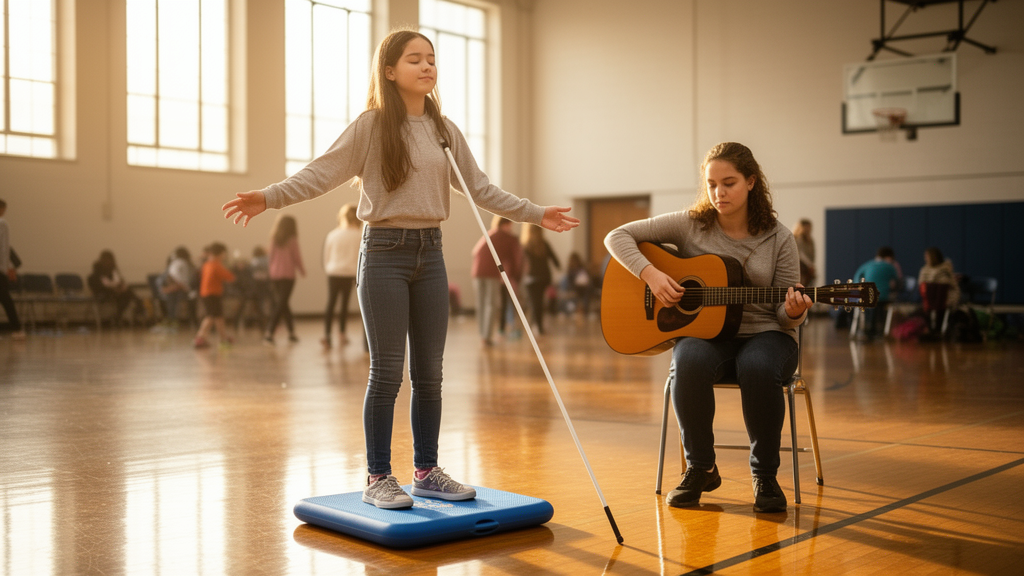
Music has long been known to move people emotionally, but a new study suggests it can also move them more steadily, at least in a very literal sense. Researchers in Tunisia report that a single 30-minute session of listening to guided preferred music measurably improved postural balance and mobility in adolescents with visual impairment, with effects appearing immediately after the session ended. The findings, published in BMC Pediatrics, add to a growing body of evidence that auditory stimulation can tune the motor system in ways that go far beyond simple enjoyment.
The study was led by Hana Maatoug and colleagues at the Research Laboratory ‘Sports Performance Optimization’ at the National Center of Medicine and Sport Sciences in Tunis, working with collaborators at the University of Gafsa, the University of Sfax and Princess Nourah bint Abdulrahman University in Riyadh. The team recruited fifteen adolescents with visual impairment and thirteen normally sighted adolescents of comparable age. The participants with visual impairment formed the visual impairment group, while the sighted participants served as a control group. Group assignment was not randomized, but within each participant the experimental manipulation was: every teenager completed both a music listening session and a control session, in a randomly assigned order, separated by an appropriate washout interval. This crossover design is one of the most efficient ways to test an acute intervention, because each person serves as their own baseline and many sources of between-subject variability cancel out.
The intervention itself was deliberately simple. During the music condition, participants listened for thirty minutes to guided preferred music, meaning each participant heard music they had chosen themselves, delivered with some form of guidance or structure rather than as passive background noise. The control session matched the music session in duration but without the musical content. The researchers measured everything twice: once before and once immediately after each session. Because the control session involved the same amount of time, attention and testing, any change that appeared only after the music condition could be attributed with reasonable confidence to the music itself rather than to practice effects, fatigue, or the mere passage of time.
The balance measurements came from posturography, a laboratory technique in which a participant stands as still as possible on a force platform while the platform records the continuous position of the center of pressure, the point at which the ground reaction force acts beneath the feet. The center of pressure wanders constantly, even in a healthy person standing quietly, because the nervous system is perpetually making tiny corrections to keep the body’s center of mass over its base of support. The mean velocity of this wandering, abbreviated CoP Vm, is one of the most sensitive indicators of postural control: slower velocity generally means steadier stance and less muscular effort spent on balance.
The researchers tested participants under four sensory conditions that systematically manipulate the information available to the postural control system. They stood on a firm surface and on a compliant foam surface, and in each case with eyes open and eyes closed. Foam destabilizes the ankle strategy and degrades the proprioceptive feedback from the soles of the feet, forcing the nervous system to rely more heavily on vestibular and remaining sensory inputs. Removing vision entirely, of course, is the condition that matters most for people with visual impairment, since they must maintain balance without the dominant sense that most humans use to stabilize themselves. Comparing performance across these conditions reveals which sensory channels a person depends on and how flexibly the postural system can reweight its inputs.
The results were striking, particularly for the adolescents with visual impairment. Only after the music session, and not after the control session, their center of pressure mean velocity decreased significantly in both surface conditions, whether their eyes were open or closed. The effect reached statistical significance on the firm surface and was even more pronounced on the foam surface, where the p value fell below 0.001. In the sighted control group, the music session also produced a significant reduction in sway velocity, but only on the foam surface, with both eyes open and eyes closed. In other words, the adolescents who needed the most postural help showed the broadest benefit, improving even in the easiest, firm-surface conditions where the sighted group had less room to improve.
Mobility improved as well. The timed up and go test, a widely used clinical measure in which a person rises from a chair, walks three meters, turns, returns and sits down again, became significantly faster after the music session in both groups. The improvement was significant at the p < 0.05 level in the sighted controls and at the p < 0.001 level in the visual impairment group. A faster timed up and go time reflects not just steadier balance but better integration of the whole sequence of transitioning from sitting to standing, walking, turning and sitting, which depends on dynamic postural control, muscle strength and attention. Alongside the motor measures, the researchers administered the quick mood scale and found that mood improved significantly after the music session in both groups, while no parameter changed significantly in either group after the control session.
Why should listening to music for half an hour sharpen a teenager’s balance? The authors point to several plausible mechanisms that previous research has suggested. Music can influence emotional and motivational states, and the observed mood improvement may itself have played a role, since anxiety and negative affect are known to degrade postural control by increasing muscular co-contraction and cognitive load. Music also engages attention and can act as an external focus, which motor learning research consistently shows is more effective than an internal focus on body mechanics. There is additionally a rhythmic dimension: auditory rhythm has privileged access to the motor system, entraining neural oscillations and potentially stabilizing the internal timing of postural corrections. For adolescents with visual impairment, whose postural systems are chronically deprived of visual feedback and who often compensate with increased reliance on vestibular and proprioceptive inputs, a session that reduces anxiety, focuses attention and provides rhythmic structure may allow those remaining sensory channels to operate more efficiently.
The clinical implications are considerable. Postural balance deficits in young people with visual impairment are not a minor inconvenience; they limit participation in physical activity, increase the risk of falls and injuries, and can set off a downward spiral of inactivity and further deconditioning. If a single, inexpensive, non-invasive session of preferred music can acutely improve both static balance and functional mobility, then music could plausibly be used as a preparatory warm-up before physical education classes, rehabilitation sessions or sports training for visually impaired adolescents, potentially making those activities safer and more productive. The authors conclude that a 30-minute single music listening session with guided preferred music was an efficient intervention for enhancing both postural balance and mobility performance in this population.
The study does come with caveats that the team and independent readers will want to weigh. The sample was small, with fifteen participants in the visual impairment group and thirteen controls, and group allocation was non-randomized, so pre-existing differences between the groups cannot be fully excluded even though the crossover design protects the within-group comparisons. The trial was registered retrospectively with the Pan African Clinical Trial Registry under identifier PACTR202506832481901, and the effects measured were acute, meaning the study cannot say how long the benefits last or whether repeated sessions would produce durable gains. The protocol was approved by the Southern Committee Protection of Persons under ethics approval number 0382/2022 and conducted in accordance with the Declaration of Helsinki, with written informed consent from parents. The authors received no external financial support for the research and declare no competing interests. Even with these limitations, the message of the study is hard to ignore: for teenagers navigating the world without full sight, something as accessible as their favorite music, listened to in a structured way for half an hour, may be enough to make their next steps measurably steadier.
Subject of Research: The acute effect of a single music listening session on postural balance and mobility in adolescents with visual impairment
Article Title: The effect of a single music listening session on postural balance and mobility performance in adolescents with visual impairment: a controlled crossover study
Article References: The effect of a single music listening session on postural balance and mobility performance in adolescents with visual impairment: a controlled crossover study. (n.d.). https://doi.org/10.1186/s12887-026-07863-7
Image Credits: AI Generated
DOI: 10.1186/s12887-026-07863-7
Keywords: postural balance, visual impairment, adolescents, music therapy, center of pressure, timed up and go, mobility, mood state, crossover study, posturography, guided preferred music, BMC Pediatrics
Cite Scienmag News
Ophelia Keating. (October 16, 2026). One Music Session Instantly Improves Balance in Teens With Visual Impairment. Scienmag. https://scienmag.com/one-music-session-instantly-improves-balance-in-teens-with-visual-impairment/
Ophelia Keating. "One Music Session Instantly Improves Balance in Teens With Visual Impairment." Scienmag, 16 October 2026, https://scienmag.com/one-music-session-instantly-improves-balance-in-teens-with-visual-impairment/. Accessed 16 October 2026.
Ophelia Keating. "One Music Session Instantly Improves Balance in Teens With Visual Impairment." Scienmag. October 16, 2026. https://scienmag.com/one-music-session-instantly-improves-balance-in-teens-with-visual-impairment/


