


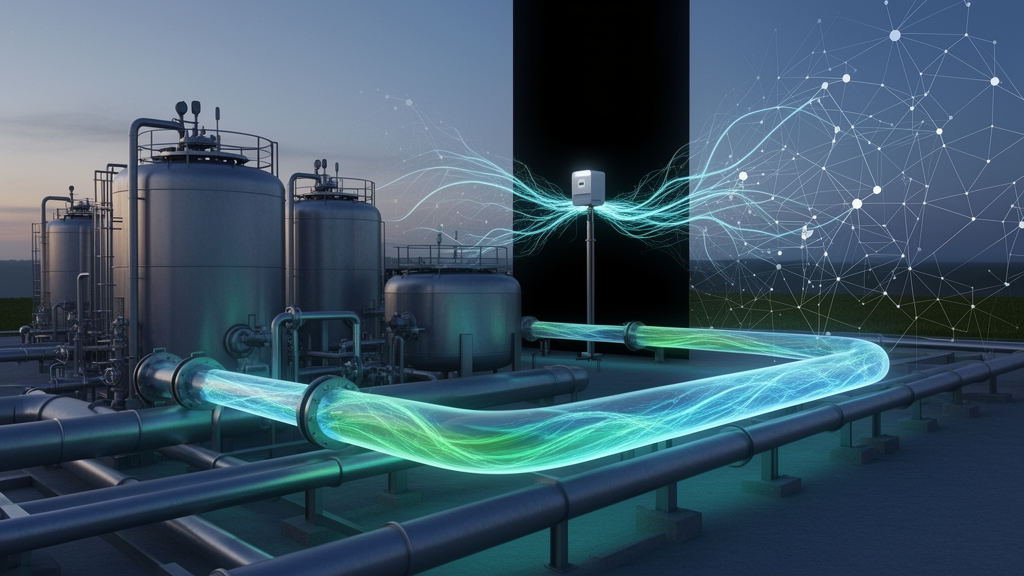
Hydrogen has become one of the most talked-about pillars of the global energy transition, yet the infrastructure that moves it — pipelines, storage facilities, refueling networks, and increasingly the smart grids that interconnect them — remains stubbornly difficult to observe in real time. A new study published in Neural Computing and Applications by Xin Liang of the Hydrogen Energy Transportation Research Department at Sinopec Marketing Research Institute of Applied Technology in Tianjin, China, tackles a problem that has quietly plagued engineers for years: how do you reconstruct the complete picture of energy flowing through a system when most of your sensors are missing, failing, or reporting irregularly? The answer, presented in a framework called SPEL-VFL, blends machine learning with hard physical law in a way that could reshape how cyber-physical energy systems are monitored.
The core challenge is one of sparse sensing. In an ideal world, every node in a hydrogen transportation network or an IoT-enabled smart grid would stream continuous, reliable measurements — pressures, flow rates, injection levels, power draws. In practice, distributed edge devices are often battery-constrained, intermittently connected, or simply too expensive to deploy at full density. The result is a patchwork of incomplete and irregular observations, and the underlying energy flow structure of the system becomes hidden. Traditional physics-based models, which rely on differential equations and precise knowledge of system parameters, demand full observability to function at all. Purely data-driven models, on the other hand, can interpolate from whatever data they see but routinely violate the conservation laws and transport physics that govern real energy systems, producing reconstructions that look plausible statistically but are physically nonsensical.
Liang’s framework, SPEL-VFL — short for physics-embedded latent energy flow learning — is designed specifically for this gap. It combines three tightly coupled components. The first is a sparse-aware encoder, a neural module that learns to extract maximum information from fragmentary, irregularly sampled measurements, effectively treating missingness as a first-class feature of the input rather than an annoyance to be imputed away. The second is a variational latent structure model, which places the hidden energy transmission relationships of the network into a probabilistic latent space. Rather than guessing a single fixed topology of how energy moves between nodes, the model maintains a distribution over plausible latent structures, capturing the uncertainty that sparse sensing inevitably introduces.
The third and arguably most important component is a physics-consistency regularization mechanism. During training, the framework penalizes solutions that drift away from physical law — the same philosophy that underpins the rapidly growing field of physics-informed neural networks, which gained prominence with the 2019 work of Raissi, Perdikaris, and Karniadakis on embedding partial differential equations into deep learning objectives. In SPEL-VFL, this means that the latent energy flows the model infers must remain consistent with the governing dynamics of the physical network, whether that network is an electrical distribution grid or a hydrogen pipeline system with injection points, line-pack storage effects, and pressure-driven transport. The regularization acts as a scientific conscience for the neural network, steering it away from mathematically convenient but physically impossible reconstructions.
The setting for this work is the broader world of IoT-enabled cyber-physical energy systems, and the study appeared in a special issue on Machine Learning and Big Data Analytics for IoT Security and Privacy, reflecting the growing recognition that energy infrastructure monitoring is as much a data and security problem as a thermodynamic one. State estimation — the classical task of inferring the true operating state of a network from noisy measurements — and missing data reconstruction have historically been treated as separate, supporting processes. The paper argues that under sparse sensing these tasks become tightly coupled and mutually dependent: you cannot reliably estimate states without reconstructing missing data, and you cannot reconstruct missing data without a coherent estimate of the system state. Conventional pipelines that handle them sequentially often fail to recover the underlying energy flow structure at all.
What makes the work particularly timely is its explicit application to hydrogen energy transportation and hydrogen intelligent mobility systems. As countries scale up hydrogen production through power-to-gas conversion and build dedicated pipeline networks, operators face a monitoring environment far less mature than the electrical grid. Hydrogen leakage detection remains an active area of sensor research, and the dynamic behavior of natural gas networks into which hydrogen is blended — including line-pack effects where gas stored in the pipeline itself buffers supply and demand — adds layers of complexity that fixed physics models struggle to track in real time. A learning framework that can infer hidden flow structures from sparse IoT measurements, while respecting the physics of gas transport, offers a way to bring hydrogen infrastructure up to the observational standards of modern smart grids.
The technical machinery behind SPEL-VFL draws on several strands of recent machine learning research. Variational autoencoders, popularized in the machine learning literature for learning probabilistic latent representations, provide the backbone for the latent structure model, allowing the framework to reason about uncertainty rather than committing to a single point estimate. Graph neural networks, which have become the standard tool for learning on network-structured data, inform the way the model captures relationships between nodes in the energy system. Attention mechanisms, drawn from the transformer architecture that reshaped natural language processing, offer a means of weighting which sparse measurements matter most for a given reconstruction. The framework also connects to classical techniques: matrix completion methods from convex optimization, particle filters for nonlinear Bayesian tracking, and recurrent neural network approaches for multivariate time series with missing values all appear in the paper’s intellectual lineage.
According to the experimental results reported in the study, SPEL-VFL achieves superior reconstruction accuracy compared with competing approaches, demonstrates stronger robustness to missing data, and produces reconstructions with improved physical plausibility. That last metric deserves emphasis. In energy systems, a reconstruction that is accurate on average but violates conservation of energy at individual nodes can mislead operators into unsafe or economically suboptimal decisions. By enforcing physics-consistency during learning rather than as an afterthought, the framework ensures that its outputs can be trusted not just statistically but physically — a property that matters enormously when the system in question is a pressurized hydrogen pipeline or a distribution grid serving critical loads.
The implications extend beyond hydrogen. Smart grids, district heating networks, integrated energy systems that couple electricity with gas and heat, and the growing fleet of IoT devices monitoring them all face the same fundamental tension: the physics is well understood, but the observations are sparse, noisy, and irregular. A framework that learns latent energy flows under exactly these conditions could improve state estimation for distribution networks, support anomaly and leakage detection, and enable more aggressive deployment of low-cost sensing by compensating algorithmically for what the hardware cannot measure. It also speaks to the security dimension highlighted by the special issue in which the paper appears — resilient reconstruction from partial observations is a natural defense against sensor failures, communication outages, and adversarial data manipulation.
There are, of course, open questions. The study’s datasets are available from the corresponding author upon reasonable request, and real-world deployment at the scale of a national hydrogen network would demand extensive validation across diverse operating conditions, sensor failure modes, and adversarial scenarios. The tension between model flexibility and physical fidelity — how strongly to regularize, and which physical laws to embed — will need careful tuning for each application domain. But the direction of travel is clear. As the energy transition multiplies the number of coupled physical networks that must be monitored in real time, and as hydrogen moves from laboratory curiosity to industrial commodity, the ability to learn the hidden flow of energy from sparse, imperfect sensors while never violating the laws of physics may prove to be one of the most consequential applications of machine learning in the infrastructure of the coming decades. Liang’s SPEL-VFL framework offers a concrete, technically grounded step in that direction, and a preview of how the next generation of energy systems will be seen — even when half their sensors are dark.
Subject of Research: Physics-embedded latent machine learning for hydrogen energy flow reconstruction under sparse IoT sensing
Article Title: Physics-embedded latent hydrogen energy flow learning under sparse sensing conditions
Article References: Liang, X. (2026). Physics-embedded latent hydrogen energy flow learning under sparse sensing conditions. Neural Computing and Applications, 38(19), Article 787. https://doi.org/10.1007/s00521-026-12320-8
Image Credits: AI Generated
DOI: 10.1007/s00521-026-12320-8
Keywords: hydrogen energy, sparse sensing, physics-informed neural networks, energy flow modeling, state estimation, variational autoencoders, IoT, smart grids, graph neural networks, missing data reconstruction, hydrogen pipelines, cyber-physical energy systems
Cite Scienmag News
Faith Mcneil. (October 10, 2026). AI Learns Hidden Hydrogen Energy Flows When Sensors Go Dark. Scienmag. https://scienmag.com/ai-learns-hidden-hydrogen-energy-flows-when-sensors-go-dark/
Faith Mcneil. "AI Learns Hidden Hydrogen Energy Flows When Sensors Go Dark." Scienmag, 10 October 2026, https://scienmag.com/ai-learns-hidden-hydrogen-energy-flows-when-sensors-go-dark/. Accessed 10 October 2026.
Faith Mcneil. "AI Learns Hidden Hydrogen Energy Flows When Sensors Go Dark." Scienmag. October 10, 2026. https://scienmag.com/ai-learns-hidden-hydrogen-energy-flows-when-sensors-go-dark/


