


Soil liquefaction remains one of the most perilous geotechnical phenomena, especially in earthquake-prone regions, as vividly demonstrated by the catastrophic Great East Japan Earthquake in 2011. This process, wherein saturated soils lose their structural integrity and temporarily behave like liquids, undermines foundation support, leading to extensive infrastructural damages. In urban areas such as Tokyo Bay, widespread liquefaction resulted in the devastation of thousands of homes, underscoring the urgent need for effective soil stabilization techniques. Among the strategies employed, chemical grouting—a method involving injecting a solidifying chemical grout into the soil to replace pore water—has shown promise by enhancing soil strength and reducing liquefaction susceptibility. However, this remediation approach faces significant challenges when applied to heterogeneous soil systems, particularly those featuring zones of low permeability that impede uniform grout dissemination.
Understanding the intricacies of grout permeation in complex soil matrices has demanded sophisticated analytical methodologies. Traditional approaches, largely reliant on the Finite Element Method (FEM), have been instrumental in modeling grout flow and permeation behavior within both homogeneous and heterogeneous soils. FEM simulations reveal a pronounced tendency of grout to circumvent low-permeability pockets, thereby creating irregular distributions that compromise remediation efficacy. Such limitations point to the necessity of further advancing predictive accuracy and optimizing injection protocols to ensure uniform treatment even in the presence of adverse geological heterogeneities.
In a groundbreaking endeavor led by Professor Shinya Inazumi from the College of Engineering at the Shibaura Institute of Technology (SIT), Japan, a novel integrative framework merges classical FEM-based permeation analysis with cutting-edge artificial intelligence (AI) predictive modeling. This multidisciplinary collaboration, which also involved researchers from the Asian Institute of Technology in Thailand, introduces a comprehensive methodology to reliably assess and predict grout permeation across soils containing low-permeability zones. Their pioneering study, published in the esteemed journal Results in Engineering, delineates how coupling numerical simulation data with machine learning techniques can transcend existing predictive limitations, offering a formidable toolset for geotechnical engineers confronting complex subsurface environments.
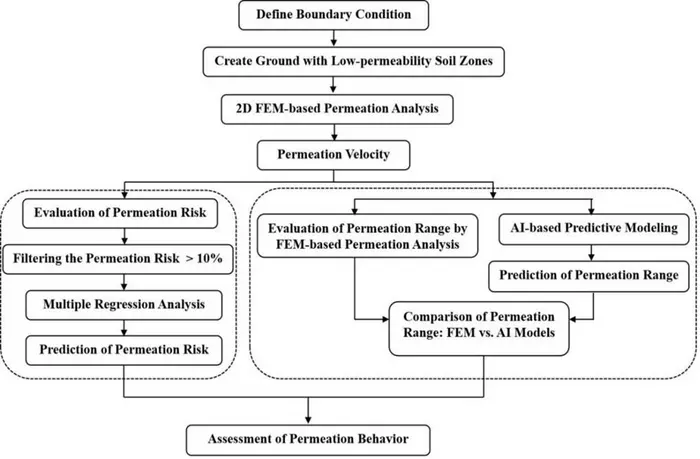
The core innovation resides in the complementary exploitation of FEM simulation outputs as training datasets for AI-based models, specifically neural networks and gradient boosting decision trees. Initially, a two-dimensional FEM simulation constructs detailed soil models featuring heterogeneities with varying permeability profiles. The analysis quantifies critical parameters such as permeation velocity fields and spatial permeation risk zones—areas where grout infiltration is predicted to be suboptimal. These quantified parameters subsequently feed into regression analyses and AI algorithms that iteratively learn the nonlinear relationships underpinning grout behavior within multiscale heterogeneous soils.
Comparative performance metrics drawn from the study reflect significant predictive prowess. FEM simulations indicated an average grout permeation rate of 94.5%, with a minimum effectiveness of 81% when low-permeability regions comprised approximately 5.5% of soil volume. Remarkably, AI-driven models not only matched but slightly exceeded these benchmarks, achieving an average permeation prediction accuracy close to 96%, coupled with a worst-case performance dip limited to 83%. The robustness of AI models is further corroborated by a high coefficient of determination (R² = 0.849) validated against both FEM simulation results and historical data from prior research, demonstrating their generalizability and reliability.
One critical advantage highlighted by the team’s findings is the dramatic reduction in computational time enabled by AI integration. While traditional FEM simulations require between 30 to 40 minutes per scenario due to intensive numerical calculations, AI models generate predictive outputs in under two seconds once trained. This acceleration signifies a quantum leap in real-time decision-making for field engineers, facilitating rapid evaluation of multiple policy scenarios, injection parameters, and soil condition variations without sacrificing accuracy or detail. Such capability could redefine operational protocols for chemical grouting interventions in geotechnical practice.
The study also delves into the mechanistic understanding of grout flow impediments, elucidating how low-permeability zones act as barriers that disrupt natural flow convection, resulting in localized decreases in permeation velocity and coverage. These insights provide actionable intelligence promoting adaptive grouting techniques that strategize around known heterogeneities to maximize efficacy. Furthermore, the derived simple regression models, utilizing accessible input parameters such as soil geometry and permeability proximities, afford practical estimation tools that obviate extensive computational demands, thereby lowering barriers to entry for various stakeholders in infrastructure maintenance and disaster mitigation.
While the initial results are highly promising, the researchers stress the imperative of complementary experimental validation using field-derived data to refine and calibrate AI models further. They highlight that expanding the diversity and volume of training data—incorporating a wider array of soil types, grout compositions, injection pressures, and other physical parameters—will mitigate risks of model overestimation and enhance predictive fidelity. This iterative feedback between simulation, AI, and empirical field validation embodies the modern scientific method at the intersection of geotechnical engineering and data science.
Looking ahead, incorporation of additional grouting process attributes such as rheological behavior of the grout, pressure dynamics during injection, and granular soil structure distributions into FEM and AI models promises to bolster the practical applicability and reliability of the framework. Such comprehensive modeling endeavors could pave the way for standardized protocols that transform soil stabilization tasks in seismically vulnerable urban centers worldwide.
Ultimately, this integrative approach offers a strategic leap forward in the ongoing battle against the destructive consequences of soil liquefaction. By harnessing the computational strengths of FEM alongside the predictive agility and speed of AI, engineers and planners can now access refined tools that enable more precise preemptive interventions. Given the increasing frequency of seismic events and expanding urban populations in vulnerable regions like Japan, technologies that enhance soil remediation efficacy are not just desirable but essential to safeguarding lives and infrastructure in the decades to come.
The interdisciplinary nature of this research embodies the future of engineering innovation, blending traditional physics-based modeling with machine learning to tackle one of the most intricate environmental hazards. Professor Inazumi and his team’s contribution underscores the critical role of artificial intelligence in reshaping civil engineering landscapes, bridging gaps between theory and practice, and delivering pragmatic, scalable solutions to global challenges.
In conclusion, the fusion of FEM and AI in modeling chemical grout permeation stands as a compelling testament to the power of hybrid scientific methodologies. The study sets a new benchmark for geotechnical risk assessment and underscores the transformative potential of data-driven engineering in managing heterogeneous soil conditions. As further refinements and validations emerge, such integrative frameworks are poised to become industry standards, profoundly influencing soil liquefaction mitigation strategies worldwide.
News Publication Date: 1-Jun-2025
References: DOI: 10.1016/j.rineng.2025.105071
Cite Scienmag News
Violet Maxwell. (May 28, 2025). AI-Enhanced FEM Models Advance Chemical Grouting Forecasts in Complex Soil Environments. Scienmag. https://scienmag.com/ai-enhanced-fem-models-advance-chemical-grouting-forecasts-in-complex-soil-environments/
Violet Maxwell. "AI-Enhanced FEM Models Advance Chemical Grouting Forecasts in Complex Soil Environments." Scienmag, 28 May 2025, https://scienmag.com/ai-enhanced-fem-models-advance-chemical-grouting-forecasts-in-complex-soil-environments/. Accessed 3 September 2026.
Violet Maxwell. "AI-Enhanced FEM Models Advance Chemical Grouting Forecasts in Complex Soil Environments." Scienmag. May 28, 2025. https://scienmag.com/ai-enhanced-fem-models-advance-chemical-grouting-forecasts-in-complex-soil-environments/


