


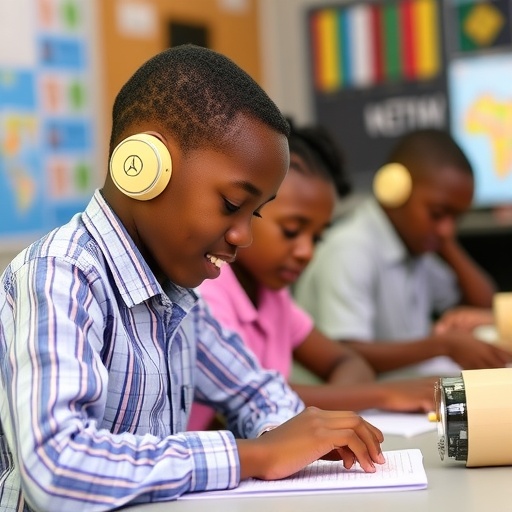
In a groundbreaking exploration of educational innovation, a new generative artificial intelligence (AI) framework is set to revolutionize STEM education across Sub-Saharan Africa. Published in the ECNU Review of Education, the study led by Sanura Jaya and Rozniza Zaharudin from Universiti Sains Malaysia offers a compelling look at how AI-driven project-based learning (PBL) methodologies can empower educators navigating resource-constrained environments. This research presents a paradigm shift, moving from the traditional content-driven teaching models to progressive competency-based learning (CBL), leveraging accessible smartphone technology to bridge educational divides.
Global education systems increasingly incorporate artificial intelligence to enhance learning outcomes, yet many classrooms in Africa remain marginalized due to infrastructural challenges and limited capacity. This study directly tackles the persistent divide between lofty educational policies and the realities observed in underfunded classrooms. By utilizing “leapfrogging technology,” AI shows promise in compensating for shortages of laboratory equipment and gaps in teacher training, thus presenting a scalable solution for STEM education hurdles.
The qualitative case study engaged ten STEM educators drawn from Nigeria, Botswana, Ghana, Namibia, and Sierra Leone. These participants underwent an intensive, hands-on workshop designed to build capacity through integrated use of various AI tools. Among these were speech-to-text-to-image (STTI) generation systems, smartphone-based block coding through a platform called Magnetcode, and virtual circuit simulation software. Grounded in Kolb’s experiential learning theory, the study methodically guided educators through cycles of hands-on experience, reflective thought, and active experimentation within their teaching practices.
One of the most transformative findings from this research reveals how AI STTI tools dramatically enhance the visualization of abstract scientific concepts. These AI systems convert verbal prompts into illustrative images, providing a cognitive scaffold that aids learners who often face language barriers or limited access to scientific visuals. Participants reported that instant visual feedback made complex biological and physical phenomena considerably easier to grasp, thereby enriching the learner’s comprehension and engagement.
Moreover, the widespread penetration of mobile devices in rural African contexts presents an unprecedented opportunity for digital inclusion. The Magnetcode application, a smartphone-based modular coding platform, facilitates computational thinking development without requiring costly laptops or desktops. By simplifying traditional programming syntax into intuitive block coding, educators can emphasize logical problem-solving skills, allowing students to focus on the conceptual foundations of coding rather than coding syntax intricacies.
The study also highlights the increasing importance of simulation tools in these educational environments. Virtual circuit simulations serve as cost-effective substitutes for physical lab equipment, enabling teachers and students to experiment with electronic circuits safely. This simulation-first approach significantly mitigates the risks of damaging expensive or scarce hardware components, while simultaneously fostering troubleshooting skills essential for hands-on STEM education. Building such confidence through virtual practice encourages more effective transitions to real-world prototyping.
Beyond the technical enhancements, the research underscores an essential pedagogical transformation. Educators are shifting from a teacher-centered approach towards becoming facilitators who nurture student-driven inquiry and creativity. This realignment is critical for embedding computational thinking and problem-solving as core competencies within modern STEM curricula. One participating teacher noted newfound confidence in designing lessons that emphasized critical thinking and interactive engagement over rote content delivery, signaling a promising evolution in instructional practice.
Importantly, the study reveals that the participating teachers are actively devising strategies to embed AI tools sustainably into their classrooms. Plans include launching extracurricular AI clubs, where students can explore and innovate beyond formal lessons, as well as leveraging recycled materials for coding and robotics projects. These locally grounded adaptations demonstrate remarkable educational agency, illustrating how AI technologies can be meaningfully contextualized despite systemic challenges such as restrictive device policies and infrastructure limitations.
The collaborative research advocates for policymakers and educators to systematically integrate AI and computational thinking into STEM education frameworks. By embedding inquiry-driven modules that combine simulation with physical prototyping, schools can create inclusive, future-ready learning environments. This alignment of policy with pedagogical practice is vital for fostering equitable access to technology-enhanced education and for equipping students with the skills necessary for a rapidly evolving digital world.
This case study exemplifies how context-responsive educational interventions can provide scalable solutions that address specific systemic barriers. It underscores the transformative potential of AI not just as a technology but as a catalyst for pedagogical innovation and educational equity in regions where resources remain scarce. The researchers conclude that the success achieved relies fundamentally on thoughtful pedagogical design and integration, with AI serving as a facilitative tool rather than the centerpiece.
As Africa continues to contend with disparities in educational infrastructure, findings from this research offer a beacon of hope. They mark a strategic leap towards a digitally empowered future for STEM education, where AI-enabled learning tools empower educators and learners alike to transcend traditional barriers. Ultimately, the research serves as an inspiring model for global education systems intent on harnessing the power of AI to bridge longstanding educational gaps.
In conclusion, the work by Sanura Jaya and Rozniza Zaharudin is a pioneering contribution to STEM teaching methodologies in under-resourced settings. It highlights the symbiotic relationship between technology and pedagogy necessary to nurture competencies in the twenty-first century. Their findings argue persuasively for a systematic embedding of AI-enhanced project-based learning in STEM curricula that can better prepare future generations for the demands of a technologically sophisticated economy.
Cite Scienmag News
Courtney Benton. (May 14, 2026). AI-Driven Project-Based Learning Revolutionizes STEM Education Across Africa. Scienmag. https://scienmag.com/ai-driven-project-based-learning-revolutionizes-stem-education-across-africa/
Courtney Benton. "AI-Driven Project-Based Learning Revolutionizes STEM Education Across Africa." Scienmag, 14 May 2026, https://scienmag.com/ai-driven-project-based-learning-revolutionizes-stem-education-across-africa/. Accessed 3 September 2026.
Courtney Benton. "AI-Driven Project-Based Learning Revolutionizes STEM Education Across Africa." Scienmag. May 14, 2026. https://scienmag.com/ai-driven-project-based-learning-revolutionizes-stem-education-across-africa/


