


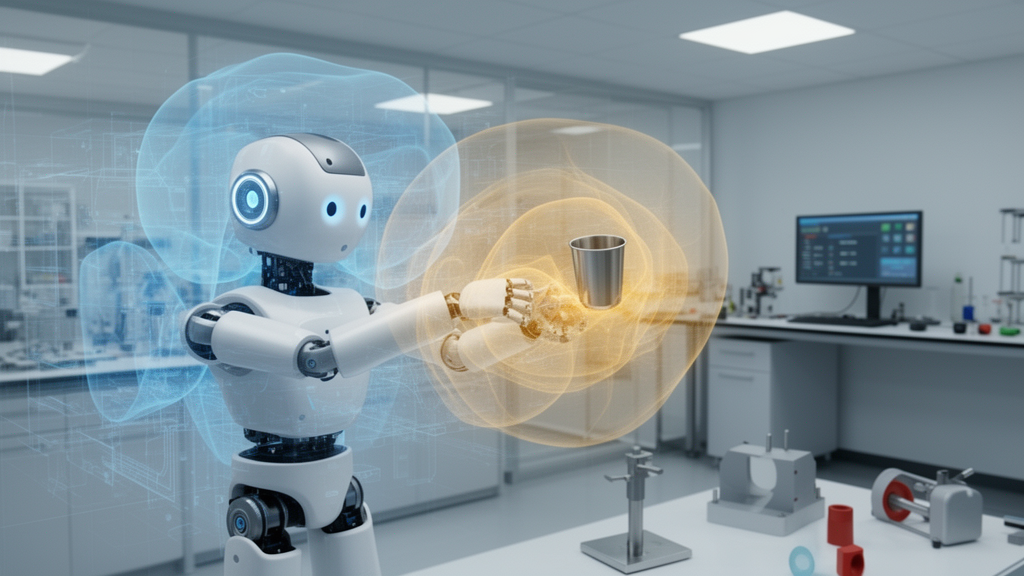
A comprehensive technical review concludes that learned world models can support safer and more effective decisions in robots and other embodied artificial intelligence systems, but only when their predictive representations, uncertainty estimates and control mechanisms are designed as an integrated whole. The survey organizes learning-based world models along six compositional dimensions: state abstraction, temporal dynamics, uncertainty source and treatment, structural prior, observation modality and decision coupling. It is a review of existing research rather than a new experiment, and it concludes that convincing evidence of robust, general deployment on real hardware remains limited. Its central finding is that predictive accuracy alone does not determine success: a world model is valuable only if it supports useful decisions when observations are incomplete, dynamics are uncertain and actions expose the system to new conditions.
In the survey’s definition, a world model is a learned predictive model that maps histories of observations and actions to a latent or explicit representation sufficient to forecast future states, observations, rewards, values or other decision-relevant quantities. A common architecture encodes observations and past actions into a compact latent state, propagates that state through a learned transition model under candidate actions and applies task-specific output heads to predict observations, rewards or values. The latent state can act as a learned belief-like summary of history, filtering noise and retaining information needed for planning. Not every model reconstructs the environment: a planning-sufficient model may predict only rewards, policies and values during imagined action sequences. MuZero is used in the survey as a conceptual example of this principle because its action-conditioned latent rollouts support search, but its game-domain performance is not treated as evidence that it is suitable for physical deployment.
The distinction between world models and adjacent components is important for interpreting results. A value model estimates expected return, while a policy model estimates action preferences; either may guide behavior without containing a predictive transition structure. Perception systems, representation learners and online state estimators are likewise classified as enabling components when they support prediction but do not themselves forecast how the world will evolve under actions. The review therefore focuses on models that either predict explicit dynamics or contain an action-conditioned latent rollout structure suitable for decision-making. This boundary also explains why some prominent generative systems are discussed cautiously. Action-conditioned video models and learned interactive simulators may qualify when they respond to interventions, while generative video models without meaningful action conditioning are treated only as adjacent technologies. Photorealistic output by itself does not demonstrate physical consistency or planning utility.
The six-dimensional taxonomy reveals why no architecture is universally superior. State abstractions may consist of explicit physical variables, predicted pixels, compact latent variables, probability distributions over hidden states or factorized object representations. Temporal dynamics can be deterministic or stochastic, recurrent or Markovian, discrete- or continuous-time, or temporally abstract. Uncertainty may be represented through ensembles, probabilistic outputs, latent stochastic variables, Bayesian approximations or implicit mechanisms. Structural priors may encode local linearity, conservation laws, objects, relations or sparse interaction graphs. Inputs may consist of state measurements, a single perceptual channel or asynchronous combinations of vision, touch and proprioception. Finally, a model can be coupled to model predictive control, trajectory optimization, imagination-based policy learning, tree search or no decision process at all. These dimensions are compositional rather than mutually exclusive, so one system can combine a compact latent state, stochastic recurrent dynamics, ensemble-based epistemic uncertainty, object structure, multimodal sensing and model predictive control.
Each combination carries a different compromise. Deterministic latent models can generate fast, memory-efficient imagined trajectories, which is valuable when an optimizer must evaluate hundreds or thousands of candidates within a robot’s control cycle. Their single predicted path also simplifies gradient-based trajectory optimization. The limitation is equally important: if several futures are plausible, a deterministic model can collapse them into an implausible average. In contact-rich manipulation, a small pose change can alter whether an object slips, sticks or impacts another object, so a mean trajectory may violate physical behavior. Stochastic and probabilistic models preserve distributions over futures and can distinguish inherent variability from uncertainty caused by limited data or distribution shift. Ensembles, particles and latent random variables make that uncertainty available to planners, but each sample increases latency and long probabilistic rollouts may accumulate variance. Continuous-time and hybrid formulations can better represent irregular sampling, delays and abrupt contact transitions, yet they also introduce the difficulty of integrating numerical dynamics, identifying modes and propagating uncertainty across discontinuities.
Multimodal world models try to overcome the blind spots of individual sensors. Vision provides global geometry and semantic context but can fail under occlusion or changing illumination; proprioception reports an agent’s internal configuration but does not directly resolve external contact; tactile and force sensing can anchor contact physics but is spatially local and temporally intermittent. Early fusion concatenates modality-specific features, late fusion combines separately encoded representations, and probabilistic fusion treats each sensor as a partial posterior over the hidden state. Such combinations can improve effective observability and reduce ambiguity about contact, but they must handle sensor dropout, corrupted measurements, conflicting evidence, asynchronous sampling and delays. Visuo-tactile transformers and multimodal state estimators are therefore classified as useful enabling components rather than standalone world models unless their representations are coupled to a predictive transition or rollout mechanism. The design target is not merely a state that can be decoded across modalities, but one that remains sufficiently informative about the consequences of candidate actions.
Structured and object-centric models represent another route to generalization. Instead of propagating one monolithic latent vector, they assign representations to entities and model pairwise or relational interactions through message passing. Their explicit locality, object factorization and permutation symmetry can improve scaling to scenes with different numbers of entities and may support systematic transfer to new layouts, which unstructured representations can find difficult. Graph-based formulations are particularly compatible with sparse physical interactions, while object slots can preserve identity through time. These benefits come with stronger assumptions: object discovery can become unstable under visual ambiguity, assumed relations may not match the true contact structure, and perception, graph inference and dynamics must be learned together. Temporal abstractions offer a different way to control long-horizon error by predicting transitions between landmarks or subgoals instead of every fine-grained control step. Such abstraction can shorten planning horizons, but its adequacy depends on whether the selected milestones retain the information needed for safe decisions.
Control integration is where theoretical model design meets the practical danger of model error. In model predictive control, a learned model generates candidate futures, an optimizer selects an action sequence, and the physical system executes only the first action before the process repeats. Receding-horizon feedback can partially absorb disturbances and model mismatch, while optimization provides a natural place to impose actuator, collision and state constraints. It can also magnify error. An optimizer may “cheat” by steering toward regions where the learned model is inaccurate but predicts an attractive outcome, a form of planner exploitation. The same risk occurs when policies are trained largely on imagined rollouts that gradually diverge from physical reality. The review highlights short rollouts, frequent replanning, uncertainty-aware objectives, terminal-value bootstrapping and hybrid model-free learning as mechanisms for reducing this problem. It also emphasizes that methods should be evaluated under matched planners and compute budgets, because improvements attributed to a model may actually come from a different decision layer.
Real-time constraints make the trade-offs measurable. For a planning horizon H, K candidate trajectories and S uncertainty realizations, rollout computation grows approximately with the product of those quantities, with S equal to one for deterministic prediction. Multimodal perception adds further delay through separate encoders, temporal alignment and fusion. The review reports that specialized neural model-predictive-control systems have operated onboard quadrotors at 50 hertz, but it argues that such results require detailed context. Evaluations should report model inference time, complete planning time, target hardware and achieved control frequency rather than presenting prediction quality alone as evidence of deployability. In model-based reinforcement learning, imagination can improve data efficiency by supplying training experiences beyond those collected from hardware. Restricting those experiences to short horizons limits bias, while real interaction or model-free learning stabilizes policy improvement. A task-oriented model may also deliberately sacrifice pixel reconstruction if its latent state retains what is needed for planning and value prediction.
The survey recommends evaluation that links prediction to behavior. One-step error and pixel-level reconstruction can overemphasize task-irrelevant backgrounds and visual details while underweighting sparse, consequential events such as impacts, slips or changes in object state. Recommended reporting includes one-step and multi-step open-loop errors at several horizons, closed-loop rollout consistency, likelihood or proper scoring rules for stochastic models, and calibration measures such as negative log-likelihood, Brier score or expected calibration error. These should be paired with task success, return, constraint violations, robustness and sample efficiency under fixed data budgets. Comparisons should include representative deterministic, stochastic and model-free baselines, report means and variance across multiple random seeds, and disclose computational cost and failure rates. Strong deployment claims should additionally use hardware-in-the-loop or physical-system evaluation. Simulation results remain useful, but the review warns that benchmark improvements on simplified environments may not establish meaningful gains in deployment.
Transfer from simulation to hardware remains a decisive obstacle because real machines introduce imperfect friction estimates, unmodeled compliance, actuator delay, sensor distortion and external disturbances. Domain randomization can vary appearance, while dynamics randomization can vary mass, friction coefficients, joint damping and delays; together these strategies can reduce dependence on simulator-specific behavior. The review says they rarely suffice alone, noting that calibration, safety layers and hybrid control architectures remain important. Transfer claims should specify whether evaluation is zero-shot, few-shot adaptation or continual online adaptation, document randomized parameters and ranges, and report stress tests involving sensor noise, latency, mismatch and disturbances. The remaining challenges include long-horizon consistency, physically valid contact prediction, reliable adaptation to changing payloads and wear, data-efficient learning, multi-agent coordination and safety under rare events. World models are therefore emerging as a promising predictive core for physical AI, but the survey’s central conclusion is conditional: their usefulness depends not on producing a visually convincing future, but on remaining decision-relevant, uncertainty-aware and physically credible after their predictions enter a closed control loop.
Subject of Research: Technical review of learned world models, uncertainty representation and closed-loop control for physical AI
Article Title: A survey of world models for physical AI with uncertainty representation and control
Article References: Kirchner, S., Purschke, N., & Knoll, A. (2026). A survey of world models for physical AI with uncertainty representation and control. Discover Artificial Intelligence, 6(1), Article 1037. https://doi.org/10.1007/s44163-026-02122-1
Image Credits: AI Generated
DOI: 10.1007/s44163-026-02122-1
Keywords: world models, physical AI, robotics, uncertainty quantification, model predictive control, model-based reinforcement learning, embodied AI, sim-to-real transfer, multimodal sensing, safe control, survey, world
Cite Scienmag News
Denise Maddox. (October 22, 2026). A survey of world models for physical AI with uncertainty representation and control. Scienmag. https://scienmag.com/a-survey-of-world-models-for-physical-ai-with-uncertainty-representation-and-control/
Denise Maddox. "A survey of world models for physical AI with uncertainty representation and control." Scienmag, 22 October 2026, https://scienmag.com/a-survey-of-world-models-for-physical-ai-with-uncertainty-representation-and-control/. Accessed 22 October 2026.
Denise Maddox. "A survey of world models for physical AI with uncertainty representation and control." Scienmag. October 22, 2026. https://scienmag.com/a-survey-of-world-models-for-physical-ai-with-uncertainty-representation-and-control/


