


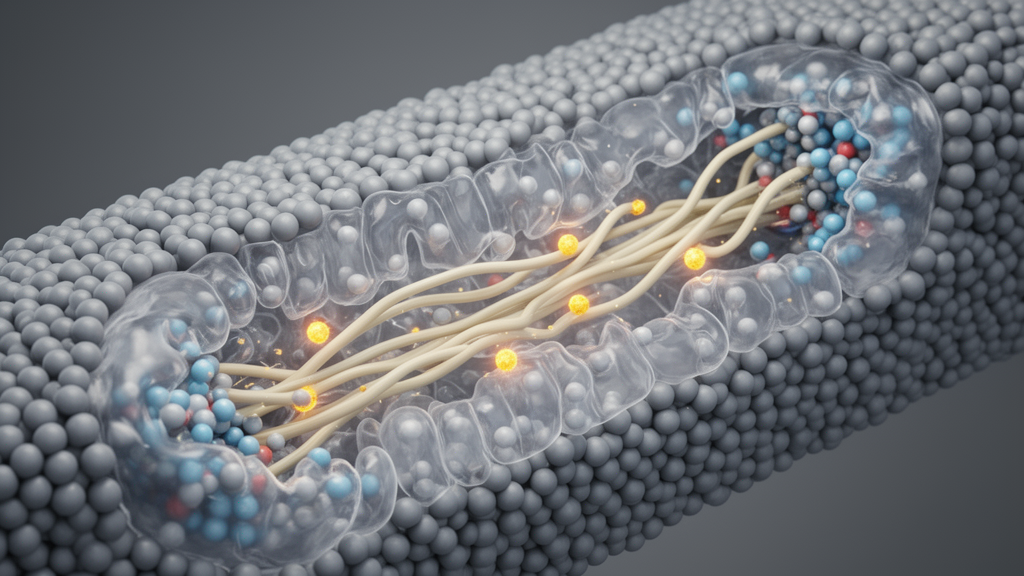
Molecular dynamics simulations indicate that adding protons to two conserved sites in the MmpL3 membrane protein can push the transporter toward different conformations, linking proton movement to the handling of a key mycobacterial cell-wall lipid. The study focused on MmpL3 from Mycobacterium smegmatis, a model system for the M. tuberculosis protein, and compared unprotonated protein with states in which either Asp256 or Asp645 was protonated. Asp256 protonation favored an open, more highly hydrated arrangement, whereas Asp645 protonation stabilized a closed and less accessible configuration.
MmpL3 is an essential inner-membrane transporter in mycobacteria. It moves trehalose monomycolate, a precursor of the mycolic acids that form major components of the bacterial cell envelope, between a transmembrane binding pocket and a periplasmic pocket. From the latter site, the lipid can be passed to downstream components involved in cell-wall construction. Because MmpL3 is conserved across mycobacterial species and required for growth and cell-wall biogenesis, understanding how it couples proton transport to lipid movement may inform efforts to develop tuberculosis drugs against this machinery.
The researchers began with a 2.6-ångström crystal structure of M. smegmatis MmpL3 and placed it in a model mycobacterial membrane containing several classes of lipids. They then simulated four fixed-protonation conditions: both conserved aspartates unprotonated, Asp256 protonated, Asp645 protonated, and both aspartates protonated. The first three principal states were each represented by five 2-microsecond replicas, while the dual-protonated state was examined with three replicas. Overall, the project generated 54 microseconds of unrestrained simulations, supplemented by 0.8 microseconds of restrained simulations and further simulations containing the transport substrate.
At the molecular level, the two protonation sites produced contrasting local effects. Protonated Asp256 frequently turned outward from the center of its Asp–Tyr dyad and formed a hydrogen bond with the Ala682 backbone, helping create an open arrangement. It also increased separation between several dyad residues and was associated with a denser water region between the TM4 and TM6 helices. By contrast, protonated Asp645 tended to remain inward-facing, formed fewer contacts with Ser293 and a more variable set of contacts with Tyr257, and reduced the projected area enclosed by the dyad residues. Hydration along TM10 also fell, especially near residue 648.
These local changes were accompanied by movement in the periplasmic domain, which contains the second lipid-binding pocket and interfaces with the transmembrane region containing the first. Protonation increased the variability of periplasmic-domain conformations across replicas, but the two sites biased the motions in different directions. The lower part of the periplasmic C-terminal domain tended to rotate clockwise in the Asp645-protonated simulations and counterclockwise in the Asp256-protonated simulations when viewed from the periplasm. Distance measurements at the narrowest part of the transport channel likewise placed Asp256 protonation toward a wider gate and Asp645 protonation toward a more compact arrangement.
The simulations also suggested that protonation reshapes both substrate pockets. At the entrance to the transmembrane pocket, defined by Leu424 and Glu553, Asp645 protonation biased the pocket toward a narrower state; four of its five replicas fell below the range sampled by the unprotonated system. Asp256 protonation produced greater replica-to-replica variability, with four replicas mainly sampling closed-like distributions and one sampling a distinctly wider configuration. At the periplasmic pocket, the separation between Ser67 and Pro450 tended to increase with Asp256 protonation. Restrained simulations that reproduced selected local hydrogen-bond geometries partially recreated these shifts, supporting an allosteric link between the proton-binding dyads and the distant pockets.
Dynamic network analysis identified candidate routes for that long-range communication. A pathway beginning at Asp256 mainly reached the periplasmic binding pocket through TM2, whereas a pathway beginning at Asp645 was connected to the transmembrane pocket through TM8. These routes provide a plausible physical explanation for the coupled domain movements, although the analysis identifies candidate pathways rather than proving that either route is necessary for transport. The authors also noted that Ser293, corresponding to Ser288 in M. tuberculosis, has been associated with resistance to MmpL3 inhibitors, making the proton-sensitive local network relevant beyond basic transport mechanism.
Adding trehalose monomycolate to the simulations revealed that protonation was associated with changes in how the lipid occupied the two pockets. In the transmembrane pocket, trehalose monomycolate remained bound throughout every trajectory and repeatedly contacted Leu424, Gln554, and His558. In the unprotonated state, its headgroup more often contacted an acidic region containing Asp525, Lys528, Asp531, Asp562, and Pro565. At least one hydrogen bond with that region occurred in 28% of unprotonated frames, compared with 6% in the Asp256-protonated and 9% in the Asp645-protonated simulations. The protonated states instead tended to position the headgroup approximately 2.3 ångströms closer to the central channel.
At the periplasmic pocket, trehalose monomycolate also remained bound but sampled two recurring sub-sites. One was beside a loop formed by residues 442–456; the other was on the Tyr44/Asp144 side of the pocket. The loop-side position placed the lipid headgroup closer to the periplasm, 26.7 ± 1.5 ångströms from the protein’s center of mass, compared with 22.4 ± 1.6 ångströms for the other position. All three Asp645-protonated replicas predominantly sampled the loop-side sub-site, as did two of three Asp256-protonated replicas and one of three unprotonated replicas. Because the individual trajectories rarely exchanged positions, the authors treated these counts as descriptive preferences rather than converged equilibrium populations.
Taken together, the results support a sequential model in which Asp256 protonation opens and hydrates the dyad region while favoring movement of trehalose monomycolate toward the central channel. Subsequent Asp645 protonation favors a more compact protein and lipid configurations closer to the periplasmic side, consistent with forward progress through the transport cycle. The work is a computational mechanistic study, not a demonstration of transport or therapeutic benefit in living bacteria. Its fixed-protonation simulations cannot define complete free-energy landscapes or transition barriers, establish the proton-to-lipid stoichiometry, or show whether the conserved tyrosins directly participate in proton transfer. Experiments directly measuring proton flux alongside lipid transport, together with reactive or constant-pH simulations, will be needed to test the proposed cycle.
Subject of Research: How protonation at conserved sites alters MmpL3 conformation and trehalose monomycolate binding in molecular dynamics simulations.
Article Title: Proton transport drives allosteric conformational changes in the MmpL3 transporter
Article References: Yang, L., North, E. J., Zgurskaya, H. I., Jackson, M., & Gumbart, J. C. (2026). Proton transport drives allosteric conformational changes in the MmpL3 transporter. PLOS Computational Biology, 22(10), e1014880. https://doi.org/10.1371/journal.pcbi.1014880
Image Credits: AI Generated
DOI: 10.1371/journal.pcbi.1014880
Keywords: MmpL3, mycobacteria, tuberculosis, proton transport, molecular dynamics, membrane transporter, trehalose monomycolate, cell-wall biogenesis, allostery, protein conformation, Proton, transport
Cite Scienmag News
Drew Townsend. (October 22, 2026). Protonation reshapes MmpL3 to coordinate mycobacterial lipid transport. Scienmag. https://scienmag.com/protonation-reshapes-mmpl3-to-coordinate-mycobacterial-lipid-transport/
Drew Townsend. "Protonation reshapes MmpL3 to coordinate mycobacterial lipid transport." Scienmag, 22 October 2026, https://scienmag.com/protonation-reshapes-mmpl3-to-coordinate-mycobacterial-lipid-transport/. Accessed 22 October 2026.
Drew Townsend. "Protonation reshapes MmpL3 to coordinate mycobacterial lipid transport." Scienmag. October 22, 2026. https://scienmag.com/protonation-reshapes-mmpl3-to-coordinate-mycobacterial-lipid-transport/


