

Thursday, October 22, 2026
Science
No Result
View All Result
  • Login
  • HOME
  • SCIENCE NEWS
  • CONTACT US
  • HOME
  • SCIENCE NEWS
  • CONTACT US
No Result
View All Result
Scienmag
No Result
View All Result
Home Science News Technology and Engineering

N-rGO anchored AgVO3 composite as cathode material for aqueous zinc-ion battery application

October 22, 2026
in Technology and Engineering
Faith Mcneil
By Faith Mcneil Scienmag Editorial Profile - Renewable Energy
Reading Time: 2 mins read
0
N-rGO anchored AgVO3 composite as cathode material for aqueous zinc-ion battery application

N-rGO anchored AgVO3 composite as cathode material for aqueous zinc-ion battery application

65
SHARES
587
VIEWS
Share on FacebookShare on Twitter
ADVERTISEMENT

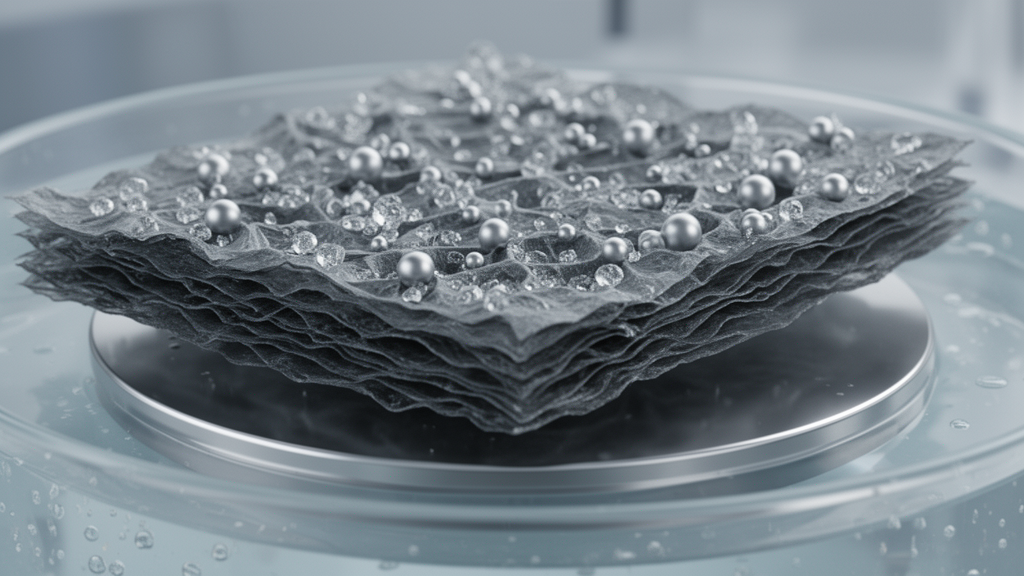
A laboratory study reports that a nitrogen-doped reduced graphene oxide–silver vanadate composite, designated NrGO–AVO, delivered a specific capacity of 178 mAh g−1 at a 1 C rate when used as the cathode in an aqueous zinc-ion battery. The NrGO–AVO//Zn cell also showed appreciable cycling stability over 500 cycles and reached a reported specific energy of 151 Wh kg−1 at a specific power of 195 W kg−1. These findings describe laboratory battery tests rather than commercial-cell performance, and the study summary does not establish readiness for deployment in full-scale energy-storage systems.

The composite was synthesized through a hydrothermal process and characterized using X-ray diffraction, Fourier transform infrared spectroscopy, Raman spectroscopy, field-emission scanning electron microscopy, thermogravimetric analysis and X-ray photoelectron spectroscopy. Its electrochemical behavior was assessed with cyclic voltammetry, galvanostatic charge–discharge measurements and electrochemical impedance spectroscopy. The researchers also used galvanostatic intermittent titration technique analysis to estimate the Zn²⁺ diffusion coefficient in NrGO–AVO and in pure AVO, allowing the composite’s ion-transport behavior to be compared with that of the unmodified material.

The central feature of the design was the incorporation of nitrogen-doped reduced graphene oxide into silver vanadate. The researchers attributed the composite’s improved overall performance to increased accessibility of active sites, which enhanced charge-transfer kinetics, and to more efficient electron transport during charge and discharge. These mechanisms were presented as the basis for the measured electrochemical improvements.

Intermittent-titration analysis indicated a higher Zn²⁺ diffusion coefficient for NrGO–AVO than for pure AVO under the tested conditions. The estimated value for the composite was of the order of 10−9 cm² s−1, whereas the value for pure AVO was of the order of 10−10 cm² s−1. This difference corresponds to favorable Zn²⁺-transport kinetics in the composite and is consistent with the broader electrochemical results.

The abstract does not provide the underlying numerical data, measurement conditions or uncertainty ranges for these estimates, so the size and reproducibility of the difference cannot be assessed in detail from the available evidence. Following cycling, the researchers performed a post-mortem study of the NrGO–AVO//Zn aqueous zinc-ion battery using X-ray diffraction, field-emission scanning electron microscopy and energy-dispersive X-ray analysis. The reported post-cycling results were interpreted as supporting the suitability of NrGO–AVO as a cathode material for aqueous zinc-ion batteries.

The abstract does not give detailed post-mortem measurements of structural changes, elemental redistribution or capacity loss, and it does not report performance beyond the stated 500-cycle stability assessment. Overall, the study presents a materials-level result: a nitrogen-doped graphene–silver vanadate cathode combining capacity, energy–power measurements, cycling stability and an estimated improvement in zinc-ion diffusion, while remaining a laboratory evaluation of a single battery architecture.

Subject of Research: Evaluation of an NrGO–silver vanadate cathode for aqueous zinc-ion batteries

Article Title: N-rGO anchored AgVO3 composite as cathode material for aqueous zinc-ion battery application

Article References: Louis, C., Shameela, P., Chandran, M., & Shafi, P. M. (2026). N-rGO anchored AgVO3 composite as cathode material for aqueous zinc-ion battery application. Ionics. https://doi.org/10.1007/s11581-026-07587-9

Image Credits: AI Generated

DOI: 10.1007/s11581-026-07587-9

Keywords: aqueous zinc-ion batteries, silver vanadate, nitrogen-doped reduced graphene oxide, cathode materials, zinc-ion diffusion, charge transfer, galvanostatic cycling, electrochemical energy storage, N-rGO, anchored, AgVO3, composite

Cite Scienmag News

Faith Mcneil. (October 22, 2026). N-rGO anchored AgVO3 composite as cathode material for aqueous zinc-ion battery application. Scienmag. https://scienmag.com/n-rgo-anchored-agvo3-composite-as-cathode-material-for-aqueous-zinc-ion-battery-application/


Faith Mcneil. "N-rGO anchored AgVO3 composite as cathode material for aqueous zinc-ion battery application." Scienmag, 22 October 2026, https://scienmag.com/n-rgo-anchored-agvo3-composite-as-cathode-material-for-aqueous-zinc-ion-battery-application/. Accessed 22 October 2026.

Faith Mcneil. "N-rGO anchored AgVO3 composite as cathode material for aqueous zinc-ion battery application." Scienmag. October 22, 2026. https://scienmag.com/n-rgo-anchored-agvo3-composite-as-cathode-material-for-aqueous-zinc-ion-battery-application/

Tags: advanced cathode material design for energy storageAgVO3anchoredaqueous zinc-ion batteriesbattery cycling stabilitycathode materialscharge transfercompositecyclic voltammetry in energy storageelectrochemical energy storageelectrochemical performance analysiselectrode material characterization techniquesgalvanostatic cyclinghydrothermal synthesis of battery materialsN-rGOnitrogen-doped reduced graphene oxidesilver vanadatesilver vanadate compositespecific energy and power in zinc-ion batterieszinc-ion battery cathode materialszinc-ion diffusionzinc-ion diffusion coefficient measurement
Share26Tweet16
Previous Post

Release-factor degradation boosts readthrough of MECP2 nonsense mutations

Next Post

Distress partially links childhood maltreatment to suicide risk in Mexican medical students

Related Posts

Bacteroides vesicles trigger autophagy and reduce skin colonization in mice
Technology and Engineering

Bacteroides vesicles trigger autophagy and reduce skin colonization in mice

October 22, 2026
Nickel substitution shifts magnetic interactions in LaFeO3 nanofibers
Technology and Engineering

Nickel substitution shifts magnetic interactions in LaFeO3 nanofibers

October 22, 2026
Simulated tin perovskite solar cell reaches 26.91% efficiency
Technology and Engineering

Simulated tin perovskite solar cell reaches 26.91% efficiency

October 22, 2026
Battery-free flexible neuromorphic device learns from touch and motion
Technology and Engineering

Battery-free flexible neuromorphic device learns from touch and motion

October 22, 2026
Xujiayao proteome links East Asian archaic Homo fossils to Denisovans
Medicine

Xujiayao proteome links East Asian archaic Homo fossils to Denisovans

October 22, 2026
Coenzyme Q10 reduces methotrexate-induced salivary gland injury in male rats
Technology and Engineering

Coenzyme Q10 reduces methotrexate-induced salivary gland injury in male rats

October 22, 2026
Next Post
Distress partially links childhood maltreatment to suicide risk in Mexican medical students

Distress partially links childhood maltreatment to suicide risk in Mexican medical students

  • Mothers who receive childcare support from maternal grandparents show more optimized

    Mothers who receive childcare support from maternal grandparents show more parental warmth, finds NTU Singapore study

    27656 shares
    Share 11059 Tweet 6912
  • University of Seville Breaks 120-Year-Old Mystery, Revises a Key Einstein Concept

    1061 shares
    Share 424 Tweet 265
  • Bee body mass, pathogens and local climate influence heat tolerance

    682 shares
    Share 273 Tweet 171
  • Researchers record first-ever images and data of a shark experiencing a boat strike

    546 shares
    Share 218 Tweet 137
  • Groundbreaking Clinical Trial Reveals Lubiprostone Enhances Kidney Function

    531 shares
    Share 212 Tweet 133
Science

Embark on a thrilling journey of discovery with Scienmag.com—your ultimate source for cutting-edge breakthroughs. Immerse yourself in a world where curiosity knows no limits and tomorrow’s possibilities become today’s reality!

RECENT NEWS

  • Qualitative Rwanda study maps WASH gaps and gender roles in pork chain
  • Distress partially links childhood maltreatment to suicide risk in Mexican medical students
  • N-rGO anchored AgVO3 composite as cathode material for aqueous zinc-ion battery application
  • Release-factor degradation boosts readthrough of MECP2 nonsense mutations

Categories

  • Agriculture
  • Anthropology
  • Archaeology
  • Athmospheric
  • Biology
  • Biotechnology
  • Blog
  • Bussines
  • Cancer
  • Chemistry
  • Climate
  • Earth Science
  • Editorial Policy
  • Marine
  • Mathematics
  • Medicine
  • Pediatry
  • Policy
  • Psychology & Psychiatry
  • Science Education
  • Science News
  • Social Science
  • Space
  • Technology and Engineering

Subscribe to Blog via Email

Enter your email address to subscribe to this blog and receive notifications of new posts by email.

Join 5,151 other subscribers

© 2025 Scienmag - Science Magazine

Welcome Back!

Login to your account below

Forgotten Password?

Retrieve your password

Please enter your username or email address to reset your password.

Log In
No Result
View All Result
  • HOME
  • SCIENCE NEWS
  • CONTACT US

© 2025 Scienmag - Science Magazine

Discover more from Science

Subscribe now to keep reading and get access to the full archive.

Continue reading