

Thursday, June 25, 2026
Science
No Result
View All Result
  • Login
  • HOME
  • SCIENCE NEWS
  • CONTACT US
  • HOME
  • SCIENCE NEWS
  • CONTACT US
No Result
View All Result
Scienmag
No Result
View All Result
Home Science News Marine

A new breakthrough in understanding regeneration in a marine worm

July 2, 2024
in Marine
Reading Time: 3 mins read
0
A new breakthrough in understanding regeneration in a marine worm
68
SHARES
618
VIEWS
Share on FacebookShare on Twitter
ADVERTISEMENT

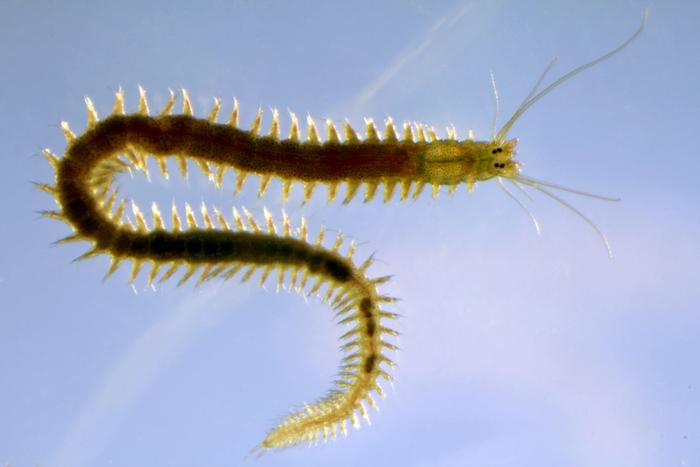
The sea worm Platynereis dumerilii is only a few centimetres long but has a remarkable ability: in just a few days, it can regenerate entire parts of its body after an injury or amputation. By focusing more specifically on the mechanisms at play in the regeneration of this worm’s tail, a research team led by a CNRS scientist1 has observed that gut cells play a role in the regeneration of the intestine as well as other tissues such as muscle and epidermis. Even more surprising, the team found that this ability of gut cells to regenerate other tissue varies according to their location: the closer they are to the posterior end of the worm, the greater the variety of cell types they can rebuild2. This study will appear in Development on 2 July.

A new breakthrough in understanding regeneration in a marine worm

Credit: © Dr. Pierre Kerner, Institut Jacques Monod

The sea worm Platynereis dumerilii is only a few centimetres long but has a remarkable ability: in just a few days, it can regenerate entire parts of its body after an injury or amputation. By focusing more specifically on the mechanisms at play in the regeneration of this worm’s tail, a research team led by a CNRS scientist1 has observed that gut cells play a role in the regeneration of the intestine as well as other tissues such as muscle and epidermis. Even more surprising, the team found that this ability of gut cells to regenerate other tissue varies according to their location: the closer they are to the posterior end of the worm, the greater the variety of cell types they can rebuild2. This study will appear in Development on 2 July.

Scientists carried out these observations by monitoring the outcome of gut cells and proliferative cells that form close to the amputated end of the worm. This was tracked using different markers in particular by fluorescent beads ingested by the worms. Annelids, or ‘segmented worms’, which have only been studied in the last 20 years, are an ideal model for the study of regeneration, a process that is widespread in animals but still mysterious for scientists.

The research team will continue this work to determine whether cell types, other than gut cells, can play a role in regenerating a variety of cell types.

Notes

1 – Working at the Institut Jacques Monod (CNRS/Université Paris Cité). Scientists at Inserm and Université Paris Cité also contributed to this research.

2 – Only cells involved in the nervous system and growth zone of the worm (a ring of stem cells involved in the continuous growth of the animal until it reaches sexual maturity) cannot, it appears, be generated by gut cells found in the posterior end of the worm.  


Journal

Development

DOI

10.1242/dev.202452

Article Title

Variations in cell plasticity and proliferation underlie distinct modes of regeneration along the antero-posterior axis in the annelid Platynereis.

Article Publication Date

2-Jul-2024

Share27Tweet17
Previous Post

New molecules to modulate gene expression

Next Post

True scale of carbon impact from long-distance travel revealed

Related Posts

Marine

Microbial Marvels: How Tiny Organisms Could Protect Crops from Rising Sea Levels

June 24, 2026
Balancing Equity and Efficiency with Atkinson’s Welfare — Marine
Marine

Balancing Equity and Efficiency with Atkinson’s Welfare

June 24, 2026
Ocean-crossing contagious cancer sparks severe outbreak in Pacific Northwest clams — Marine
Marine

Ocean-crossing contagious cancer sparks severe outbreak in Pacific Northwest clams

June 24, 2026
Climate Crisis Endangers River Microbial Biodiversity — Marine
Marine

Climate Crisis Endangers River Microbial Biodiversity

June 24, 2026
Brown Seaweed Flour Boosts Nutritional Value and Digestibility of Gluten-Free Cookies — Marine
Marine

Brown Seaweed Flour Boosts Nutritional Value and Digestibility of Gluten-Free Cookies

June 23, 2026
San Diego Zoo Wildlife Alliance Collaborates with SDSU on Pioneering Innovation Projects — Marine
Marine

San Diego Zoo Wildlife Alliance Collaborates with SDSU on Pioneering Innovation Projects

June 23, 2026
Next Post
True scale of carbon impact from long-distance travel revealed

True scale of carbon impact from long-distance travel revealed

  • Mothers who receive childcare support from maternal grandparents show more parental warmth, finds NTU Singapore study

    Mothers who receive childcare support from maternal grandparents show more parental warmth, finds NTU Singapore study

    27656 shares
    Share 11059 Tweet 6912
  • University of Seville Breaks 120-Year-Old Mystery, Revises a Key Einstein Concept

    1061 shares
    Share 424 Tweet 265
  • Bee body mass, pathogens and local climate influence heat tolerance

    682 shares
    Share 273 Tweet 171
  • Researchers record first-ever images and data of a shark experiencing a boat strike

    546 shares
    Share 218 Tweet 137
  • Groundbreaking Clinical Trial Reveals Lubiprostone Enhances Kidney Function

    531 shares
    Share 212 Tweet 133
Science

Embark on a thrilling journey of discovery with Scienmag.com—your ultimate source for cutting-edge breakthroughs. Immerse yourself in a world where curiosity knows no limits and tomorrow’s possibilities become today’s reality!

RECENT NEWS

  • Tracking Lanthanide-Labeled Microplastics in Plants
  • POSTECH Researchers Slash Cost of Reconstituted Cell-Free Systems by 95%
  • AI and Physics Collaborate to Design Advanced Hydrogen Storage Materials
  • ECMWF Integrates Cloud Radar Data into Global Forecasting System for the First Time Worldwide

Categories

  • Agriculture
  • Anthropology
  • Archaeology
  • Athmospheric
  • Biology
  • Biotechnology
  • Blog
  • Bussines
  • Cancer
  • Chemistry
  • Climate
  • Earth Science
  • Editorial Policy
  • Marine
  • Mathematics
  • Medicine
  • Pediatry
  • Policy
  • Psychology & Psychiatry
  • Science Education
  • Social Science
  • Space
  • Technology and Engineering

Subscribe to Blog via Email

Success! An email was just sent to confirm your subscription. Please find the email now and click 'Confirm Follow' to start subscribing.

Join 5,147 other subscribers

© 2025 Scienmag - Science Magazine

Welcome Back!

Login to your account below

Forgotten Password?

Retrieve your password

Please enter your username or email address to reset your password.

Log In
No Result
View All Result
  • HOME
  • SCIENCE NEWS
  • CONTACT US

© 2025 Scienmag - Science Magazine
