


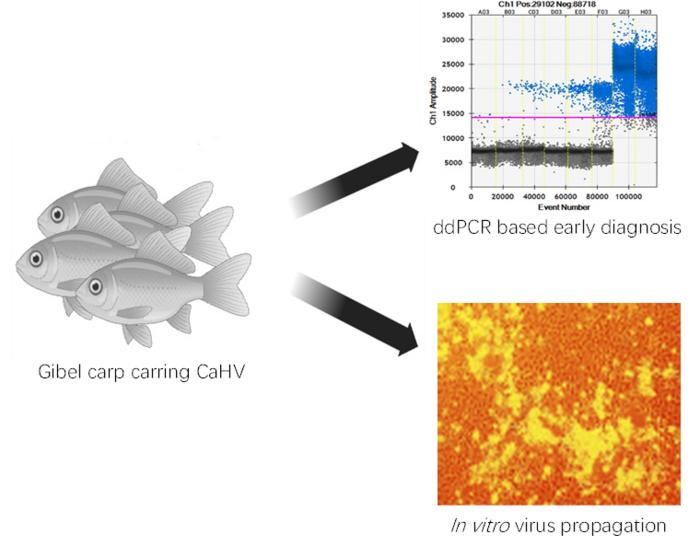
Researchers at the Institute of Hydrobiology, Chinese Academy of Sciences, have established a highly permissive cell line GiCS derived from the skin tissue of gibel carp (Carassius gibelio). This cell line, along with a novel diagnostic method, offers robust tools for the early detection and study of Carassius auratus herpesvirus (CaHV), according to two studies by the authors published in the KeAi journal Water Biology and Security.

Credit: Lang Gui and Fei Ke
Researchers at the Institute of Hydrobiology, Chinese Academy of Sciences, have established a highly permissive cell line GiCS derived from the skin tissue of gibel carp (Carassius gibelio). This cell line, along with a novel diagnostic method, offers robust tools for the early detection and study of Carassius auratus herpesvirus (CaHV), according to two studies by the authors published in the KeAi journal Water Biology and Security.
Gibel carp, a popular aquaculture species in China with an annual production exceeding 2.5 million tons, faces significant threats from infectious diseases, particularly those of viral origins. CaHV is known to cause severe gill hemorrhages and high mortality rates in gibel carp. Despite the virus being isolated and sequenced nearly a decade ago, knowledge on its pathogenesis has been limited due to the absence of a suitable cell line for in vitro virus propagation.
To that end, the researchers analyzed the pathway for viruses’ entry into a fish. “Understanding the importance of the skin as the primary contact point with pathogens in aquatic environments, we focused on developing a cell line from this tissue, explains Ke Fei, lead authors of the two studies.
The GiCS cell line, characterized by a modal chromosome number of 156, exhibits high susceptibility to CaHV and several other aquatic animal viruses. This marks the first time that CaHV can be stably cultured in vitro.
In addition, a detection method utilizing droplet digital PCR was developed. This method allows for the sensitive detection of CaHV in infected fish on the first day post-infection, with a detection limit of less than 1 copy per microliter.
“The newly established in vitro infection model will significantly benefit and expedite our research on the pathogenesis mechanism of CaHV. It also opens up avenues for developing cell-based vaccines against the virus,” adds Ke. “With the droplet digital PCR method, we can now identify infected fish before clinical symptoms appear, enabling early intervention to prevent disease spread and reduce economic losses.”
###
Contact the author: Contact author name: Fei Ke,Institute of Hydrobiology, Chinese Academy of Sciences, Wuhan 430072, China,Email: kefei@ihb.ac.cn
The publisher KeAi was established by Elsevier and China Science Publishing & Media Ltd to unfold quality research globally. In 2013, our focus shifted to open access publishing. We now proudly publish more than 100 world-class, open access, English language journals, spanning all scientific disciplines. Many of these are titles we publish in partnership with prestigious societies and academic institutions, such as the National Natural Science Foundation of China (NSFC).
Journal
Water Biology and Security
Method of Research
Experimental study
Subject of Research
Cells
Article Title
A novel cell line established from skin tissue of gibel carp (Carassius gibelio) is susceptible to Carassius auratus herpesvirus infection;A droplet digital PCR method (ddPCR) for sensitive detection and quantification of Carassius auratus herpesvirus (CaHV)
COI Statement
The authors declare no conflicts of interest
Cite Scienmag News
Alan Morgan. (May 29, 2024). A big step for fish herpesvirus diagnostics and treatment. Scienmag. https://scienmag.com/a-big-step-for-fish-herpesvirus-diagnostics-and-treatment/
Alan Morgan. "A big step for fish herpesvirus diagnostics and treatment." Scienmag, 29 May 2024, https://scienmag.com/a-big-step-for-fish-herpesvirus-diagnostics-and-treatment/. Accessed 5 September 2026.
Alan Morgan. "A big step for fish herpesvirus diagnostics and treatment." Scienmag. May 29, 2024. https://scienmag.com/a-big-step-for-fish-herpesvirus-diagnostics-and-treatment/

