


Unravelling the diversity of planetary aurorae
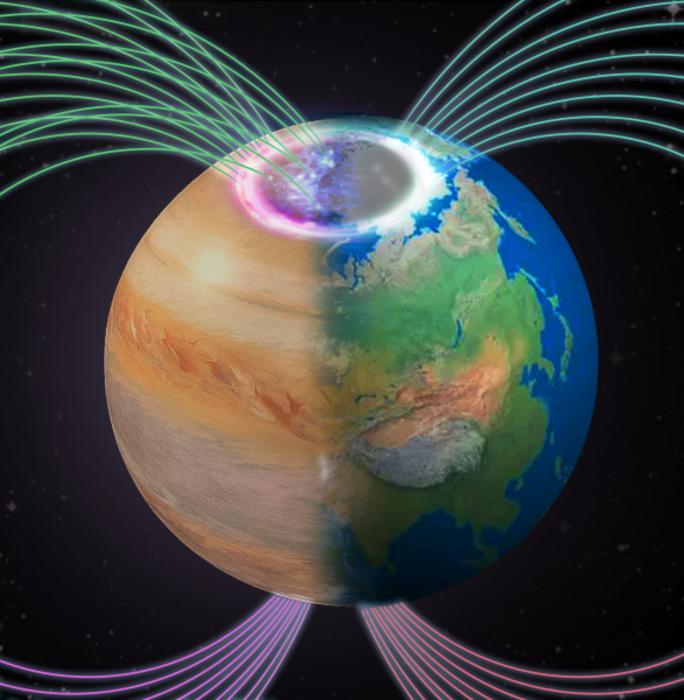
Earth, Saturn and Jupiter all generate their own dipole-like magnetic field, resulting in funnel-canopy-shaped magnetic geometry that leads the space’s energetic electrons to precipitate into polar regions and cause polar auroral emissions. On the other hand, the three planets differ in many aspects, including their magnetic strength, rotating speed, solar wind condition, moon activities, etc. It is unclear how these different conditions are related to the different auroral structures that have been observed on those planets for decades.
Using three-dimensional magnetohydrodynamics calculations, which model the coupled dynamics of electrically conducting fluids and electromagnetic fields, the research team assessed the relative importance of these conditions in controlling the main auroral morphology of a planet. Combining solar wind conditions and planetary rotation, they defined a new parameter that controls the main auroral structure, which for the first time, nicely explains the different auroral structures observed at Earth, Saturn and Jupiter.
Stellar winds’ interaction with planetary magnetic fields is a fundamental process in the universe. The research can be applied to grasp the space environments of Uranus, Neptune, and even exoplanets.
‘Our study has revealed the complex interplay between solar wind and planetary rotation, providing a deeper understanding of aurorae across different planets. These findings will not only enhance our knowledge of the aurorae in our solar system but also be potentially extend to the study of aurorae in exoplanetary systems,’ said Professor Binzheng Zhang, Principal Investigator and the first author of the project.
‘We have learnt that the aurorae at Earth and Jupiter are different since 1979, it is a big surprise that they can be explained by a unified framework,’ added Professor Denis GRODENT, Head of the STAR institute at the University of Liege and co-author of the project.
By advancing our fundamental understanding of how planetary magnetic fields interact with the solar wind to drive auroral displays, this research has important practical applications for monitoring, predicting, and exploring the magnetic environments of the solar system.
This study also represents a significant milestone in understanding auroral patterns across planets that deepened our knowledge of diverse planetary space environments, paving the way for future research into the mesmerising celestial light shows that continue to capture our imagination.
The journal paper ‘A unified framework for global auroral morphologies of different planets’ can be accessed here:
For media enquiries, please contact Ms Casey To, External Relations Officer (tel: 3917 4948; email: caseyto@hku.hk / Ms Cindy Chan, Assistant Director of Communications of HKU Faculty of Science (tel: 39175286; email: cindycst@hku.hk).

Credit: The University of Hong Kong
Unravelling the diversity of planetary aurorae
Earth, Saturn and Jupiter all generate their own dipole-like magnetic field, resulting in funnel-canopy-shaped magnetic geometry that leads the space’s energetic electrons to precipitate into polar regions and cause polar auroral emissions. On the other hand, the three planets differ in many aspects, including their magnetic strength, rotating speed, solar wind condition, moon activities, etc. It is unclear how these different conditions are related to the different auroral structures that have been observed on those planets for decades.
Using three-dimensional magnetohydrodynamics calculations, which model the coupled dynamics of electrically conducting fluids and electromagnetic fields, the research team assessed the relative importance of these conditions in controlling the main auroral morphology of a planet. Combining solar wind conditions and planetary rotation, they defined a new parameter that controls the main auroral structure, which for the first time, nicely explains the different auroral structures observed at Earth, Saturn and Jupiter.
Stellar winds’ interaction with planetary magnetic fields is a fundamental process in the universe. The research can be applied to grasp the space environments of Uranus, Neptune, and even exoplanets.
‘Our study has revealed the complex interplay between solar wind and planetary rotation, providing a deeper understanding of aurorae across different planets. These findings will not only enhance our knowledge of the aurorae in our solar system but also be potentially extend to the study of aurorae in exoplanetary systems,’ said Professor Binzheng Zhang, Principal Investigator and the first author of the project.
‘We have learnt that the aurorae at Earth and Jupiter are different since 1979, it is a big surprise that they can be explained by a unified framework,’ added Professor Denis GRODENT, Head of the STAR institute at the University of Liege and co-author of the project.
By advancing our fundamental understanding of how planetary magnetic fields interact with the solar wind to drive auroral displays, this research has important practical applications for monitoring, predicting, and exploring the magnetic environments of the solar system.
This study also represents a significant milestone in understanding auroral patterns across planets that deepened our knowledge of diverse planetary space environments, paving the way for future research into the mesmerising celestial light shows that continue to capture our imagination.
The journal paper ‘A unified framework for global auroral morphologies of different planets’ can be accessed here:
For media enquiries, please contact Ms Casey To, External Relations Officer (tel: 3917 4948; email: caseyto@hku.hk / Ms Cindy Chan, Assistant Director of Communications of HKU Faculty of Science (tel: 39175286; email: cindycst@hku.hk).
Journal
Nature Astronomy
Method of Research
Experimental study
Subject of Research
Not applicable
Article Publication Date
20-May-2024
Cite Scienmag News
Cameron Wolfe. (May 29, 2024). Cosmic light shows decoded: HKU space scientists unravel the unified framework for diverse aurorae across planets unlocking pathways for better space weather prediction. Scienmag. https://scienmag.com/cosmic-light-shows-decoded-hku-space-scientists-unravel-the-unified-framework-for-diverse-aurorae-across-planets-unlocking-pathways-for-better-space-weather-prediction/
Cameron Wolfe. "Cosmic light shows decoded: HKU space scientists unravel the unified framework for diverse aurorae across planets unlocking pathways for better space weather prediction." Scienmag, 29 May 2024, https://scienmag.com/cosmic-light-shows-decoded-hku-space-scientists-unravel-the-unified-framework-for-diverse-aurorae-across-planets-unlocking-pathways-for-better-space-weather-prediction/. Accessed 3 September 2026.
Cameron Wolfe. "Cosmic light shows decoded: HKU space scientists unravel the unified framework for diverse aurorae across planets unlocking pathways for better space weather prediction." Scienmag. May 29, 2024. https://scienmag.com/cosmic-light-shows-decoded-hku-space-scientists-unravel-the-unified-framework-for-diverse-aurorae-across-planets-unlocking-pathways-for-better-space-weather-prediction/

