


Despite popular concern about generative AI making jobs redundant, a new survey by INSEAD shows employees and business leaders alike are enthusiastic about the transformative technology. In fact, two out of three respondents are already using it in their personal and professional lives.

Credit: INSEAD
Despite popular concern about generative AI making jobs redundant, a new survey by INSEAD shows employees and business leaders alike are enthusiastic about the transformative technology. In fact, two out of three respondents are already using it in their personal and professional lives.
Conducted last summer, the survey of more than 1,200 INSEAD alumni across industries and continents highlights how concerns on the ground about AI’s potential negative impact are not necessarily in line with popular misgivings. For one thing, respondents’ top worry was not that AI would kill jobs but its potential misuse, with associated ethical and safety implications.
Indeed, more respondents said generative AI, or GenAI, will benefit employees more than top leaders, as opposed to those who indicated the opposite. This likely reflects a belief that AI will democratise access to information and improve efficiency for a wide range of jobs.
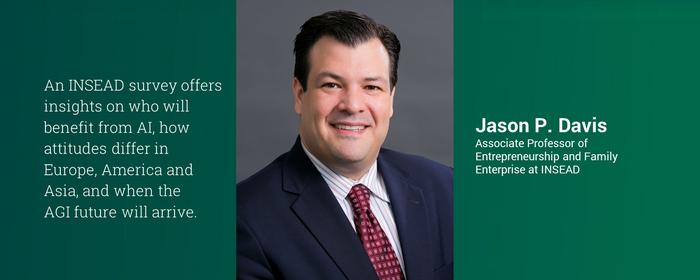
“The survey offers an early view of leaders’ views on AI technology,” says Jason P. Davis, Associate Professor of Entrepreneurship and Family Enterprise at INSEAD. Knowing how people are using GenAI and their attitudes towards the technology, he explains, could help us anticipate its trajectory across industries and continents.
INSEAD alumni – unique across top business schools for their global representation – provided the scope for Davis’s team to delve into perceptions across industries and geographies. Slightly over half of the survey’s respondents said their organisations were already using generative technologies. This points to a significant uptake and integration of GenAI in business operations. Another 27 percent of organisations planned to start using GenAI within the next year or beyond. Only 21 percent of organisations had no plans to engage.
Other interesting findings from the survey include variations in attitudes across industries and geographies. While respondents worldwide were enthusiastic about GenAI, those based in Europe were more inclined to see organisations as benefitting more than individuals.
This group was also less likely to be using generative tools than counterparts in North America and Asia, perhaps reflecting a higher scepticism regarding new technologies and concern about digital privacy in Europe.
Interestingly, respondents in this part of the world tended to see AGI happening faster than those in North America, although this may reflect less interaction with GenAI in personal and professional contexts.
The researchers also found that in sectors like communication services, financials and materials, a significant portion of respondents believed organisations will benefit more than individuals from GenAI. By comparison, a majority in the healthcare and utilities sectors think that individuals and organisations will benefit equally.
To find out more, read What Business Leaders Really Think About Generative AI by Davis on INSEAD Knowledge.
For any queries, please reach out to news@insead.edu.
Cite Scienmag News
Courtney Benton. (April 22, 2024). Most executives already using generative AI tools, INSEAD survey shows. Scienmag. https://scienmag.com/most-executives-already-using-generative-ai-tools-insead-survey-shows/
Courtney Benton. "Most executives already using generative AI tools, INSEAD survey shows." Scienmag, 22 April 2024, https://scienmag.com/most-executives-already-using-generative-ai-tools-insead-survey-shows/. Accessed 3 September 2026.
Courtney Benton. "Most executives already using generative AI tools, INSEAD survey shows." Scienmag. April 22, 2024. https://scienmag.com/most-executives-already-using-generative-ai-tools-insead-survey-shows/

