


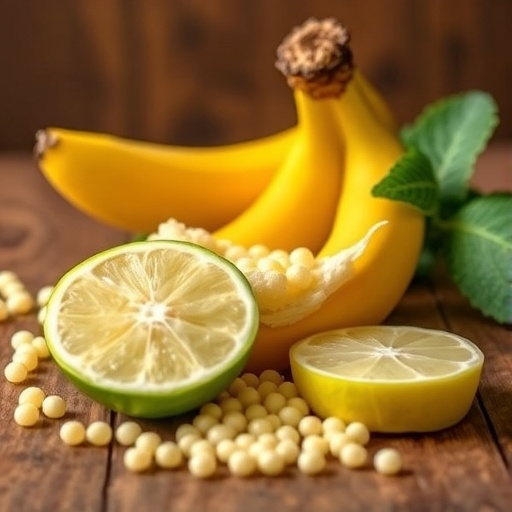
In a groundbreaking advancement that merges natural product chemistry with innovative biomaterial engineering, researchers have unveiled a novel approach leveraging lime peel extract encapsulated within alginate–gelatin microbeads to mitigate browning in Musa spp. tissue cultures. This pioneering technique holds profound implications for agricultural biotechnology, particularly in the optimization of banana and plantain tissue culture propagation, which frequently encounters the challenge of enzymatic browning—a process detrimental to culture viability and commercial scalability.
Browning in plant tissue cultures, especially within Musa spp., manifests as a physiological response triggered primarily by polyphenol oxidase (PPO) activity, leading to the oxidation of phenolic compounds. This biochemical cascade hampers cell viability, compromises morphological stability, and significantly reduces propagation efficiency. Traditional methods to counteract browning, including the use of synthetic antioxidants and frequent subculturing, often incur elevated costs and environmental concerns. The current research addresses this persistent bottleneck through an ingenious natural intervention.
The extraction of bioactive compounds from lime peel—an abundant agricultural byproduct often discarded as waste—represents an eco-friendly and sustainable source of phenolic antioxidants. Lime peel is rich in flavonoids, vitamin C, and limonoids, which collectively exhibit robust antioxidative properties capable of scavenging reactive oxygen species (ROS). However, the direct application of such extracts in tissue cultures suffers from instability, rapid degradation, and inconsistent release kinetics, undermining their protective efficacy against browning.
To tackle these limitations, the study employs a sophisticated encapsulation strategy wherein lime peel extract is immobilized within a biopolymeric matrix composed of alginate and gelatin. Alginate, a polysaccharide derived from brown seaweed, is renowned for its gentle gelation facilitated by divalent cations, biocompatibility, and capacity for controlled release. Gelatin, a denatured collagen derivative, complements alginate by enhancing mechanical strength, biodegradability, and cellular affinity. The synergistic combination of these polymers results in microbeads exhibiting tunable porosity, optimal swelling behavior, and sustained antioxidative agent diffusion.
The microencapsulation process utilizes emulsification coupled with ionotropic gelation, permitting the formation of uniform alginate–gelatin beads with a core laden with lime peel extract. Crucial parameters such as polymer concentration, crosslinker ion density, and drying conditions were meticulously optimized to preserve the bioactivity of the encapsulated extract while ensuring bead integrity in the tissue culture milieu. Characterization techniques including scanning electron microscopy (SEM), Fourier-transform infrared spectroscopy (FTIR), and differential scanning calorimetry (DSC) corroborated the successful biochemical incorporation and physical stability of the microbeads.
Upon integrating these microbeads within Musa spp. tissue culture media, a significant retarding effect on browning was observed. Biochemical assays indicated a marked reduction in PPO activity and oxidative stress markers, correlating with enhanced explant viability. The controlled release mechanism sustained the antioxidative milieu in the culture environment, circumventing the need for repetitive extract supplementation. Morphological assessments revealed improved shoot proliferation rates and healthier tissue morphogenesis compared to control groups lacking encapsulated antioxidants.
This innovative intervention not only advances the understanding of plant tissue culture physiology but also introduces a scalable platform for biostable delivery of natural antioxidants. Encapsulation enhances the shelf-life and bioavailability of lime peel bioactives, aligning perfectly with the principles of green chemistry and sustainable agriculture. Moreover, this methodology can be extrapolated to other recalcitrant crops plagued by browning, potentially revolutionizing large-scale micropropagation protocols.
In addition to immediate biotechnological applications, the research invites further exploration into the mechanistic pathways through which encapsulated phytochemicals modulate enzymatic activities and intracellular redox balances in cultured tissues. Genomic and proteomic studies could unravel how sustained antioxidant presence influences stress-responsive gene expression, cellular metabolism, and epigenetic modifications during in vitro propagation. Such insights would deepen the integration of biomaterial science with plant molecular biology.
Commercial adoption of alginate–gelatin microbeads loaded with lime peel extract could drastically reduce the reliance on synthetic anti-browning agents, thus mitigating potential toxicological risks and reducing input costs. The valorization of citrus peel waste aligns with circular economy models, transforming agro-industrial residues into value-added bioproducts. This holistic approach embodies a shift towards sustainable crop production paradigms in the face of global food security challenges.
Future investigations may focus on scaling the microbead synthesis process to industrial volumes, assessing long-term storage stability, and determining the environmental fate of biodegraded polymers post-application. Additionally, customized release profiles tailored to specific crop species and culture stages could optimize antioxidative efficacy. Potential integration with automated tissue culture systems could further enhance operational efficiency.
This novel encapsulation technology symbolizes a confluence of disciplines—plant biotechnology, polymer science, and natural product chemistry—ushering in a new era of smart biostimulants for plant tissue culture. As global agriculture seeks sustainable intensification, such innovative solutions will be pivotal in ensuring crop health, maximizing yield potentials, and minimizing environmental footprints.
By pioneering the encapsulation of lime peel extract within alginate–gelatin microbeads and demonstrating their capacity to inhibit enzymatic browning in Musa spp. tissue culture, the researchers have set a transformative benchmark. This approach exemplifies how natural resource utilization combined with advanced biomaterials can address longstanding cultivation challenges, paving the way for more resilient and efficient plant propagation technologies.
The study’s implications extend beyond bananas, potentially influencing protocols in other vegetatively propagated crops susceptible to oxidative browning, such as pears, apples, and potatoes. The platform’s adaptability to encapsulate various bioactives opens avenues for customizing functional microbeads for diverse agricultural and horticultural applications, including disease resistance, growth promotion, and stress tolerance.
In conclusion, this research encapsulates a critical step forward in enhancing tissue culture methodologies through natural antioxidants’ microencapsulation. Its contribution is poised to resonate in scientific, industrial, and environmental domains alike, underscoring the synergy between sustainable bioresource management and cutting-edge materials science aimed at securing future food production systems.
Cite Scienmag News
Denise Maddox. (June 11, 2026). Lime Peel Extract Microbeads Inhibit Banana Browning. Scienmag. https://scienmag.com/lime-peel-extract-microbeads-inhibit-banana-browning/
Denise Maddox. "Lime Peel Extract Microbeads Inhibit Banana Browning." Scienmag, 11 June 2026, https://scienmag.com/lime-peel-extract-microbeads-inhibit-banana-browning/. Accessed 3 September 2026.
Denise Maddox. "Lime Peel Extract Microbeads Inhibit Banana Browning." Scienmag. June 11, 2026. https://scienmag.com/lime-peel-extract-microbeads-inhibit-banana-browning/


