

Saturday, October 31, 2026
Science
No Result
View All Result
  • Login
  • HOME
  • SCIENCE NEWS
  • CONTACT US
  • HOME
  • SCIENCE NEWS
  • CONTACT US
No Result
View All Result
Scienmag
No Result
View All Result
Home Science News Technology and Engineering

Machine learning model predicts strength of rice husk ash concrete

October 29, 2026
in Technology and Engineering
Alan Morgan
By Alan Morgan Scienmag Editorial Profile - Precision Agriculture
Reading Time: 2 mins read
0
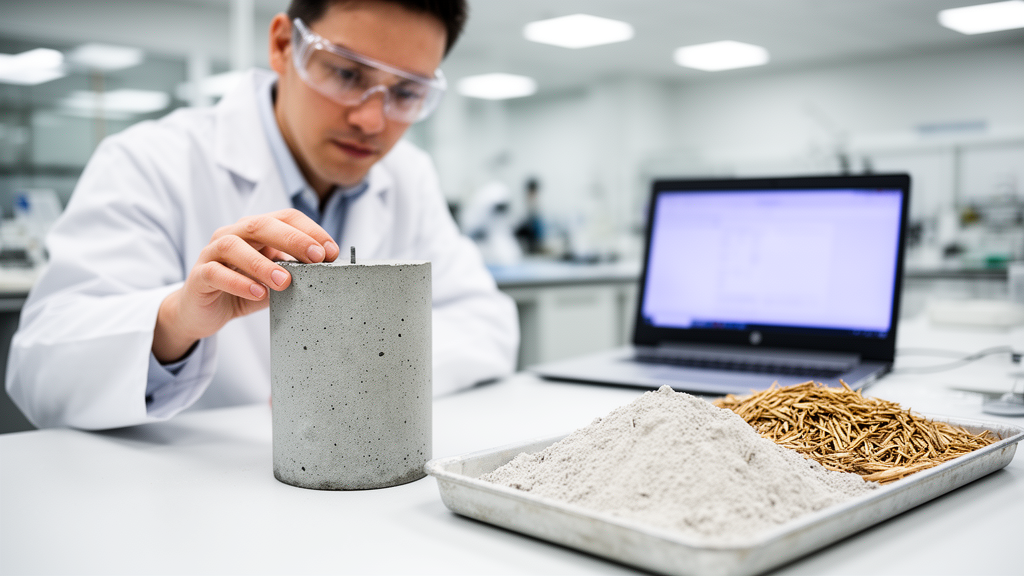
Machine learning model predicts strength of rice husk ash concrete

Machine learning model predicts strength of rice husk ash concrete

65
SHARES
587
VIEWS
Share on FacebookShare on Twitter
ADVERTISEMENT

Engineers have built a machine-learning framework that predicts the compressive strength of concrete made with rice husk ash, a supplementary cementitious material that can partially replace ordinary Portland cement. The study, published in Discover Materials on 28 October 2026, draws on published experimental data to train and compare five regression algorithms, aiming to reduce the time and resources consumed by conventional laboratory trial mixes.

Rice husk ash has long attracted interest as a way to make concrete production more sustainable, but optimizing its compressive strength is difficult because mix-design and curing variables interact in complex ways. The research team, led by Kaushal Kumar with co-authors including Nikolai Ivanovich Vatin and Saurav Dixit, compiled a dataset described by nine input variables: rice husk ash replacement level, water-to-cement ratio, curing time, aggregate size, superplasticizer dosage, cement content, fine aggregate content, coarse aggregate content and water content. Compressive strength served as the target variable.

The framework tested four increasingly challenging validation scenarios using five algorithms: linear regression, decision tree, random forest, support vector machine and k-nearest neighbors. Hyperparameters were tuned with GridSearchCV using five-fold cross-validation. In the final optimized comparison, the support vector machine performed best, achieving an R² of 0.875641, a root-mean-square error of 5.919637 MPa and a mean absolute error of 4.813035 MPa. Random forest showed almost similar performance with an R² of 0.860683 and a lower mean absolute percentage error.

Interpretability analysis played a central role in the study. Using SHAP values, partial dependence plots and individual conditional expectation analysis, the researchers found that curing time and the water-to-cement ratio were influential predictors of strength. The authors are careful to frame these findings as associations rather than causal relationships, because several of the mix-design variables are physically coupled to one another, which complicates any causal reading of the model’s behavior.

Performance dropped significantly in the most difficult validation scenario, in which both the cement content and the aggregate size differed from those seen during model training. This result marks the practical limits of the framework: it is intended as a decision-making tool within the range of parameters studied, not as a universal predictor for any rice husk ash concrete mix. The authors state that independent experimental verification is needed before the model is adopted in engineering practice.

The study also emphasizes that the published version is being shared early as peer-reviewed, accepted research, citable with a permanent DOI, and subject to further edits before the final version of record appears.

Subject of Research: Machine learning prediction of compressive strength in rice husk ash concrete

Article Title: Data-driven prediction of compressive strength in rice husk ash concrete using machine learning for sustainable construction

Article References: Kumar, K., Chaudhary, P., Singh, C., Dhanda, A., Sharma, K., Vatin, N. I., Pandey, H., Salmani, R., & Dixit, S. (2026). Data-driven prediction of compressive strength in rice husk ash concrete using machine learning for sustainable construction. Discover Materials. https://doi.org/10.1007/s43939-026-00996-7

Image Credits: AI Generated

DOI: 10.1007/s43939-026-00996-7

Keywords: rice husk ash, concrete, compressive strength, machine learning, sustainable construction, support vector machine, random forest, SHAP, water-to-cement ratio, cement replacement, Data-driven, prediction

Cite Scienmag News

Alan Morgan. (October 29, 2026). Machine learning model predicts strength of rice husk ash concrete. Scienmag. https://scienmag.com/machine-learning-model-predicts-strength-of-rice-husk-ash-concrete/

Alan Morgan. "Machine learning model predicts strength of rice husk ash concrete." Scienmag, 29 October 2026, https://scienmag.com/machine-learning-model-predicts-strength-of-rice-husk-ash-concrete/. Accessed 31 October 2026.

Alan Morgan. "Machine learning model predicts strength of rice husk ash concrete." Scienmag. October 29, 2026. https://scienmag.com/machine-learning-model-predicts-strength-of-rice-husk-ash-concrete/


Tags: cement replacementcompressive strengthconcreteData-drivendata-driven concrete compressive strength modelinghyperparameter tuning in concrete strength modelsimpact of mix variables on rice husk ash concreteMachine learningmachine learning concrete strength predictionmachine learning validation scenarios for concreteoptimizing concrete mix design with machine learningpredictionpredictive modeling of concrete curing processesRandom Forestregression algorithms for concrete strengthresource-efficient concrete testing with machine learningrice husk ashrice husk ash sustainable concreteSHAPsupport vector machinesupport vector machine for concrete strength predictionsustainable constructionsustainable construction materials with rice husk ashwater-to-cement ratio
Share26Tweet16
Previous Post

Testosterone Therapy Shows Mixed Effects in Parkinson’s Disease, Review Finds

Next Post

Perovskite Materials Promise Green Gains but Carry Lead and Toxicity Risks

Related Posts

Systematic review maps sustainability tensions in offshore wind development
Climate

Systematic review maps sustainability tensions in offshore wind development

October 30, 2026
Amateur maps and sketches helped put Hong Kong’s wartime pillboxes on official charts
Archaeology

Amateur maps and sketches helped put Hong Kong’s wartime pillboxes on official charts

October 30, 2026
Heavier logging trucks only pay off when the road network lets them work
Technology and Engineering

Heavier logging trucks only pay off when the road network lets them work

October 30, 2026
Supersulfated cement outperforms Portland cement in curbing concrete’s alkali-silica reaction
Technology and Engineering

Supersulfated cement outperforms Portland cement in curbing concrete’s alkali-silica reaction

October 30, 2026
Heritage remade: how three Gulf districts turn patrimonialisation into cultural tourism
Technology and Engineering

Heritage remade: how three Gulf districts turn patrimonialisation into cultural tourism

October 30, 2026
Patch Shuffling Trick Makes Adversarial Attacks on Vision Transformers Far More Transferable
Technology and Engineering

Patch Shuffling Trick Makes Adversarial Attacks on Vision Transformers Far More Transferable

October 30, 2026
Next Post
Perovskite Materials Promise Green Gains but Carry Lead and Toxicity Risks

Perovskite Materials Promise Green Gains but Carry Lead and Toxicity Risks

  • Mothers who receive childcare support from maternal grandparents show more optimized

    Mothers who receive childcare support from maternal grandparents show more parental warmth, finds NTU Singapore study

    27656 shares
    Share 11059 Tweet 6912
  • University of Seville Breaks 120-Year-Old Mystery, Revises a Key Einstein Concept

    1061 shares
    Share 424 Tweet 265
  • Bee body mass, pathogens and local climate influence heat tolerance

    682 shares
    Share 273 Tweet 171
  • Researchers record first-ever images and data of a shark experiencing a boat strike

    546 shares
    Share 218 Tweet 137
  • Groundbreaking Clinical Trial Reveals Lubiprostone Enhances Kidney Function

    531 shares
    Share 212 Tweet 133
Science

Embark on a thrilling journey of discovery with Scienmag.com—your ultimate source for cutting-edge breakthroughs. Immerse yourself in a world where curiosity knows no limits and tomorrow’s possibilities become today’s reality!

RECENT NEWS

  • Trademarks Meet Patents in New Method to Spot Technology Opportunities
  • Reddit self-declarations offer auditable labels for demographic inference
  • Scots pine needles map trace element pollution in Polish industrial town
  • Dual-blockchain scheme secures vehicle handovers without pre-shared keys

Categories

  • Agriculture
  • Anthropology
  • Archaeology
  • Athmospheric
  • Biology
  • Biotechnology
  • Blog
  • Bussines
  • Cancer
  • Chemistry
  • Climate
  • Earth Science
  • Editorial Policy
  • Marine
  • Mathematics
  • Medicine
  • Pediatry
  • Policy
  • Psychology & Psychiatry
  • Science Education
  • Science News
  • Social Science
  • Space
  • Technology and Engineering

Subscribe to Blog via Email

Enter your email address to subscribe to this blog and receive notifications of new posts by email.

Join 5,150 other subscribers

© 2025 Scienmag - Science Magazine

Welcome Back!

Login to your account below

Forgotten Password?

Retrieve your password

Please enter your username or email address to reset your password.

Log In
No Result
View All Result
  • HOME
  • SCIENCE NEWS
  • CONTACT US

© 2025 Scienmag - Science Magazine

Discover more from Science

Subscribe now to keep reading and get access to the full archive.

Continue reading





