


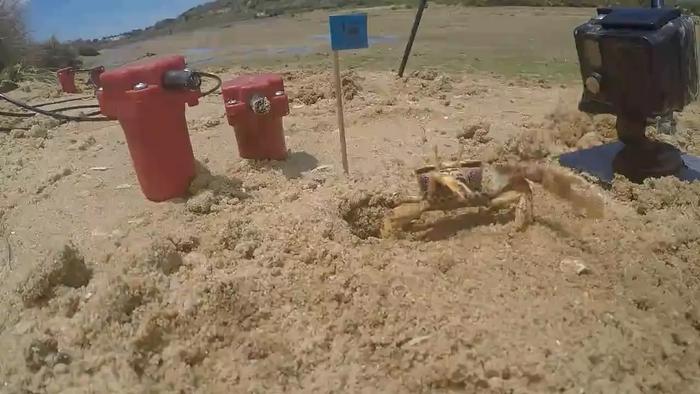
For the first time in scientific history, researchers from the University of Oxford have successfully captured and analyzed the courtship behaviors of fiddler crabs through the innovative use of geophones. This ground-breaking study, recently published in the Journal of Experimental Biology, sheds light on how these intriguing crustaceans communicate amid the cacophony that characterizes their intertidal habitats. The research reveals the complexity and significance of vibrational signals in the courtship rituals of the European fiddler crab (Afruca tangeri), transforming our understanding of animal communication on the noisy seashore.
Fiddler crabs are renowned for their unique courtship displays, which involve both visual and vibrational components. Male crabs primarily rely on producing rhythmic vibrational signals by drumming their large claws against the substrate or tapping their shells on the ground. Historically, it remained an enigma how these signals could effectively convey information about male quality, especially considering the challenging acoustic environment where they operate, filled with natural noises from waves, wind, and other creatures.
To address this conundrum, researchers at the University of Oxford’s Animal Vibration Lab meticulously examined the courtship behavior of the European fiddler crab. Utilizing a sophisticated combination of GoPro cameras and geophones, they recorded the vibrational signals generated by male crabs in a natural setting. This multifaceted approach allowed them to investigate the interplay between the physical characteristics of the males—particularly their claw size—and the vibrational signals produced during courtship.
The crabs exhibited a structured, four-step courtship routine. Initially, they began with subtle waving of their enlarged claws. This was followed by a series of sequential waving motions and body drops designed to create distinct vibrational signals. When a female approached, the male would escalate the display to include simultaneous motions and even underground drumming. Throughout this ritual, the intensity of the seismic energy increased, making it clear that the vibrational signals were not merely accidental noise, but rather integral components of the courtship process.
Key findings from the study indicated that the morphology of the male crabs significantly influenced the characteristics of the seismic signals. Specifically, males with larger claws produced vibrational signals that were not only louder but also exhibited higher energy levels and amplitude spikes during drumming. This fascinating outcome suggests that vibrational communication serves as an honest signal of male quality, allowing females to assess potential mates from a distance without requiring direct visual contact.
Lead author Tom Mulder emphasized the importance of these results, stating that the study demonstrates that males cannot easily misrepresent their size. The females can glean crucial information about a male’s quality through the loudness and features of the vibrational signals they emit. This revelation could redefine our perceptions of sexual selection and mate choice in these crustaceans, highlighting the sophistication of their signaling strategies in a competitive environment.
Moreover, researchers observed that while the frequency of the vibrations remained constant, several other attributes—such as rhythm, length, and loudness—varied depending on the specific courtship behavior being performed. This variability enabled the team to accurately distinguish between different behaviors, such as body drops versus underground drumming, solely based on seismic recordings. In an impressive technical advancement, the researchers trained a machine learning model to classify these behaviors automatically, achieving an accuracy rate of up to 70%. Such capabilities hold great promise for the future, as they suggest potential applications in remote monitoring of various animal behaviors based on ground vibrations.
This study opens up new avenues for understanding vibrational communication across diverse species, particularly those inhabiting noisy environments. For instance, the techniques developed here could be employed to monitor endangered species in the African savannah or even agricultural pests, allowing for innovative approaches to both conservation and agricultural management.
The researchers also noted that percussive communication methods come with advantages in the habitats where fiddler crabs dwell. By varying the loudness and repetition of their signals, males utilize a straightforward yet effective strategy to establish a presence and communicate across a noisy landscape. This adaptability provides insight into evolutionary solutions for communication challenges faced by small animals dwelling in crowded environments.
As the study progresses, corresponding author Dr. Beth Mortimer added that larger claws facilitate overcoming seismic noise, enabling these males to signal their presence to females from greater distances. This has profound evolutionary implications, as female interest is directly correlated with the percussive signals males are able to produce, highlighting the interdependence of physical attributes and communicative effectiveness.
In summary, the research conducted by the University of Oxford has not only elucidated the role of vibrational signals in the courtship behaviors of fiddler crabs but has also set the stage for future inquiries into the complexities of animal communication strategies in complex environments. This study represents a significant leap forward in our understanding of inter-species communication and lays down a framework for interdisciplinary exploration of acoustic and vibrational signaling, with potential repercussions in the fields of biology, ecology, and conservation.
As researchers continue to delve into the world of animal communication, the insights garnered from this study will undoubtedly serve as a foundation for future explorations, opening our eyes to the myriad ways in which creatures navigate their environments and interact with each other.
Cite Scienmag News
Drew Townsend. (April 9, 2025). Fiddler Crab Courtship: Researchers Tune in to Love Songs in the Sand. Scienmag. https://scienmag.com/fiddler-crab-courtship-researchers-tune-in-to-love-songs-in-the-sand/
Drew Townsend. "Fiddler Crab Courtship: Researchers Tune in to Love Songs in the Sand." Scienmag, 9 April 2025, https://scienmag.com/fiddler-crab-courtship-researchers-tune-in-to-love-songs-in-the-sand/. Accessed 3 September 2026.
Drew Townsend. "Fiddler Crab Courtship: Researchers Tune in to Love Songs in the Sand." Scienmag. April 9, 2025. https://scienmag.com/fiddler-crab-courtship-researchers-tune-in-to-love-songs-in-the-sand/


