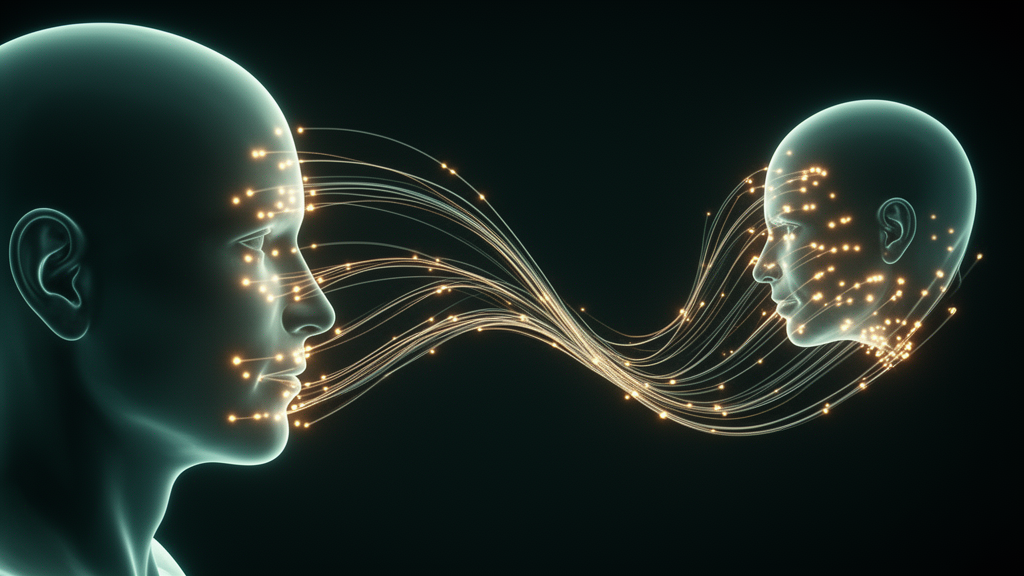
A pilot study published in Discover Artificial Intelligence introduces a lightweight framework that uses a Neural ODE to learn the timing of facial expression transitions between two fixed keyframes, rather than generating new facial content outright. The method, called Latent Narrative Sculpting (LNS), takes a source keyframe and a target keyframe and produces a sixteen-frame transition sequence in which the first and last frames are preserved exactly by construction. The authors, led by Luyao Ma, position the work explicitly as a feasibility study rather than a full facial video synthesis system, and the results reflect that cautious framing.
The central idea is to separate temporal scheduling from visual rendering. A frozen Stable Diffusion variational autoencoder encodes each keyframe into a compact latent representation, a small convolutional projector compresses that representation into a 128-dimensional vector, and a Neural ODE then models a continuous trajectory between the two projected points. From the geometry of that trajectory, the framework derives an arc-length-based nonlinear schedule that determines how quickly the transition progresses across the sixteen output frames. The actual appearance of intermediate frames is then produced by straightforward pixel-space blending between the source and target images, weighted by the learned schedule.
This separation matters because it changes what the deep learning components are actually doing. The Neural ODE does not synthesize new facial geometry, muscle deformation, or identity changes; it learns the pacing of the transition. The training objective combines three losses: an endpoint loss that pulls the trajectory to the target projection, a smoothness loss that penalizes abrupt jumps between consecutive latent states, and a tracking loss that keeps the learned path near the straight line between source and target to prevent the trajectory from wandering into unstable regions of the latent space. The dynamics network is a three-layer multilayer perceptron with 256 hidden units, integrated with the adaptive Dormand–Prince solver.
The arc-length scheduling mechanism is the method’s main technical contribution. Rather than spacing frames uniformly in time, LNS computes the cumulative distance traveled along the latent trajectory and normalizes it, so that regions where the latent representation changes rapidly receive a different share of the timeline than regions of slower change. Because the schedule starts at zero and ends at one, the source and target keyframes are reproduced exactly at the boundaries. This geometry-aware pacing contrasts with the uniform schedules used by simple cross-dissolve or linear interpolation, and the paper’s diagnostics show that the learned schedule is distinctly front-loaded, meaning the transition progresses more quickly in the early frames and then eases toward the target.
The evaluation was deliberately small. The authors used a subset of the RAVDESS facial expression dataset containing 319 videos from three actors, split subject-wise into 217 training pairs and 30 validation pairs, with the held-out actor reserved for validation. Six configurations were compared across three random seeds: Full LNS, a No-Lorenz variant, a Linear Baseline, a Cross-Dissolve baseline, a VAE Decode baseline that interpolates in the original latent space before lossy decoding, and a Flow Warp baseline based on Farnebäck optical flow. Each configuration was evaluated on the 30 validation pairs under all three seeds, yielding 90 evaluations per method.
The headline numbers show high image-level similarity for the full method, with a structural similarity index of 0.9972 plus or minus 0.0019 and a learned perceptual similarity of 0.0028 plus or minus 0.0028. But the paper is notably honest about what those numbers do and do not show. Cross-Dissolve and Linear Baseline remained highly competitive and slightly outperformed Full LNS on some pixel-level metrics, achieving SSIM of 0.9974 and 0.9973 respectively. The authors attribute this to the nature of the task: in endpoint-preserving interpolation, direct blending is naturally well aligned with image-similarity metrics, so the learned scheduler’s advantage lies in timing rather than frame-level reconstruction.
The diagnostic results reinforce this interpretation. Temporal scheduling plots show that LNS and its No-Lorenz variant follow a nonlinear, front-loaded schedule while the uniform baselines progress linearly. Frame-to-frame change analysis on a log scale shows the interpolation-based methods remaining stable across the sequence, whereas the Flow Warp baseline exhibits a large endpoint spike and substantially higher optical flow energy of 0.2159 compared with 0.0537 for Full LNS. Paired statistical tests found significant differences between Full LNS and the uniform baselines on SSIM and LPIPS, and against Flow Warp on SSIM, LPIPS, and flow energy, though the authors caution that statistical significance does not imply practical superiority given the small absolute differences.
One exploratory component did not earn its place. The framework includes an optional Lorenz-inspired perturbation, in which a chaotic Lorenz system trajectory is projected into the latent space and gated by a sinusoidal function that vanishes at both endpoints, so the perturbation affects only the interior of the transition. Under the tested perturbation strength of 0.02, Full LNS and No-Lorenz LNS produced nearly identical results across all metrics, and the difference was not statistically significant. The authors treat the module as exploratory rather than a proven contributor to performance and suggest that future work test stronger or adaptive perturbation strengths.
Computational cost is a genuine selling point. Full LNS generated a sixteen-frame transition in about 0.0196 seconds on a single NVIDIA RTX 3090 GPU, roughly 816 frames per second at 256 by 256 resolution, with negligible overhead relative to the simple interpolation baselines and far less cost than decoding through the VAE. Because the VAE encoder stays frozen and no video-scale training data is required, the entire pipeline is reproducible on one GPU, which distinguishes it from large-scale diffusion video generators such as Make-A-Video or Imagen Video that demand extensive training and do not guarantee exact keyframe preservation.
The limitations are stated plainly and are substantial. The validation set contains only one held-out actor and 30 pairs, so the findings are preliminary evidence of feasibility rather than proof of generalization. Endpoint metrics are verification checks, not evidence of independent target generation. Because rendering uses pixel-space blending, intermediate frames are constrained to mixtures of the two endpoint images and cannot produce novel mid-expression facial geometry. No perceptual user study or animator evaluation was conducted, so the paper cannot claim that the nonlinear schedule improves perceived naturalness, emotional smoothness, or narrative pacing. The authors also note the absence of classical animation timing baselines such as ease-in/ease-out, Bézier, spline, and Catmull–Rom curves, which would be the most direct competitors for a method whose contribution is temporal scheduling. Future work plans to extend evaluation to larger datasets, add video-specific temporal metrics such as Fréchet Video Distance, and conduct human preference studies to determine whether learned latent-trajectory scheduling offers real advantages over established hand-designed animation timing functions.
Subject of Research: Latent trajectory scheduling for endpoint-preserving emotional facial keyframe interpolation in digital animation
Article Title: Latent trajectory scheduling for endpoint-preserving emotional keyframe interpolation in digital animation
Article References: Ma, L. (2026). Latent trajectory scheduling for endpoint-preserving emotional keyframe interpolation in digital animation. Discover Artificial Intelligence, 6(1), Article 1588. https://doi.org/10.1007/s44163-026-02527-y
Image Credits: AI Generated
DOI: 10.1007/s44163-026-02527-y
Keywords: Neural ODE, facial keyframe interpolation, latent space, Stable Diffusion VAE, temporal scheduling, arc-length, RAVDESS, animation, emotion synthesis, Lorenz perturbation, pilot study, digital media art
Cite Scienmag News
Cassandra Pierce. (October 27, 2026). Neural ODE Learns Nonlinear Timing for Facial Keyframe Transitions in Animation. Scienmag. https://scienmag.com/neural-ode-learns-nonlinear-timing-for-facial-keyframe-transitions-in-animation/
Cassandra Pierce. "Neural ODE Learns Nonlinear Timing for Facial Keyframe Transitions in Animation." Scienmag, 27 October 2026, https://scienmag.com/neural-ode-learns-nonlinear-timing-for-facial-keyframe-transitions-in-animation/. Accessed 28 October 2026.
Cassandra Pierce. "Neural ODE Learns Nonlinear Timing for Facial Keyframe Transitions in Animation." Scienmag. October 27, 2026. https://scienmag.com/neural-ode-learns-nonlinear-timing-for-facial-keyframe-transitions-in-animation/