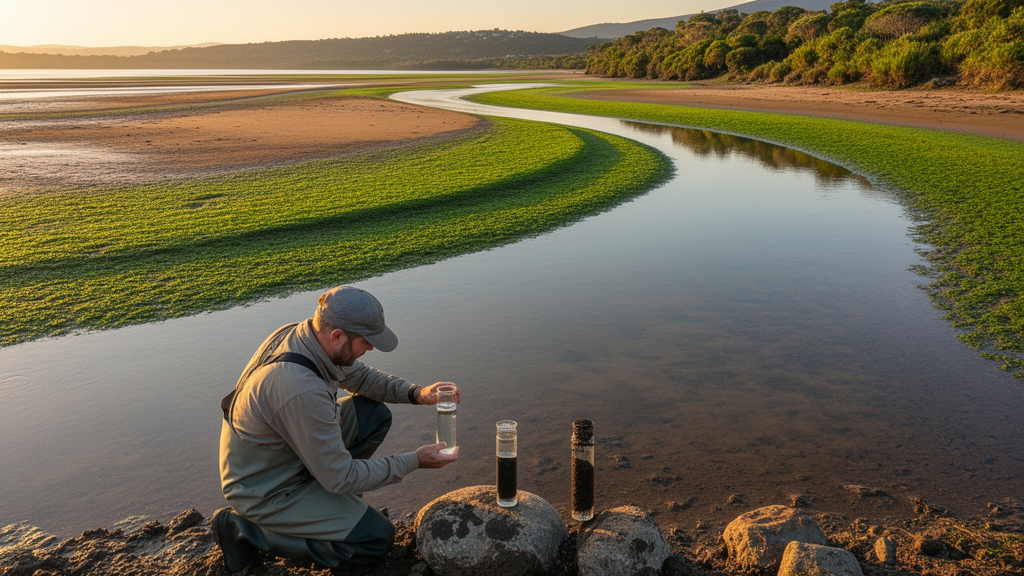
Researchers from North-West University in Potchefstroom, South Africa, have mapped how bacterial communities divide between the water and sediments of the Knysna Estuary, finding that the two habitats host clearly separated microbial populations shaped by salinity, pH, nutrients and trace metals. The study, published as an original research article in Frontiers in Marine Science, combined DNA metabarcoding of the 16S rRNA gene with elemental profiling by inductively coupled plasma mass spectrometry.
The survey identified 18 bacterial phyla across the estuary, with Proteobacteria dominating both sample types. This phylum accounted for 52.33 percent of sequences in water samples and 40.67 percent in sediments. At broader taxonomic levels the two habitats overlapped, but when the researchers examined family and genus ranks, a clear segregation emerged, with distinct bacterial taxa unique to each sampling type.
Diversity measurements reinforced that picture. The team observed significant differences between water and sediment in both Shannon and Simpson alpha diversity as well as in beta diversity. Together, these results indicate a partitioning of bacterial communities between the two habitats, with sediments acting as a richer and more compositionally heterogeneous microbial reservoir than the overlying water column.
To understand what drives this separation, the researchers turned to multivariate statistics. Redundancy analysis and species response curves revealed that gradients in salinity and pH, together with the distribution of nutrients and trace metals, were primarily associated with variation in bacterial communities in both habitats. The genus Synechococcus displayed particularly strong sensitivity to these environmental conditions.
The two communities also differed in how they responded to environmental fluctuation. Bacterial communities in the water exhibited wider ecological tolerances, a pattern the authors link to the constantly changing conditions of an estuary, where oceanic and riverine waters mix. Sediment communities, by contrast, were more specialised and more strongly associated with local geochemistry.
That sediment specialisation showed up in specific chemical associations. Sediment bacterial communities were particularly tied to the concentrations of metals including cobalt, lead and nickel, along with nutrients such as phosphorus and calcium, and various ions. This tighter coupling to local chemistry suggests the seafloor acts as a geochemically structured microbial habitat in its own right.
The Knysna Estuary, like estuaries generally, supports diverse biological communities and a range of socioeconomic activities, and its waters are defined by the mixing of oceanic and riverine inputs. The authors note that increasing anthropogenic pressures have led to widespread habitat degradation and nutrient pollution, with nearly half of South Africa’s estuaries currently affected. Bacterial communities play important roles in the ecological and geochemical processes that such systems depend on.
By pairing genetic sequencing with direct chemical measurement, the study offers a template for understanding how microbial assemblages respond to different biogeochemical conditions in a dynamic estuarine system. The authors describe their work as establishing a baseline for future research in the Knysna Estuary, one that could inform targeted monitoring and intervention practices as pressures on South Africa’s estuaries continue to grow.
Subject of Research: Bacterial community structure and its relationship to geochemical gradients in the water and sediments of the Knysna Estuary, South Africa
Article Title: Bacterial partitioning across water and sediment geochemical gradients in the Knysna estuary, South Africa
Article References: Fourie, M., Bezuidenhout, J. J., Lekota, K. E., & Bergh, E. W. (2026). Bacterial partitioning across water and sediment geochemical gradients in the Knysna estuary, South Africa. Frontiers in Marine Science, 13, Article 1971632. https://doi.org/10.3389/fmars.2026.1971632
Image Credits: AI Generated
DOI: 10.3389/fmars.2026.1971632
Keywords: Knysna Estuary, bacterial communities, 16S rRNA metabarcoding, sediment microbiology, Proteobacteria, trace metals, salinity gradient, estuarine ecology, Synechococcus, South Africa, biogeochemistry, microbial diversity
Cite Scienmag News
Violet Maxwell. (October 28, 2026). Bacteria split into distinct water and sediment communities in South Africa’s Knysna Estuary. Scienmag. https://scienmag.com/bacteria-split-into-distinct-water-and-sediment-communities-in-south-africas-knysna-estuary/
Violet Maxwell. "Bacteria split into distinct water and sediment communities in South Africa’s Knysna Estuary." Scienmag, 28 October 2026, https://scienmag.com/bacteria-split-into-distinct-water-and-sediment-communities-in-south-africas-knysna-estuary/. Accessed 29 October 2026.
Violet Maxwell. "Bacteria split into distinct water and sediment communities in South Africa’s Knysna Estuary." Scienmag. October 28, 2026. https://scienmag.com/bacteria-split-into-distinct-water-and-sediment-communities-in-south-africas-knysna-estuary/