

Tuesday, October 27, 2026
Science
No Result
View All Result
  • Login
  • HOME
  • SCIENCE NEWS
  • CONTACT US
  • HOME
  • SCIENCE NEWS
  • CONTACT US
No Result
View All Result
Scienmag
No Result
View All Result
Home Science News Earth Science

Antibiotics in rice paddies boost microbial production of toxic methylmercury

October 27, 2026
in Earth Science
Morgan Morrow
By Morgan Morrow Scienmag Editorial Profile - Bacteriology
Reading Time: 2 mins read
0
Antibiotics in rice paddies boost microbial production of toxic methylmercury

Antibiotics in rice paddies boost microbial production of toxic methylmercury

65
SHARES
587
VIEWS
Share on FacebookShare on Twitter
ADVERTISEMENT

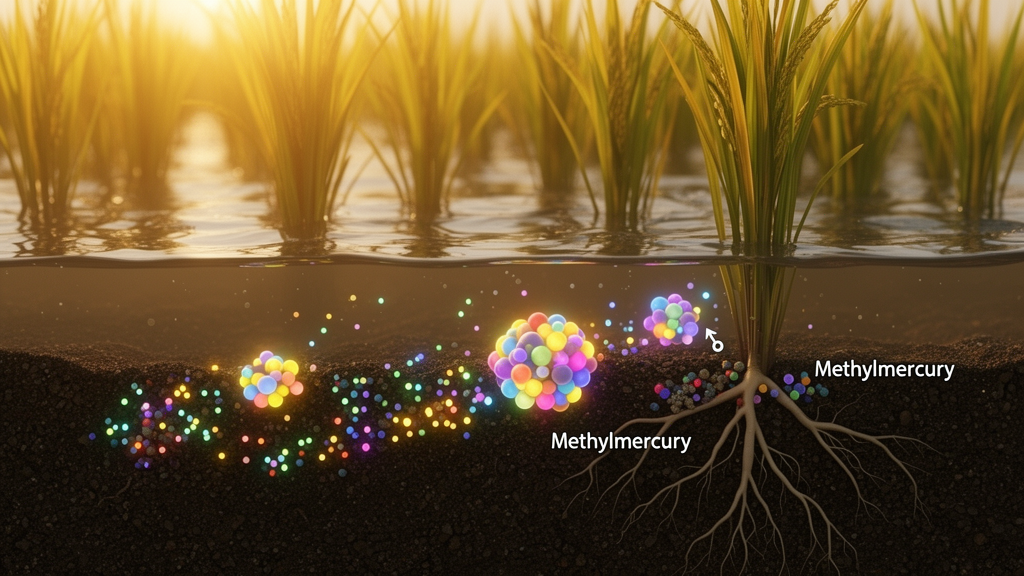
Antibiotic residues in agricultural soils may be quietly amplifying one of the food chain’s most insidious neurotoxins. A study published in Nature Communications reports that fluoroquinolone antibiotics, a widely used class of drugs, enhance the production of methylmercury in paddy soils by selectively reshaping the metabolic activity of microbial communities.

The researchers tested 40 paddy soils collected from China’s major rice-growing regions. When fluoroquinolones were added at a concentration of 10 milligrams per kilogram of soil, methylmercury content rose by 2.9 percent to 19.7 percent after 21 days of incubation. Methylmercury is the neurotoxic organic form of mercury that accumulates in food webs, and rice paddies are recognized environments where mercury methylation can occur.

Through metabolic inhibition experiments and microcosm studies, the team determined that the increase stemmed primarily from stimulated microbial mercury methylation rather than from suppressed breakdown of existing methylmercury. Sulfate-reducing bacteria dominated the process: when sulfate reduction was inhibited, fluoroquinolone-induced mercury methylation decreased by 31 percent to 75 percent.

Integrated microbiome analysis and functional prediction, based on soil microbial communities and metagenomic analyses of enriched sulfate-reducing bacterial consortia, identified bacteria carrying the hgcA gene as the key methylators.

Notably, the antibiotics did not significantly change the abundance or community structure of the methylating microbes. Instead, fluoroquinolone exposure selectively suppressed competing microbial groups while promoting metabolically active, antibiotic-tolerant sulfate-reducing bacteria, particularly those using the reductive acetyl-CoA pathway. This shift in metabolic activity, rather than a shift in who was present, elevated mercury methylation activity.

The findings suggest that widespread antibiotic contamination could amplify mercury risks in soils through tolerant microbial communities, potentially representing what the authors describe as a hidden yet critical link between emerging contaminants, heavy metals, and food safety.

The study is an open-access article published on 27 October 2026, shared early as a peer-reviewed, accepted version subject to further edits. The work was led by Hailong Li and Huan Zhong, with a large team of co-authors from multiple institutions.

Antibiotic residues are now widespread in agricultural soils, yet their influence on microbe-mediated mercury transformations had been poorly understood. By demonstrating that a common pharmaceutical pollutant can tip the metabolic balance of soil microbes toward greater methylmercury synthesis, the study adds a new dimension to concerns about how chemical pollution interacts in combination, with antibiotics and heavy metals jointly shaping risks in the environments that produce the world’s food.

Subject of Research: How antibiotic contamination stimulates microbial methylmercury synthesis in rice paddy soils

Article Title: Antibiotic contamination stimulates microbial methylmercury synthesis in rice paddies

Article References: Li, H., Li, X., Zhang, X., Tang, W., Liu, J., Yu, R.-Q., Rensing, C., Luo, Y., Wang, X., Xia, J., Yang, Y.-N., Hu, Y., Zhao, H.-R., Liu, Y., Wu, M., Li, C., Xiao, L., & Zhong, H. (2026). Antibiotic contamination stimulates microbial methylmercury synthesis in rice paddies. Nature Communications. https://doi.org/10.1038/s41467-026-79083-7

Image Credits: AI Generated

DOI: 10.1038/s41467-026-79083-7

Keywords: methylmercury, fluoroquinolone antibiotics, rice paddies, sulfate-reducing bacteria, mercury methylation, soil microbiome, hgcA gene, food safety, heavy metals, antibiotic contamination, paddy soils, microbial ecology

Cite Scienmag News

Morgan Morrow. (October 27, 2026). Antibiotics in rice paddies boost microbial production of toxic methylmercury. Scienmag. https://scienmag.com/antibiotics-in-rice-paddies-boost-microbial-production-of-toxic-methylmercury/


Morgan Morrow. "Antibiotics in rice paddies boost microbial production of toxic methylmercury." Scienmag, 27 October 2026, https://scienmag.com/antibiotics-in-rice-paddies-boost-microbial-production-of-toxic-methylmercury/. Accessed 27 October 2026.

Morgan Morrow. "Antibiotics in rice paddies boost microbial production of toxic methylmercury." Scienmag. October 27, 2026. https://scienmag.com/antibiotics-in-rice-paddies-boost-microbial-production-of-toxic-methylmercury/

Tags: antibiotic contaminationantibiotic residues and food chain neurotoxinsAntibiotics in rice paddiesenvironmental health risks of antibiotic use in agriculturefluoroquinolone antibioticsfluoroquinolone antibiotics and environmental impactfood safetyheavy metalshgcA geneimpact of antibiotics on microbial metabolic activitymercury bioaccumulation in rice ecosystemsmercury methylationmercury methylation pathways in paddy soilsmethylmercurymethylmercury production in soilsmicrobial community shifts due to antibioticsmicrobial ecologymicrobial mercury methylationpaddy soilsrice paddiessoil microbiomesoil microbiome and metagenomic analysissulfate-reducing bacteriasulfate-reducing bacteria in mercury methylation
Share26Tweet16
Previous Post

AI Literacy in Universities Remains Fragmented and Skewed Toward Tool Skills

Next Post

Scandals rewrite how we remember the artist, but not how we remember the art

Related Posts

Why markets alone fail to recycle critical raw materials—and what policy can do
Earth Science

Why markets alone fail to recycle critical raw materials—and what policy can do

October 27, 2026
AI has transformed aerosol science, and a new analysis maps exactly how
Athmospheric

AI has transformed aerosol science, and a new analysis maps exactly how

October 27, 2026
Coffee Husk Turns Waste Into Wastewater Treatment in Circular Process
Earth Science

Coffee Husk Turns Waste Into Wastewater Treatment in Circular Process

October 27, 2026
Satellites and Machine Learning Track Sewage Plumes Off Chennai’s Coast
Marine

Satellites and Machine Learning Track Sewage Plumes Off Chennai’s Coast

October 27, 2026
AI and IoT promise a closed-loop future for tracking persistent pollutants
Earth Science

AI and IoT promise a closed-loop future for tracking persistent pollutants

October 27, 2026
Urban Coastal Sediments Reveal Contrasting Fingerprints of Human and Natural Particle Inputs
Earth Science

Urban Coastal Sediments Reveal Contrasting Fingerprints of Human and Natural Particle Inputs

October 27, 2026
Next Post
Scandals rewrite how we remember the artist, but not how we remember the art

Scandals rewrite how we remember the artist, but not how we remember the art

  • Mothers who receive childcare support from maternal grandparents show more optimized

    Mothers who receive childcare support from maternal grandparents show more parental warmth, finds NTU Singapore study

    27656 shares
    Share 11059 Tweet 6912
  • University of Seville Breaks 120-Year-Old Mystery, Revises a Key Einstein Concept

    1061 shares
    Share 424 Tweet 265
  • Bee body mass, pathogens and local climate influence heat tolerance

    682 shares
    Share 273 Tweet 171
  • Researchers record first-ever images and data of a shark experiencing a boat strike

    546 shares
    Share 218 Tweet 137
  • Groundbreaking Clinical Trial Reveals Lubiprostone Enhances Kidney Function

    531 shares
    Share 212 Tweet 133
Science

Embark on a thrilling journey of discovery with Scienmag.com—your ultimate source for cutting-edge breakthroughs. Immerse yourself in a world where curiosity knows no limits and tomorrow’s possibilities become today’s reality!

RECENT NEWS

  • Rebuilding Aghdam: how a destroyed city is testing sustainable urban recovery
  • Scientists can predict low birthweights in West Africa up to a year ahead using climate data
  • Explainable AI models track EV battery health over 6G networks
  • Nurses Emerge as Key Players in Taming Targeted Cancer Therapy Side Effects

Categories

  • Agriculture
  • Anthropology
  • Archaeology
  • Athmospheric
  • Biology
  • Biotechnology
  • Blog
  • Bussines
  • Cancer
  • Chemistry
  • Climate
  • Earth Science
  • Editorial Policy
  • Marine
  • Mathematics
  • Medicine
  • Pediatry
  • Policy
  • Psychology & Psychiatry
  • Science Education
  • Science News
  • Social Science
  • Space
  • Technology and Engineering

Subscribe to Blog via Email

Enter your email address to subscribe to this blog and receive notifications of new posts by email.

Join 5,151 other subscribers

© 2025 Scienmag - Science Magazine

Welcome Back!

Login to your account below

Forgotten Password?

Retrieve your password

Please enter your username or email address to reset your password.

Log In
No Result
View All Result
  • HOME
  • SCIENCE NEWS
  • CONTACT US

© 2025 Scienmag - Science Magazine

Discover more from Science

Subscribe now to keep reading and get access to the full archive.

Continue reading