


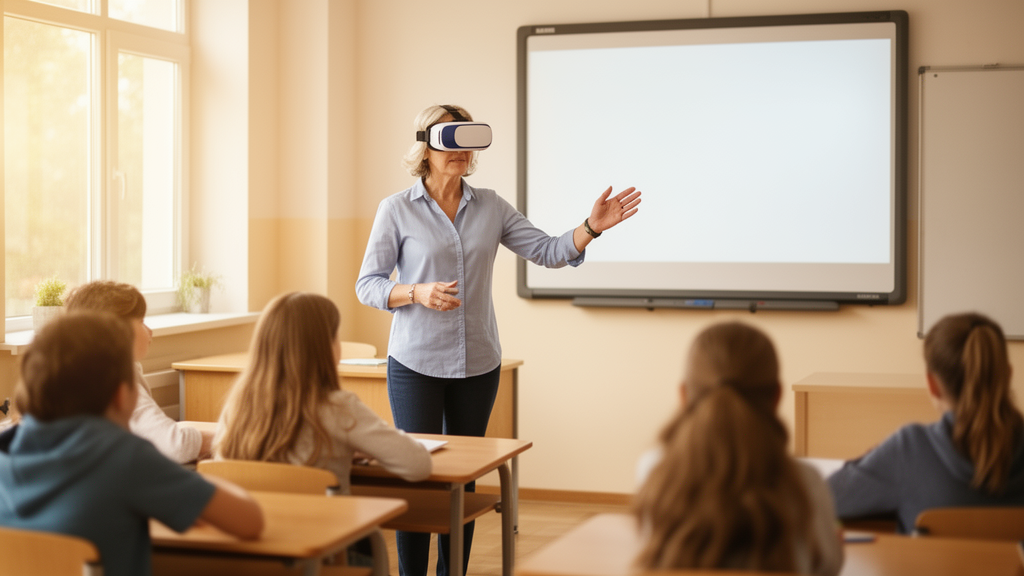
A systematic review published in Discover Education has found that when it comes to bringing augmented and virtual reality games into science, technology, engineering and mathematics classrooms, the decisive factor is not the technology itself but the teacher. The review, conducted in accordance with the PRISMA 2020 reporting guidelines, searched the Scopus, Web of Science and ERIC databases and screened 380 initial records down to just 12 eligible empirical studies published between 2015 and early 2025. That small yield is itself a central result: despite a large body of literature on immersive learning and student outcomes, remarkably few studies have examined how teachers actually adopt, adapt and sustain these games in practice.
The technology landscape within the included studies was strikingly lopsided. Eleven of the twelve studies, or 91.7 percent, involved augmented reality, while only one study used virtual reality and no mixed reality study met the inclusion criteria. The single virtual reality implementation took place in higher education, whereas every primary and secondary education study relied on augmented reality. Mobile devices such as smartphones and tablets served as the primary platform in ten of the twelve studies. Location-based augmented reality, which depends on GPS signals and outdoor access, was the most common subtype, appearing in six studies, followed by marker-based augmented reality requiring printable images and a camera in four studies.
The researchers also graded the practical burden each technology placed on teachers and found a gradient that tracked educational level. Five studies, 41.7 percent, described low-burden implementations built on printable markers and simple app installation, and these were concentrated in primary education. Six studies, half of the total, involved medium-burden location-based games requiring GPS calibration, outdoor space planning and management of device batteries and network connectivity, typical of secondary education contexts. The single high-burden case was a desktop virtual reality system in higher education that demanded dedicated physical space, headsets, a computer and advanced technical knowledge. This distribution suggests that current teacher-focused research concentrates on the technologies most readily accessible within ordinary school constraints.
Across the twelve studies, teachers took on four interconnected pedagogical roles: learner, facilitator, co-designer and reflective practitioner. As learners, teachers played the games themselves before classroom use, both to build familiarity and to experience the pedagogical affordances and constraints from a student’s perspective. In one study, teachers exploring an augmented reality game as if they were students predicted that their own pupils would give up within five minutes. The facilitator role was the most commonly observed, encompassing logistics management, group formation, technical assistance and scaffolding in three areas: helping students navigate the interface, interpreting game storylines and complex concepts, and prompting reflection that connected gameplay to learning objectives.
The co-designer role emerged as critical for sustainable integration, and it took three distinct forms. Teachers created and adapted content using authoring tools and back-office systems, designing new questions and challenges and adjusting difficulty parameters. They engaged in pedagogical planning and interdisciplinary bridging, frequently collaborating with colleagues from other subject areas to build cross-curricular resources. In the most advanced form, collaboration extended to co-developing the technology itself: pre-service teachers in one study partnered with an arts school to develop a virtual reality game called Dead Herring. Teachers overwhelmingly valued systems that let them tailor pre-existing frameworks to their curricula, even while doubting their own ability to build games from scratch, and in one study every teacher acknowledged the importance of a back-office tool for introducing curriculum content and assessing students.
Teachers perceived strong opportunities in immersive games. The most frequently cited benefit was student motivation and engagement, reported across seven of the included studies. Teachers also valued the capacity of these games to make abstract or invisible STEM concepts, such as planetary scales, microscopic parasites and chemical structures, tangible and visible. They pointed to the fostering of twenty-first-century skills including collaborative problem solving, inquiry-based learning and computational thinking, and they praised location-based augmented reality in particular for promoting situated learning in authentic real-world settings such as parks and school grounds, bridging formal and informal learning environments. Beyond student-focused gains, teachers described professional development benefits, including renewed content knowledge, new competencies in analyzing their own practice, and growth in technological pedagogical content knowledge.
Yet adoption was hindered by a multilayered ecosystem of barriers. A fundamental obstacle was teacher readiness: low familiarity with augmented and virtual reality, uncertainty about how to leverage the technology pedagogically, low self-efficacy and resistance to change. The evidence base showed generally low baseline familiarity, with most teachers unaware of augmented reality’s educational potential, and in one study sixteen of eighteen teachers had never used the technology while only two of eighteen had used digital games with students. Resource constraints compounded the problem, including chronic device shortages, unreliable internet or GPS signals, rapid battery drain and, most pervasively, a profound lack of time for training, adaptation and implementation.
Institutional culture imposed further friction. Widespread school bans on student mobile device use stood in direct conflict with mobile augmented reality, the most accessible form of the technology. A persistent bias equating games with distraction and leisure made them difficult to accept in exam-focused secondary environments, and teachers reported curricular misalignment, feeling tension between open-ended inquiry-based games and inflexible curricula and standardized assessment formats. Design-implementation gaps added another layer, with unintuitive interfaces, overly complex mechanisms and fictional narratives that confused students and demanded significant teacher intervention.
In response, teachers developed adaptive strategies. They engaged in curricular bridging, linking game activities to mandated curriculum topics. When technology access was limited, some created low-tech, paper-based adaptations of digital games using posters and cards. To address design gaps, they provided enhanced scaffolding through pre-game briefings, in-game prompts and structured post-play reflection sessions. To offset constraints on time and institutional support, they turned to collaborative planning with colleagues and participated in structured reflective discussions after gameplay. On the support side, the review found that effective help combined teacher-friendly authoring tools and activity repositories, live technical assistance, conceptual frameworks for structuring game-based lessons, and long-term, blended professional development, such as a six-month program or a fifty-hour course, that included experiential learning, collaborative co-design and guided reflection, alongside institutional structures like dedicated planning time and professional learning communities that foster risk-taking.
The authors caution that the evidence base carries significant limitations. More than half of the included studies, 58.3 percent, originated from Portugal, and half of all studies came from just two research teams, a concentration that may reflect publication or database biases and limits generalizability to other national and institutional settings. All studies used qualitative or mixed-methods designs, and the review covered only English-language publications in three databases. The authors call for future research on virtual and mixed reality integration, longitudinal studies of teacher development beyond short-term interventions, investigation of reflective practice conditions, and work establishing causal links between specific teacher roles, scaffolding strategies and measurable student outcomes in STEM.
Subject of Research: Teacher adoption of augmented, virtual and mixed reality game-based learning in STEM education
Article Title: A systematic review of teacher adoption of augmented and virtual reality game based learning in STEM education
Article References: Nikolaou, M.-S., Schiza, K., Palha, S., El Bedewy, S., Soldano, C., & Bouwer, A. (2026). A systematic review of teacher adoption of augmented and virtual reality game based learning in STEM education. Discover Education, 5(1), Article 1232. https://doi.org/10.1007/s44217-026-02313-z
Image Credits: AI Generated
DOI: 10.1007/s44217-026-02313-z
Keywords: augmented reality, virtual reality, mixed reality, game-based learning, STEM education, teacher professional development, systematic review, PRISMA, co-design, educational technology, teacher roles, implementation barriers
Cite Scienmag News
Courtney Benton. (October 27, 2026). Teachers, Not Students, Are the Bottleneck in Bringing Immersive Games to STEM Classrooms. Scienmag. https://scienmag.com/teachers-not-students-are-the-bottleneck-in-bringing-immersive-games-to-stem-classrooms/
Courtney Benton. "Teachers, Not Students, Are the Bottleneck in Bringing Immersive Games to STEM Classrooms." Scienmag, 27 October 2026, https://scienmag.com/teachers-not-students-are-the-bottleneck-in-bringing-immersive-games-to-stem-classrooms/. Accessed 27 October 2026.
Courtney Benton. "Teachers, Not Students, Are the Bottleneck in Bringing Immersive Games to STEM Classrooms." Scienmag. October 27, 2026. https://scienmag.com/teachers-not-students-are-the-bottleneck-in-bringing-immersive-games-to-stem-classrooms/


