


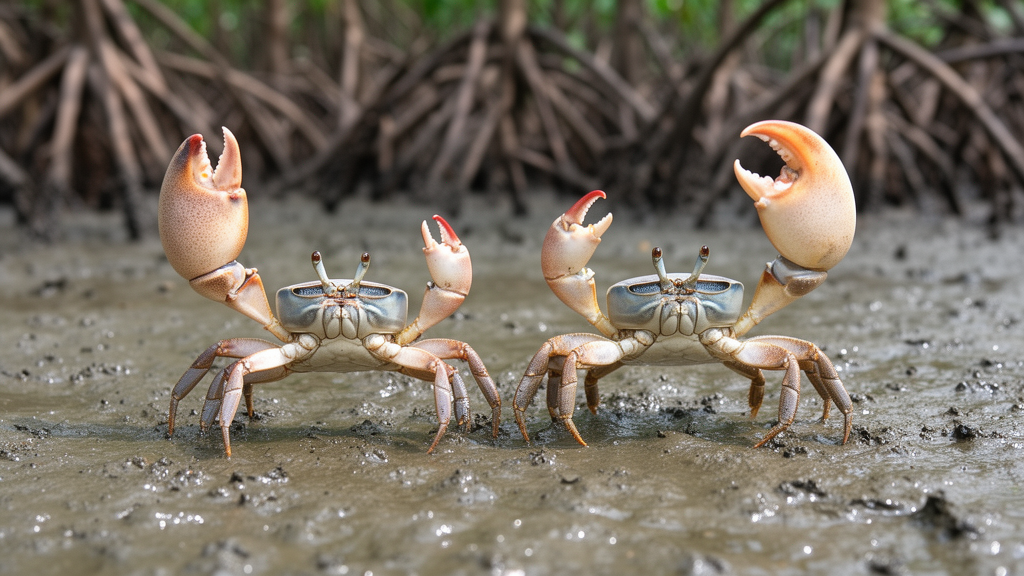
Two fiddler crab species that live side by side on the mudflats of Ca Mau Province in southern Vietnam look so similar that field surveys have repeatedly confused them, yet a new morphological study shows that their most telling differences lie hidden in the fine proportions of their claws and in which side of the body carries the enlarged major claw. The research, published in the journal Discover Animals, compared 206 adult male crabs belonging to Austruca annulipes and Austruca perplexa and found that after correcting for body size, only two of six representative morphometric traits separated the species, while behavioral and functional measures, including claw handedness and a newly applied brachychely index, revealed much clearer divergence.
The genus Austruca belongs to the family Ocypodidae, and its members are ecologically essential inhabitants of tropical intertidal habitats such as mangrove forests, estuaries, salt marshes, and tidal flats. Through feeding and burrowing, these crabs aerate sediment, decompose organic matter, and cycle nutrients, maintaining the physical, chemical, and biological integrity of coastal environments. They are often described as ecosystem engineers within mangrove systems because they facilitate microbial communities and the breakdown of plant litter. They also serve as a nutritional resource for higher trophic levels, and their site fidelity, sensitivity to environmental change, and quantifiable behaviors make them effective bioindicators of habitat quality and anthropogenic disturbance.
In Vietnam, three Austruca species have been recorded: A. annulipes, A. lactea, and A. perplexa. Of these, A. annulipes and A. perplexa are commonly found along southern coastal mudflats, where overlapping morphological features have led to frequent misidentification in field surveys and taxonomic records. Accurate species identification matters not only for taxonomic clarity but also for ecological and conservation research, since conclusions about population biology or habitat quality can be distorted if two species are counted as one. The new study set out to describe and compare external morphological traits, handedness patterns, and relative claw exaggeration in the two species collected from Ca Mau, providing a quantitative baseline for future work on population biology, behavioral ecology, and functional morphology.
Between March and May 2024, the researchers collected specimens at monthly intervals from three intertidal mudflat sites in Ca Mau Province: Hoa Binh, Ganh Hao, and Dam Doi. Sampling took place during low tide using hand collection, and species identification followed established diagnostic features. In total, 206 adult male specimens were gathered, comprising 104 A. annulipes and 102 A. perplexa, with roughly ten specimens per species collected at each location to represent a broad size range. All specimens were preserved in 70 percent ethanol and transported to the laboratory for analysis. In the field, the two species could be told apart most reliably by color: A. annulipes displays a vivid orange-to-red carapace and a bright red major claw, whereas A. perplexa shows a predominantly white carapace with a pale yellowish major claw. These color patterns were consistent across all three sampling sites, although overall body sizes overlapped extensively, with carapace width ranging from 9.3 to 14.8 millimeters across all specimens, meaning size alone is insufficient for reliable identification.
In the laboratory, the team measured 19 morphological parameters using a digital micrometer caliper accurate to 0.01 millimeter, covering carapace dimensions, major and minor claw measurements, and walking leg lengths. The position of the major claw, which may sit on either the left or right side of the body, was recorded in the field before preservation. For measurement consistency, the major claw was assigned to the left side for labeling purposes regardless of actual handedness. All measurements were then log-transformed, and Pearson’s correlation analysis was used to remove highly collinear variables, with any pair of traits correlated above 0.85 reduced to a single representative measure. For example, propodus length was highly correlated with pollex length and manus length and was dropped, and among body-size measures, one carapace width measure was retained as the sole size covariate because it showed lower measurement error. This screening left six representative variables for inferential analysis: manus width, manus height, manus length, pollex length, dactylus length, and dactylus width.
The statistical approach centered on analysis of covariance, with log-transformed carapace width as a continuous covariate to control for body size and species as the fixed factor. Body size had a strong effect on all six traits, with p values below 0.0001, indicating positive allometry or isometry relative to carapace width. After size correction, however, species-level differences emerged in only two traits. Manus width was significantly larger in A. perplexa, with a species coefficient of plus 0.0903 and a p value below 0.0001, indicating a relatively broader manus in the major claw. Pollex length was slightly but significantly larger in A. annulipes, with a coefficient of minus 0.0293 and a p value of 0.0385. The remaining four traits showed no significant interspecific differences, suggesting these dimensions may be functionally conserved despite the taxonomic divergence between the species.
To visualize these relationships, the researchers generated log-log scatterplots for each trait against carapace width, with species-specific parallel-slopes regression lines. The manus width plot showed a clear vertical offset for A. perplexa relative to A. annulipes, consistent with the significant positive species effect, while the pollex length plot showed a smaller offset in the opposite direction. In the other four traits, the regression lines for the two species were closely aligned, matching the insignificant species effects. Slopes were parallel in all models, confirming that the parallel-slopes ANCOVA specification was appropriate. The authors note that without adjusting for body size, raw differences could be confounded by size variation unrelated to functional or taxonomic factors.
A principal component analysis of size-corrected residuals added a multivariate perspective. The first two principal components explained 47.4 percent and 17.2 percent of the variance, respectively. The first dimension was driven primarily by manus width and pollex length, the two traits that had differed significantly after size correction, while the second dimension was influenced mainly by manus height and manus length. The biplot, overlaid with 95 percent confidence ellipses for each species, revealed substantial overlap in morphospace between the two species, with the ellipses intersecting broadly. This pattern reinforces the ANCOVA finding that only a subset of traits differs significantly after size correction and that overall shape variation is largely shared between the species.
The clearest behavioral divergence appeared in claw handedness. Among 102 A. annulipes individuals, 38.2 percent had the major claw on the left side and 61.8 percent on the right, a right-to-left ratio of 1.62 to 1.00, a difference that was statistically significant with a chi-squared value of 5.65 and a p value of 0.02. In contrast, A. perplexa showed a near-equal distribution, with 51.9 percent right-clawed and 48.1 percent left-clawed, a ratio of 1.00 to 1.08 that did not differ statistically from symmetry. The authors suggest that the symmetry in A. perplexa may reflect random regeneration following claw loss through molting or autotomy, indicating an absence of directional selection, whereas the right-biased asymmetry in A. annulipes could indicate selective pressures favoring right-clawed individuals, potentially linked to reproductive or competitive advantages. The study’s authors acknowledge limitations, including limited sample size and geographic scope, and the fact that potential influences such as age, molt history, and microhabitat variation were not assessed.
The brachychely index, a metric applied here for the first time in this comparison, quantifies the relative shortness and robustness of the major claw by measuring how far an individual deviates from allometric expectations. Lower index values indicate stronger expression of brachychely, the exaggerated claw form typically associated with visual signaling, mate competition, or territorial defense. The mean index was higher in A. annulipes at 0.27 plus or minus 0.02 standard error compared with 0.20 plus or minus 0.02 in A. perplexa, and a t test showed the difference was statistically significant, with t equal to 2.2, 204 degrees of freedom, and a p value of 0.03. Because a higher value reflects a stronger deviation from expected allometric proportions, the result indicates that A. annulipes possesses significantly greater claw exaggeration than its congener. Taken together, the findings show that species differences in these sympatric crabs are concentrated in specific functional traits related to display and competition rather than in generalized body shape, and that claw development and handedness patterns may be subject to species-specific selective pressures rather than being conserved across the genus. The authors propose that future studies integrating behavioral observations and reproductive success measures could clarify whether the greater claw investment in A. annulipes confers a mating advantage under local ecological conditions.
Subject of Research: Comparative claw morphology, handedness, and brachychely in two sympatric fiddler crab species in Ca Mau, Vietnam
Article Title: Comparative analysis of claw morphology, handedness, and brachychely in Austruca annulipes and Austruca perplexa (Decapoda: Ocypodidae) in Ca Mau, Vietnam
Article References: Ly, V. V., Khongthep, A., Ainthaphan, K., Attachaiya, P., Jansuksri, P., Pluemjai, M., Chonsongkram, T., & Dinh, Q. M. (2026). Comparative analysis of claw morphology, handedness, and brachychely in Austruca annulipes and Austruca perplexa (Decapoda: Ocypodidae) in Ca Mau, Vietnam. Discover Animals, 3(1), Article 106. https://doi.org/10.1007/s44338-025-00132-4
Image Credits: AI Generated
DOI: 10.1007/s44338-025-00132-4
Keywords: fiddler crabs, Austruca annulipes, Austruca perplexa, claw handedness, brachychely index, morphometrics, ANCOVA, Ca Mau Vietnam, mangrove ecosystems, species identification, sexual selection, intertidal mudflats
Cite Scienmag News
Drew Townsend. (October 27, 2026). Fiddler Crab Claw Secrets: Handedness and Claw Shape Split Two Lookalike Species in Vietnam. Scienmag. https://scienmag.com/fiddler-crab-claw-secrets-handedness-and-claw-shape-split-two-lookalike-species-in-vietnam/
Drew Townsend. "Fiddler Crab Claw Secrets: Handedness and Claw Shape Split Two Lookalike Species in Vietnam." Scienmag, 27 October 2026, https://scienmag.com/fiddler-crab-claw-secrets-handedness-and-claw-shape-split-two-lookalike-species-in-vietnam/. Accessed 27 October 2026.
Drew Townsend. "Fiddler Crab Claw Secrets: Handedness and Claw Shape Split Two Lookalike Species in Vietnam." Scienmag. October 27, 2026. https://scienmag.com/fiddler-crab-claw-secrets-handedness-and-claw-shape-split-two-lookalike-species-in-vietnam/


