


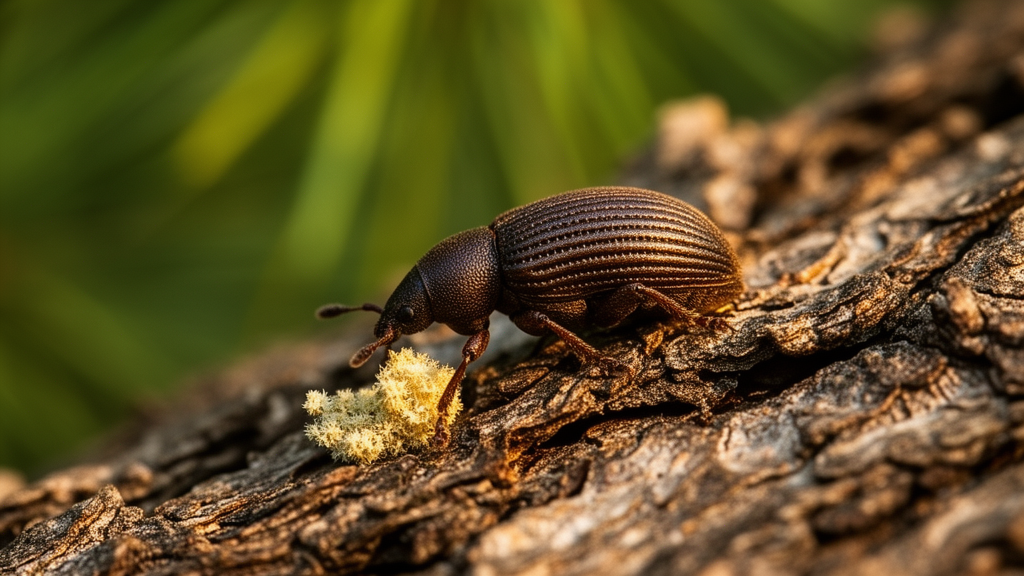
An invasive bark beetle that has recently colonised coastal pine shelterbelts in eastern China carries a richer cargo of symbiotic fungi than scientists had anticipated. A survey of the red-haired pine bark beetle, Hylurgus ligniperda, in Shandong Province has yielded 435 strains of ophiostomatoid fungi from 326 adult beetles, and detailed morphological and genetic analysis has identified 13 species across six genera — six of which are described as new to science.
Hylurgus ligniperda, commonly called the red-haired pine bark beetle, is presumed to be native to Europe and the Mediterranean Basin. From there it has been introduced to Oceania, North America and South America, and in East Asia it first established in Japan and later Korea. It has now colonised Shandong Province, where researchers report that its invasion has reduced the windbreak and sand-fixation capacity of the coastal shelterbelt and poses a threat to the local forest ecosystem. Unlike some aggressive bark beetles, the species feeds on the phloem of sub-healthy pines and does not directly kill trees, but its presence is considered a significant concern in newly invaded regions.
Bark beetles maintain close symbiotic relationships with ophiostomatoid fungi, a group whose morphology is highly adapted for beetle dispersal, notably through adhesive spore masses that beetles carry to host plants. These fungi are considered integral to successful bark beetle colonisation: they can weaken host tree resistance, and some contribute nutrients that support beetle development in the nutrient-poor phloem of conifers. Some associated species are pathogens or staining fungi that degrade wood quality. Because the presence of these symbionts is thought to actively facilitate bark beetle invasions, characterising the fungal community of a newly established beetle population is a priority for understanding its ecological impact.
The fieldwork took place in coastal shelterbelts in Yantai and Weihai, in the Yanwei region of Shandong Province, between December 2021 and April 2023. The forest stands consisted mainly of roughly 45-year-old plantations of Japanese black pine, Pinus thunbergii, with a minor component of similarly aged Pinus densiflora. The team collected adult beetles from two sources: insect traps and beetle galleries. Each adult was transferred individually into sterile tubes, surface-disinfected with 0.1% sodium hypochlorite, rinsed, fragmented, and placed on 2% malt extract agar to grow out associated fungi. Representative strains of each morphotype were then selected for in-depth study.
Identification combined classical morphology with multilocus DNA phylogenetics. The researchers sequenced up to six gene regions per isolate — the nuclear ribosomal ITS and LSU regions, plus beta-tubulin, transcription elongation factor 1-alpha, calmodulin and RNA polymerase II second largest subunit. Alignments were processed and concatenated, and phylogenetic trees were inferred using both Maximum Likelihood and Bayesian Inference methods with best-fit partition models selected by the Akaike information criterion. The 28 representative isolates resolved into 13 terminal clades spanning six genera within the Ophiostomatales: Ceratocystiopsis, Graphilbum, Hawksworthiomyces, Leptographium (including Grosmannia huntii), Masuyamyces and Ophiostoma.
Six of the 13 species were new. Two Ceratocystiopsis species, C. pseudoweihaiensis and C. pseudoyantaiensis, are close relatives of species previously described from Shandong; the new Graphilbum species, Gr. jiuguanense, is nearest to Gr. niveum; the new Leptographium species, L. ligniperdae, sits within the L. olivaceum species complex alongside L. rhizoidum and L. sagmatosporum; and the two new Masuyamyces species, M. xishanensis and M. dongshanensis, are sister species distinguishable by the presence or absence of ascomatal necks and differences in their pesotum-like asexual structures. The seven known species were Gr. translucens, Hawksworthiomyces taylorii, Grosmannia huntii, Leptographium koreanum, L. radiaticola, Masuyamyces pallidulus and Ophiostoma ips. All six new species are currently known only from Shandong Province, and ex-type cultures have been deposited in Chinese culture collections with holotypes in Beijing.
Isolation frequencies differed markedly depending on where the beetles were caught. Trap-captured adults yielded the greater species diversity, 12 of the 13 species, whereas gallery-derived adults accounted for the higher share of isolates, 53.3% of the total, but only seven species. Ophiostoma ips was the most frequently isolated fungus overall at 36.55%, followed by L. radiaticola at 14.94% and L. koreanum at 11.72%. Chi-square tests showed that G. huntii (χ² = 7.403, p = 0.0065), L. koreanum (χ² = 6.911, p = 0.0086) and L. radiaticola (χ² = 19.388, p < 0.0001) were isolated significantly more often from gallery adults than from trap-captured adults, while no significant differences were found for H. taylorii, M. pallidulus or O. ips. Several species, including Gr. translucens and five of the new species, came exclusively from trap-captured beetles, and L. ligniperdae was obtained only from gallery adults.
The authors interpret these patterns as evidence that the fungal load of a beetle changes with its circumstances. Beetles flying to traps are exposed to a broader range of environmental fungi and may simply be carrying what they pick up en route, whereas the narrower, high-frequency assemblage inside galleries suggests a more specific association. The team suggests that the three Leptographium-group species found predominantly in galleries may be adapted to the gallery environment, and hypothesises that L. radiaticola in particular may help the beetle overcome host tree defences — an interpretation the authors frame as a hypothesis supported by the gallery-trap frequency difference, not a demonstrated mechanism. They also note that previous studies have shown beetle-carried fungi can influence nutrient acquisition and help degrade tree defensive compounds.
Placing the Chinese findings in a global context, the study compiled records of ophiostomatoid fungi associated with H. ligniperda across five continents. In total, 45 species have been documented in association with this beetle. Europe shows the highest recorded diversity with 15 species, followed by North America with 14, South Africa and East Asia with 13 each, Oceania with ten and South America with six. Seven species occur on three or more continents, and Ophiostoma ips is the only species shared across all six regions compared. The authors conclude that regional variation is the primary driver of community differentiation: the beetle appears to assemble distinct fungal communities in each region it invades, mixing long-distance partners with locally acquired native fungi.
Several findings point to the origins and novelty of the Chinese association. The G. huntii and L. radiaticola strains isolated in Shandong clustered in a single clade with high sequence similarity to strains from southeastern Australia that were also isolated from H. ligniperda, leading the authors to hypothesise that the Shandong beetle population shares a source with the Australian one. Leptographium radiaticola had previously been recorded in China from other beetle hosts in Shanxi and Yunnan, but this is its first record in Shandong, and the sequences obtained here were distinct from those of Yunnan strains. Leptographium koreanum, by contrast, appears to be predominantly Asian, and a previous pathogenicity study reported that it can induce significant bark necrosis in Pinus tabuliformis; the authors hypothesise that the newly arrived beetle has established contact with this native fungus. The authors caution that fungal isolation is influenced by factors such as individual beetle variability and environmental contamination, but argue that the extensive sampling provides a reliable picture of the ophiostomatoid community carried by H. ligniperda in Yantai and Weihai. Understanding this newly formed association, they argue, is a prerequisite for managing an invader whose success in new environments appears closely tied to the fungi it carries.
Subject of Research: Fungal symbionts associated with the invasive bark beetle Hylurgus ligniperda in eastern China
Article Title: Ophiostomatoid fungi associated with Hylurgus ligniperda , including six new species from eastern China
Article References: Xie, D., Chen, H., Jia, N., Niu, F., Wang, X., Yu, J., & Chi, D. (2025). Ophiostomatoid fungi associated with Hylurgus ligniperda, including six new species from eastern China. IMA Fungus, 16, Article e169382. https://doi.org/10.3897/imafungus.16.169382
Image Credits: AI Generated
DOI: 10.3897/imafungus.16.169382
Keywords: Hylurgus ligniperda, ophiostomatoid fungi, bark beetle symbiosis, invasive species, new fungal species, Shandong Province, Ophiostoma ips, Leptographium, multilocus phylogenetics, forest pests, Pinus thunbergii, coastal shelterbelt
Cite Scienmag News
Roger Howard. (October 27, 2026). Invasive pine bark beetle carries six previously unknown fungal species in China. Scienmag. https://scienmag.com/invasive-pine-bark-beetle-carries-six-previously-unknown-fungal-species-in-china/
Roger Howard. "Invasive pine bark beetle carries six previously unknown fungal species in China." Scienmag, 27 October 2026, https://scienmag.com/invasive-pine-bark-beetle-carries-six-previously-unknown-fungal-species-in-china/. Accessed 27 October 2026.
Roger Howard. "Invasive pine bark beetle carries six previously unknown fungal species in China." Scienmag. October 27, 2026. https://scienmag.com/invasive-pine-bark-beetle-carries-six-previously-unknown-fungal-species-in-china/


