

Tuesday, October 27, 2026
Science
No Result
View All Result
  • Login
  • HOME
  • SCIENCE NEWS
  • CONTACT US
  • HOME
  • SCIENCE NEWS
  • CONTACT US
No Result
View All Result
Scienmag
No Result
View All Result
Home Science News Agriculture

Korla Fragrant Pear Genes and Metabolites Shift During Black Spot Infection

October 27, 2026
in Agriculture
Juliet Wilcox
By Juliet Wilcox Scienmag Editorial Profile - Human Genetics
Reading Time: 2 mins read
0
Korla Fragrant Pear Genes and Metabolites Shift During Black Spot Infection

Korla Fragrant Pear Genes and Metabolites Shift During Black Spot Infection

65
SHARES
587
VIEWS
Share on FacebookShare on Twitter
ADVERTISEMENT

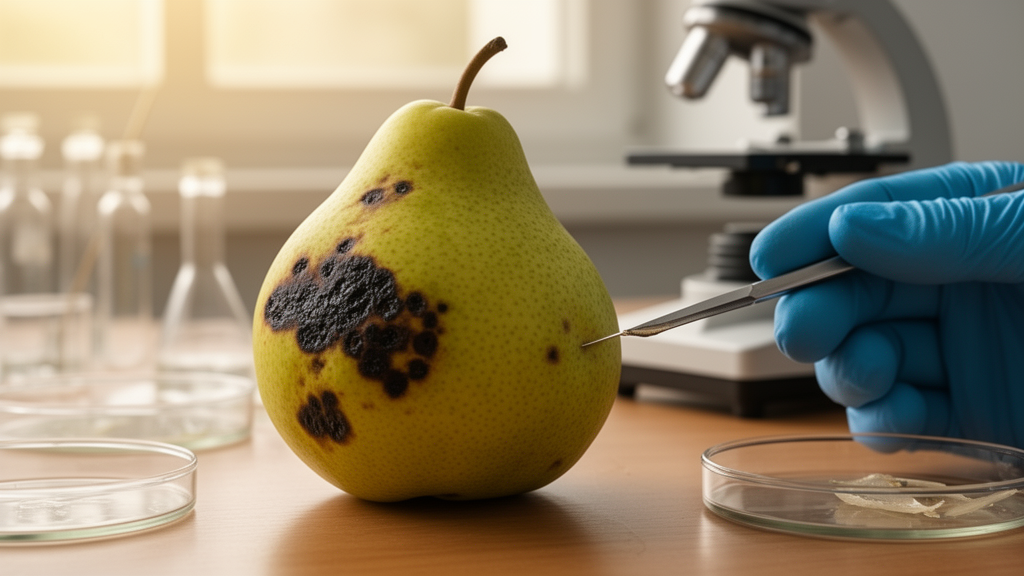
Researchers have mapped how Korla fragrant pear, a fruit tree native to Xinjiang, China, responds at the molecular level to black spot disease, a fungal infection caused by Alternaria alternata that triggers early defoliation and fruit rot and imposes significant economic losses in pear production. In a study published in BMC Plant Biology, the team combined transcriptome and metabolome profiling of pear leaves sampled at multiple time points after inoculation, aiming to fill a gap in understanding how pear species react to this pathogen — knowledge that has so far limited progress in breeding disease-resistant trees.

The dual approach revealed an extensive molecular response. Compared with the pre-inoculation baseline at 0 hours, the analysis identified 17,362 differentially expressed genes, while comparison against time-matched mock-inoculated controls yielded 9,840 such genes. A core set of 9,008 genes common to both comparisons was then clustered into six distinct expression profiles, with pathway enrichment analysis carried out for each cluster separately.

On the metabolic side, the profiling detected 2,596 differentially regulated metabolites relative to the 0-hour baseline and 2,616 relative to the mock controls, with 2,017 metabolites shared between the two comparisons. When the transcriptomic and metabolomic datasets were integrated, three major response-associated pathways stood out: flavonoid biosynthesis, photosynthesis-related processes, and plant hormone signal transduction, suggesting that the pear’s defense involves coordinated changes in gene expression, secondary metabolism, energy production, and hormonal signaling.

To narrow the field of candidates for further study, the researchers applied weighted gene co-expression network analysis, which identified 12 candidate hub genes. These include six transcription factors and three genes belonging to the flavonoid pathway, all flagged for subsequent functional validation. The authors emphasize that the work provides an integrated overview of the transcriptomic and metabolic changes associated with the Korla fragrant pear response to A. alternata infection and prioritizes candidate genes for future validation, rather than demonstrating function of the genes themselves. As an open-access, peer-reviewed study published on 27 October 2026, it offers a resource for breeders seeking resistance traits, though the identified hub genes remain candidates until experimental validation confirms their roles in defense against the pathogen.

Subject of Research: Transcriptomic and metabolomic responses of Korla fragrant pear to black spot disease caused by Alternaria alternata

Article Title: Integrated transcriptomic and metabolomic analysis of Korla fragrant pear responses to black spot disease caused by Alternaria alternata

Article References: Song, B., Xu, B., Zhang, L., He, T., & Zhu, X. (2026). Integrated transcriptomic and metabolomic analysis of Korla fragrant pear responses to black spot disease caused by Alternaria alternata. BMC Plant Biology. https://doi.org/10.1186/s12870-026-10072-0

Image Credits: AI Generated

DOI: 10.1186/s12870-026-10072-0

Keywords: Korla fragrant pear, black spot disease, Alternaria alternata, transcriptomics, metabolomics, differentially expressed genes, flavonoid biosynthesis, plant hormone signaling, WGCNA, hub genes, disease resistance, Xinjiang

Cite Scienmag News

Juliet Wilcox. (October 27, 2026). Korla Fragrant Pear Genes and Metabolites Shift During Black Spot Infection. Scienmag. https://scienmag.com/korla-fragrant-pear-genes-and-metabolites-shift-during-black-spot-infection/


Juliet Wilcox. "Korla Fragrant Pear Genes and Metabolites Shift During Black Spot Infection." Scienmag, 27 October 2026, https://scienmag.com/korla-fragrant-pear-genes-and-metabolites-shift-during-black-spot-infection/. Accessed 27 October 2026.

Juliet Wilcox. "Korla Fragrant Pear Genes and Metabolites Shift During Black Spot Infection." Scienmag. October 27, 2026. https://scienmag.com/korla-fragrant-pear-genes-and-metabolites-shift-during-black-spot-infection/

Tags: Alternaria alternatablack spot diseaseblack spot infection gene expressiondifferential gene expression in infected pear leavesdifferentially expressed genesdisease resistanceflavonoid biosynthesisfungal infection impact on pear geneticshub genesintegrated transcriptomic and metabolomic studies in fruit treesKorla fragrant pearKorla fragrant pear disease resistancemetabolome profiling in pear diseaseMetabolomicsmolecular mechanisms of pear black spot diseasepear breeding for disease resistancepear metabolite changes during fungal attackplant hormone signalingplant-pathogen interaction in peartranscriptome analysis of pear disease responseTranscriptomicsWGCNAXinjiangXinjiang pear disease response pathways
Share26Tweet16
Previous Post

GWAS Pinpoints Candidate Genes Behind Wheat Stripe Rust Resistance

Next Post

Brachypodium genome reveals conserved gene networks governing seed dormancy in temperate cereals

Related Posts

Brachypodium genome reveals conserved gene networks governing seed dormancy in temperate cereals
Agriculture

Brachypodium genome reveals conserved gene networks governing seed dormancy in temperate cereals

October 27, 2026
GWAS Pinpoints Candidate Genes Behind Wheat Stripe Rust Resistance
Agriculture

GWAS Pinpoints Candidate Genes Behind Wheat Stripe Rust Resistance

October 27, 2026
Satellites Reveal Hidden Drought Patterns in India’s Hadoti Region
Agriculture

Satellites Reveal Hidden Drought Patterns in India’s Hadoti Region

October 27, 2026
Maize transcription factor ZmHY5L shapes waxy gene starch quality and grain size
Agriculture

Maize transcription factor ZmHY5L shapes waxy gene starch quality and grain size

October 27, 2026
Machine Learning Screen Finds Everyday Flavor Compounds That Activate Human Irritation Receptor TRPA1
Agriculture

Machine Learning Screen Finds Everyday Flavor Compounds That Activate Human Irritation Receptor TRPA1

October 27, 2026
Hormone Balance, Not Amounts, Tracks Sprout Regrowth in Stumped Yunnan Pine Seedlings
Agriculture

Hormone Balance, Not Amounts, Tracks Sprout Regrowth in Stumped Yunnan Pine Seedlings

October 27, 2026
Next Post
Brachypodium genome reveals conserved gene networks governing seed dormancy in temperate cereals

Brachypodium genome reveals conserved gene networks governing seed dormancy in temperate cereals

  • Mothers who receive childcare support from maternal grandparents show more optimized

    Mothers who receive childcare support from maternal grandparents show more parental warmth, finds NTU Singapore study

    27656 shares
    Share 11059 Tweet 6912
  • University of Seville Breaks 120-Year-Old Mystery, Revises a Key Einstein Concept

    1061 shares
    Share 424 Tweet 265
  • Bee body mass, pathogens and local climate influence heat tolerance

    682 shares
    Share 273 Tweet 171
  • Researchers record first-ever images and data of a shark experiencing a boat strike

    546 shares
    Share 218 Tweet 137
  • Groundbreaking Clinical Trial Reveals Lubiprostone Enhances Kidney Function

    531 shares
    Share 212 Tweet 133
Science

Embark on a thrilling journey of discovery with Scienmag.com—your ultimate source for cutting-edge breakthroughs. Immerse yourself in a world where curiosity knows no limits and tomorrow’s possibilities become today’s reality!

RECENT NEWS

  • Brachypodium genome reveals conserved gene networks governing seed dormancy in temperate cereals
  • Korla Fragrant Pear Genes and Metabolites Shift During Black Spot Infection
  • GWAS Pinpoints Candidate Genes Behind Wheat Stripe Rust Resistance
  • Frontiers in Oncology retracts 2024 sorafenib and tarexib hepatocellular carcinoma paper after authors fail to supply raw data

Categories

  • Agriculture
  • Anthropology
  • Archaeology
  • Athmospheric
  • Biology
  • Biotechnology
  • Blog
  • Bussines
  • Cancer
  • Chemistry
  • Climate
  • Earth Science
  • Editorial Policy
  • Marine
  • Mathematics
  • Medicine
  • Pediatry
  • Policy
  • Psychology & Psychiatry
  • Science Education
  • Science News
  • Social Science
  • Space
  • Technology and Engineering

Subscribe to Blog via Email

Enter your email address to subscribe to this blog and receive notifications of new posts by email.

Join 5,151 other subscribers

© 2025 Scienmag - Science Magazine

Welcome Back!

Login to your account below

Forgotten Password?

Retrieve your password

Please enter your username or email address to reset your password.

Log In
No Result
View All Result
  • HOME
  • SCIENCE NEWS
  • CONTACT US

© 2025 Scienmag - Science Magazine

Discover more from Science

Subscribe now to keep reading and get access to the full archive.

Continue reading