

Tuesday, October 27, 2026
Science
No Result
View All Result
  • Login
  • HOME
  • SCIENCE NEWS
  • CONTACT US
  • HOME
  • SCIENCE NEWS
  • CONTACT US
No Result
View All Result
Scienmag
No Result
View All Result
Home Science News Earth Science

Pesticides, Nitrate and Heavy Metals Found in Raw-Eaten Vegetables from Konya

October 27, 2026
in Earth Science
Violet Maxwell
By Violet Maxwell Scienmag Editorial Profile - Natural Hazards
Reading Time: 3 mins read
0
Pesticides, Nitrate and Heavy Metals Found in Raw-Eaten Vegetables from Konya

Pesticides, Nitrate and Heavy Metals Found in Raw-Eaten Vegetables from Konya

65
SHARES
587
VIEWS
Share on FacebookShare on Twitter
ADVERTISEMENT

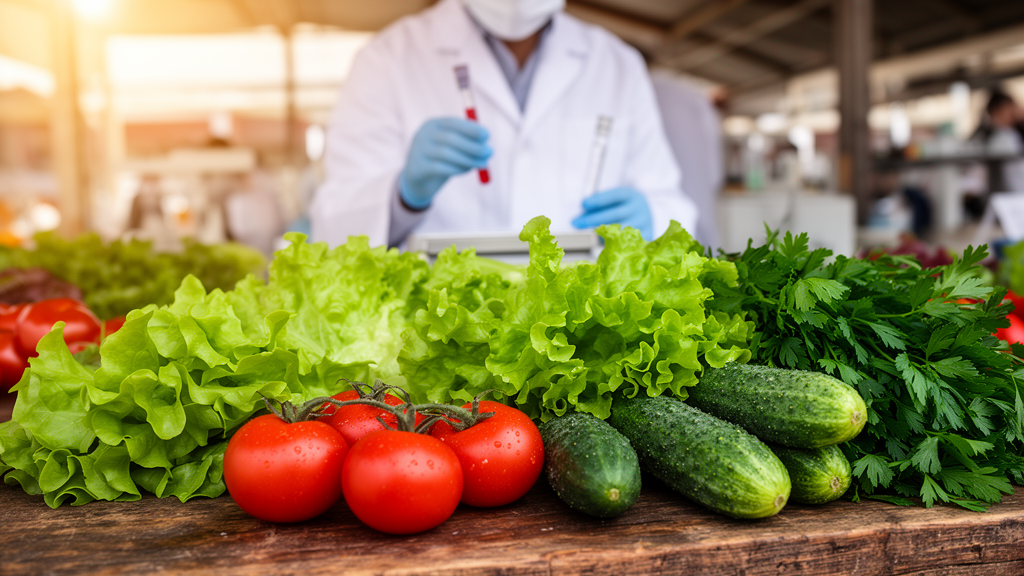
Arugula, purslane, parsley, dill, green onion, cress and lettuce — vegetables typically eaten raw — collected from local producers in Konya Province, Turkey, carried measurable loads of nitrates, toxic trace elements and pesticide residues, according to a study published in Environmental Monitoring and Assessment. The researchers sampled 294 vegetable lots in two sampling campaigns, one in August 2021 during summer and one in March 2022 during winter, and analysed them for lead, cadmium, arsenic, mercury and tin, nitrate content, and 31 pesticide active substances.

The survey revealed clear seasonal contrasts in mean concentrations. Summer samples showed higher mean lead (0.050 mg/kg) and arsenic (0.054 mg/kg), while winter vegetables carried higher mean nitrate (2446.88 mg/kg) and cadmium (0.011 mg/kg). Fixed-effects factorial analysis found these differences between seasons and vegetable types to be statistically significant (p < 0.05). Pesticide residues were detected in 68% of summer samples and 48% of winter samples, with the detected active substances dominated by insecticides (38.1% in summer, 47% in winter) and fungicides (33.3% in summer, 53% in winter).

Several findings raised compliance concerns. Acetamiprid exceeded maximum residue limits across multiple commodities, including summer parsley, arugula, green onions and cress, as well as winter purslane and dill. Banned agrochemicals, including chlorpyrifos and acetochlor, were also detected in isolated samples, indicating that substances no longer authorised still reach the food chain in the study region.

Yet the study’s most consequential result concerns what mattered more than season. When the authors applied nested variance decomposition, producer-level practices accounted for the vast majority of variation in contamination — 58.46% to 99.93% for pesticides and 34.50% to 90.56% for heavy metals and nitrate. Under this analysis, season was statistically non-significant (p > 0.05) as an isolated variance component. In other words, which farm a vegetable came from predicted its contamination profile far better than whether it was harvested in summer or winter.

Principal component analysis corroborated these distributions, isolating cress, arugula, purslane and winter dill based on their residue loadings. The authors conclude that agricultural practices among individual producers are the primary driver of contamination risks in these raw-consumed vegetables.

The combination of nitrate levels, trace elements such as lead, cadmium, arsenic, mercury and tin, and multiple pesticide classes — including substances whose use is banned — paints a picture of contamination shaped mainly at the level of individual growing operations rather than by broad seasonal patterns.

The study is limited to one province and two sampling seasons, and the reported values are mean concentrations across vegetable types, so the results should not be generalised to other regions or years. These variance findings indicate that contamination in the sampled vegetables differed mainly from one producer to another rather than between the two sampling seasons.

Subject of Research: Pesticide residues, nitrate and heavy metal contamination of raw-consumed green vegetables in Konya Province, Turkey

Article Title: Determination of pesticide residues, nitrate, and some heavy metal in green vegetables from Turkey’s Konya Province

Article References: Küçükapan, F. F., & Nizamlıoğlu, N. M. (2026). Determination of pesticide residues, nitrate, and some heavy metal in green vegetables from Turkey’s Konya Province. Environmental Monitoring and Assessment, 198(11), Article 1260. https://doi.org/10.1007/s10661-026-16108-0

Image Credits: AI Generated

DOI: 10.1007/s10661-026-16108-0

Keywords: pesticide residues, nitrate, heavy metals, Konya, green vegetables, acetamiprid, chlorpyrifos, food safety, seasonal variation, producer practices, Turkey, maximum residue limits

Cite Scienmag News

Violet Maxwell. (October 27, 2026). Pesticides, Nitrate and Heavy Metals Found in Raw-Eaten Vegetables from Konya. Scienmag. https://scienmag.com/pesticides-nitrate-and-heavy-metals-found-in-raw-eaten-vegetables-from-konya/


Violet Maxwell. "Pesticides, Nitrate and Heavy Metals Found in Raw-Eaten Vegetables from Konya." Scienmag, 27 October 2026, https://scienmag.com/pesticides-nitrate-and-heavy-metals-found-in-raw-eaten-vegetables-from-konya/. Accessed 27 October 2026.

Violet Maxwell. "Pesticides, Nitrate and Heavy Metals Found in Raw-Eaten Vegetables from Konya." Scienmag. October 27, 2026. https://scienmag.com/pesticides-nitrate-and-heavy-metals-found-in-raw-eaten-vegetables-from-konya/

Tags: acetamipridanalysis of raw vegetable contamination in Turkeychlorpyrifosenvironmental monitoring of vegetable contaminationfood safetyfood safety concerns in fresh producegreen vegetableshealth risks of pesticide and heavy metal exposureheavy metal contamination in raw leafy greensheavy metalsimpact of agricultural practices on vegetable safetyKonyamaximum residue limitsnitratenitrate contamination in vegetablespesticide residue analysis in Turkish vegetablespesticide residue regulation and compliancepesticide residuespesticide residues in raw vegetables from Konyaproducer practicesseasonal variationseasonal variation in pesticide and heavy metal levelstoxic trace elements in raw vegetablesTurkey
Share26Tweet16
Previous Post

Ghost of the brambles: botanists name a long-overlooked raspberry relative from southwestern China

Next Post

TabNet brings interpretable attention to miRNA classification, but classical models still lead

Related Posts

Machine Learning Models Forecast PM2.5-Bound PAH Levels in Nagoya
Earth Science

Machine Learning Models Forecast PM2.5-Bound PAH Levels in Nagoya

October 27, 2026
SWOT satellite reveals fine-scale ocean eddies boost global surface chlorophyll
Earth Science

SWOT satellite reveals fine-scale ocean eddies boost global surface chlorophyll

October 27, 2026
Manure and chia mucilage reshape lunar and martian regolith simulants in lab tests
Earth Science

Manure and chia mucilage reshape lunar and martian regolith simulants in lab tests

October 27, 2026
Waste palmyrah kernel shells turned into nitrogen-doped carbon that grabs CO2 efficiently
Earth Science

Waste palmyrah kernel shells turned into nitrogen-doped carbon that grabs CO2 efficiently

October 27, 2026
Climate change and water overuse top expert ranking of threats to Spain’s freshwater ecosystems
Earth Science

Climate change and water overuse top expert ranking of threats to Spain’s freshwater ecosystems

October 27, 2026
Water Saturation, Not Porosity, Decides Pay in Gulf of Suez Asl Sandstone
Earth Science

Water Saturation, Not Porosity, Decides Pay in Gulf of Suez Asl Sandstone

October 27, 2026
Next Post
TabNet brings interpretable attention to miRNA classification, but classical models still lead

TabNet brings interpretable attention to miRNA classification, but classical models still lead

  • Mothers who receive childcare support from maternal grandparents show more optimized

    Mothers who receive childcare support from maternal grandparents show more parental warmth, finds NTU Singapore study

    27656 shares
    Share 11059 Tweet 6912
  • University of Seville Breaks 120-Year-Old Mystery, Revises a Key Einstein Concept

    1061 shares
    Share 424 Tweet 265
  • Bee body mass, pathogens and local climate influence heat tolerance

    682 shares
    Share 273 Tweet 171
  • Researchers record first-ever images and data of a shark experiencing a boat strike

    546 shares
    Share 218 Tweet 137
  • Groundbreaking Clinical Trial Reveals Lubiprostone Enhances Kidney Function

    531 shares
    Share 212 Tweet 133
Science

Embark on a thrilling journey of discovery with Scienmag.com—your ultimate source for cutting-edge breakthroughs. Immerse yourself in a world where curiosity knows no limits and tomorrow’s possibilities become today’s reality!

RECENT NEWS

  • USDA grant funds $5 million greenhouse modernization at University of Arkansas
  • Drug use-linked heart infections fall nationwide as stimulant cases rise in the West
  • Pancreatic Cancer Hiding in the Lungs: A Case of Mistaken Interstitial Disease
  • Grafting Tomato Onto Resistant Rootstock Boosts Yield and Blocks Bacterial Wilt

Categories

  • Agriculture
  • Anthropology
  • Archaeology
  • Athmospheric
  • Biology
  • Biotechnology
  • Blog
  • Bussines
  • Cancer
  • Chemistry
  • Climate
  • Earth Science
  • Editorial Policy
  • Marine
  • Mathematics
  • Medicine
  • Pediatry
  • Policy
  • Psychology & Psychiatry
  • Science Education
  • Science News
  • Social Science
  • Space
  • Technology and Engineering

Subscribe to Blog via Email

Enter your email address to subscribe to this blog and receive notifications of new posts by email.

Join 5,151 other subscribers

© 2025 Scienmag - Science Magazine

Welcome Back!

Login to your account below

Forgotten Password?

Retrieve your password

Please enter your username or email address to reset your password.

Log In
No Result
View All Result
  • HOME
  • SCIENCE NEWS
  • CONTACT US

© 2025 Scienmag - Science Magazine

Discover more from Science

Subscribe now to keep reading and get access to the full archive.

Continue reading