


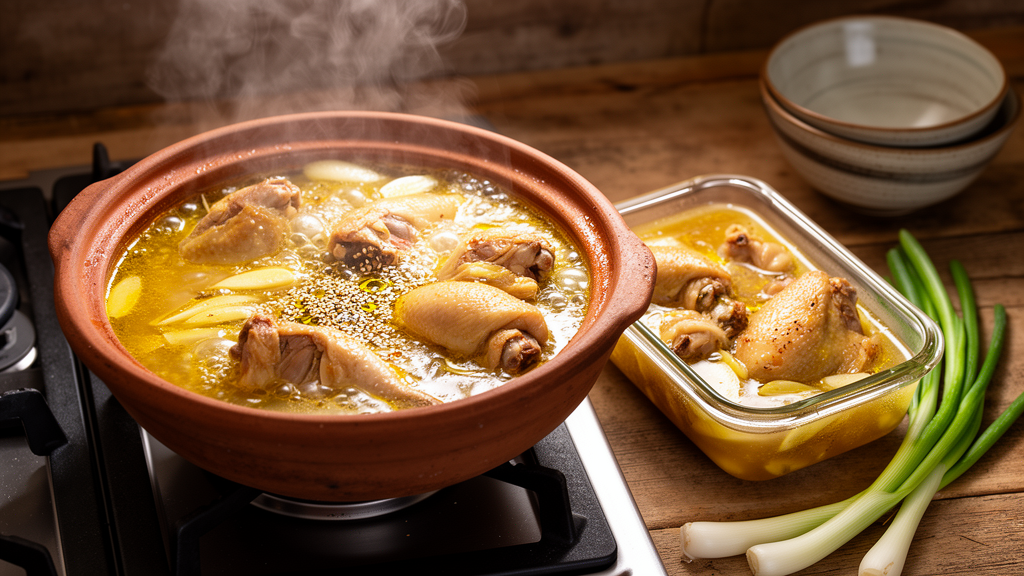
Hakka rice wine chicken, a beloved dish from Lingnan cuisine in southern China, owes its appeal to a layered aroma of wine-like, sweet, and meaty notes built from chicken, ginger, and Hakka rice wine. As such dishes move toward industrial production, they typically pass through a stewing-refrigeration-reheating cycle before reaching consumers, and each step can reshape the volatile chemistry that defines the flavor.
Chicken drumstick meat was stir-fried with ginger slices in peanut oil, combined with Hakka rice wine, and then stewed for one hour in an electric stew cooker. Samples were collected at five points: after pretreatment but before stewing, after fresh stewing, after immediate reheating, after reheating following three days of vacuum-packaged refrigerated storage at 4 degrees Celsius, and after reheating following six days of such storage. Reheating was performed by immersing the sealed cooking bags in boiling water for ten minutes, mimicking a common cold-chain practice. Only chicken tissue was analyzed; all ginger slices were removed before sampling.
The electronic nose captured the broad picture first. In the principal component analysis of sensor responses, the pre-stewing sample separated clearly from every other group, confirming that stewing itself substantially transformed the volatile profile. The freshly stewed sample, the immediately reheated sample, and the sample reheated after three days of chilling clustered together, indicating that neither immediate reheating nor short-term refrigeration produced an obvious shift in the overall aroma signature. Only the sample reheated after six days of storage pulled away from the rest along the first principal component, signaling a genuine change in its volatile character after prolonged cold storage and reheating.
Gas chromatography-mass spectrometry then identified a total of 90 volatile organic compounds across the samples. The number of detected compounds rose from 67 before stewing to 83 after stewing, and the total volatile concentration increased significantly, reflecting the enrichment of the flavor base during slow simmering. Phenethyl alcohol, a characteristic volatile of Hakka rice wine that carries rose-like and sweet notes, reached 407.64 micrograms per kilogram in the freshly stewed sample and stood out as a key compound of that stage. The researchers traced its likely origins to microbial biosynthesis during rice wine fermentation, direct introduction from the wine itself, and thermal reactions involving phenylalanine released from chicken proteins during stewing.
The analysis also detected caramel-like compounds such as 2,3-dihydro-3,5-dihydroxy-6-methyl-4H-pyran-4-one, a Maillard reaction product, alongside ginger-derived terpenes including beta-pinene and alpha-zingiberene. Together these compounds formed the volatile foundation of the dish after stewing. Esters, which contribute floral and fruity aromas, also increased in total concentration after stewing, with geranyl acetate and gamma-butyrolactone adding to the underlying alcoholic and sweet character of the product.
Immediate reheating after stewing proved remarkably gentle on the flavor system. The concentrations of core compounds including phenethyl alcohol, alpha-zingiberene, beta-phellandrene, and the pyranone did not differ significantly between the freshly stewed and immediately reheated samples. The electronic nose and principal component analysis agreed that the two groups remained closely aligned, sharing 78 volatile compounds. After three days of refrigerated storage followed by reheating, some individual carbonyl compounds did change: nonanal and benzaldehyde increased significantly, while hexanal and 6-methyl-5-hepten-2-one rose numerically without reaching statistical significance. The total volatile content climbed from 1147.42 to 1596.55 micrograms per kilogram, yet the overall profile still resembled that of the freshly stewed and immediately reheated samples.
The six-day storage period told a different story. In the sample reheated after six days of chilling, the total relative concentration of volatile compounds reached its highest level at 2372.85 micrograms per kilogram. Hydrocarbons surged dramatically, from 122.55 micrograms per kilogram in the pre-stewing sample to 1050.65 micrograms per kilogram in this group. The concentration of beta-phellandrene rose to 10.41 times its initial value, and alpha-zingiberene reached 3.75 times its level in the immediately reheated sample. Gamma-terpinene, cedrene, and beta-elemene appeared, while cis-calamenene was detected exclusively in this group. Meanwhile, phenethyl alcohol, the caramel-like pyranone, and acetic acid all declined, and ketones such as 2-undecanone and 2-nonanone increased. The researchers noted that lipid oxidation-related compounds did not follow a single time-dependent pattern; hexanal showed no significant differences among the reheated groups, and nonanal peaked at the three-day stage before falling back.
To separate statistical discriminants from genuine aroma contributors, the team combined partial least squares discriminant analysis with odor activity value calculations. The PLS-DA model, validated with a 200-iteration permutation test, identified 26 compounds with variable importance in projection values above 1, and 15 compounds showed odor activity values of at least 1 in at least one sample group. Crossing the two criteria yielded eight key volatile markers: nonanal, beta-phellandrene, camphene, 1,8-cineole, phenethyl alcohol, p-cresol, citral, and 3-furfural. Three-furfural, with an odor activity value that reached 338.51 at the three-day stage, was considered the primary contributor to the sweet and mellow aroma character, while beta-sesquiphellandrene reached an odor activity value of 173.54 in the six-day group, reflecting the growing contribution of terpenes with woody and herbal notes.
The authors were careful to frame their mechanistic interpretations as inferences rather than demonstrated pathways. Because free amino acids, reducing sugars, lipid peroxides, and other intermediate indicators were not measured, and no ingredient-omission controls were included, the proposed roles of the Maillard reaction, esterification, and the antioxidant effects of ginger constituents remain hypotheses grounded in the observed volatile marker changes and supporting literature. Ginger-derived phenolic compounds such as gingerols and shogaols are known to exhibit radical-scavenging activity, and the researchers suggested that such constituents may have helped limit lipid oxidation during short-term refrigerated storage, possibly explaining why the three-day samples remained relatively stable where other precooked meat systems have shown pronounced warmed-over flavor development.
The study’s practical message is straightforward for producers of traditional stewed dishes moving into cold-chain distribution. Immediate reheating after stewing preserves the aroma profile that stewing builds, and even three days of refrigerated storage followed by reheating leaves the overall flavor framework largely intact, though individual carbonyl compounds begin to shift. Six days of storage, however, marks a threshold at which the potential aroma profile tilts visibly toward woody and herbal attributes as terpenes and certain ketones rise and the compounds behind sweet, alcoholic, and caramel-like notes recede. The eight key volatile markers identified here offer a concrete monitoring toolkit for quality control, allowing manufacturers to track whether a given batch has crossed the point at which the dish’s characteristic sweet-mellow character begins to give way to a different aromatic identity.
Subject of Research: How stewing, refrigeration, and reheating change the volatile flavor compounds of Hakka rice wine chicken
Article Title: Effects of stewing, refrigeration, and reheating on the volatile flavor of Hakka rice wine chicken based on E-nose and HS-SPME-GC–MS
Article References: Chen, Y., Wang, J., Chen, Y., Xu, Z., & Li, M. (2026). Effects of stewing, refrigeration, and reheating on the volatile flavor of Hakka rice wine chicken based on E-nose and HS-SPME-GC–MS. Food Chemistry: X, 40, Article 104648. https://doi.org/10.1016/j.fochx.2026.104648
Image Credits: AI Generated
DOI: 10.1016/j.fochx.2026.104648
Keywords: Hakka rice wine chicken, volatile compounds, stewing, refrigeration, reheating, electronic nose, HS-SPME-GC-MS, PLS-DA, odor activity value, flavor chemistry, traditional Chinese cuisine, cold-chain processing
Cite Scienmag News
Alan Morgan. (October 27, 2026). Reheating After Six Days of Chilling Reshapes the Aroma of Hakka Rice Wine Chicken. Scienmag. https://scienmag.com/reheating-after-six-days-of-chilling-reshapes-the-aroma-of-hakka-rice-wine-chicken/
Alan Morgan. "Reheating After Six Days of Chilling Reshapes the Aroma of Hakka Rice Wine Chicken." Scienmag, 27 October 2026, https://scienmag.com/reheating-after-six-days-of-chilling-reshapes-the-aroma-of-hakka-rice-wine-chicken/. Accessed 27 October 2026.
Alan Morgan. "Reheating After Six Days of Chilling Reshapes the Aroma of Hakka Rice Wine Chicken." Scienmag. October 27, 2026. https://scienmag.com/reheating-after-six-days-of-chilling-reshapes-the-aroma-of-hakka-rice-wine-chicken/


