


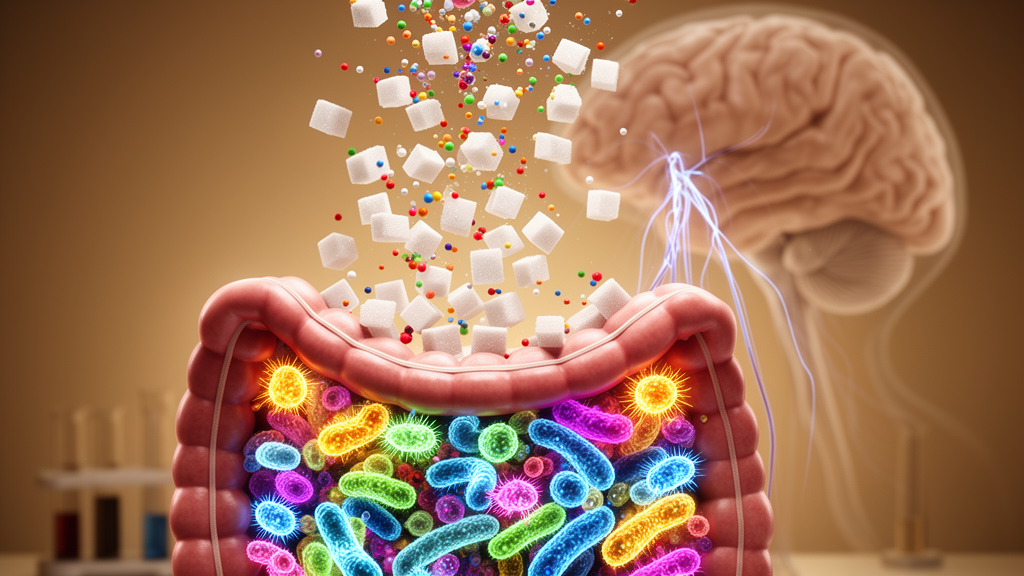
A new narrative review argues that the artificial sweeteners, colorants, preservatives, nanoparticles and emulsifiers found in processed foods may share a surprising biological fingerprint: each appears capable of disrupting the community of bacteria living in the human gut, and that disruption, the authors propose, could in principle feed into processes relevant to glioblastoma, the most aggressive primary brain cancer. The review, published in Frontiers in Microbiomes, is careful to frame its conclusions as hypothesis-generating rather than proven, but its synthesis of more than 20 studies offers one of the first attempts to connect dietary additives, gut dysbiosis and brain cancer within a single mechanistic framework.
Glioblastoma accounts for roughly half of all malignant central nervous system tumors, and despite surgery, radiotherapy and temozolomide chemotherapy, median survival remains approximately 15 months, with a five-year survival rate of only about 5 percent. Incidence has been rising across multiple global regions, a trend that improvements in diagnostics alone cannot fully explain, which has prompted growing interest in modifiable environmental and dietary contributors. At the same time, ultra-processed foods now supply more than 60 percent of daily calories in several high-income populations, dramatically increasing human exposure to synthetic additives.
The review, led by researchers at Weill Cornell Medicine-Qatar, examined five additive categories: artificial sweeteners, food colorants, preservatives, food-grade nanoparticles, and emulsifiers or mixed-additive formulations. Across 22 studies spanning bacterial culture, rodent, avian and porcine models, and human trials, the authors identified a recurring, though not universal, dysbiotic pattern. Depletion of short-chain fatty acid-producing bacteria such as Bifidobacterium, Lactobacillus and Faecalibacterium appeared alongside expansion of Proteobacteria-associated taxa, reduced SCFA output, elevated lipopolysaccharide production, disruption of tryptophan metabolism, and loss of tight-junction proteins that maintain the intestinal barrier.
Artificial sweeteners drew the most attention, with 13 of the 23 studies reviewed. Sucralose emerged as the most comprehensively characterized additive: chronic exposure in animal models disrupted the tryptophan–kynurenine pathway, elevating quinolinic acid while depleting kynurenic acid and L-tryptophan, and increased susceptibility to chemically induced colitis while downregulating the tight-junction proteins occludin and claudins. Saccharin shifted bacterial functional gene content toward lipopolysaccharide biosynthesis and bacterial toxins. Not every sweetener behaved the same way, however. Xylitol consistently increased colonic SCFA production and expanded beneficial Bifidobacterium and Lactobacillus populations across three studies, a reminder that microbial responses are compound-specific and context-dependent.
The review is also candid about contradictory evidence. A 14-day randomized double-blind crossover trial in healthy adults found that aspartame and sucralose, at doses well below the acceptable daily intake, produced no measurable change in gut microbiota composition, diversity or SCFA output. Another study found sucralose reduced colitis severity while increasing tumor growth through effects on T cells rather than through the microbiome. The authors treat these results as boundary conditions on the proposed dysbiotic signature rather than contradictions of it, underscoring how much may depend on dose, duration, co-exposure and host species.
Among all additives examined, aspartame provided the most complete hypothesized chain from dietary exposure to brain cancer biology. In an intracranial mouse tumor model, mice given aspartame in drinking water for 15 days showed a significant decrease in the bacterial family Rikenellaceae alongside a genome-wide shift in m6A RNA methylation and mRNA expression in tumor tissue. Three m6A-regulated genes, CDKN1A, MYC and TGFB1, were significantly upregulated in aspartame-exposed tumors, a pattern independently validated in human glioblastoma datasets from TCGA and CGGA. Notably, the aspartame diet did not significantly affect tumor growth in this model; the finding concerns epigenetic and molecular reprogramming independent of tumor size, and the human validation is correlational.
Support from the opposite direction strengthens the hypothesis, the authors argue. A separate 2026 study found that intermittent fasting selectively suppressed a TP53-subtype glioblastoma in mice through a gut-microbiota-mediated pathway, reshaping the microbiome, reducing microbial methionine production, decreasing m6A methylation and suppressing TGF-β signaling. The two studies implicate different TGF-β family members, TGFB1 and TGFB2 respectively, and were conducted independently rather than as one continuous experiment, so the overlap is at the pathway level rather than an exact molecular match.
Downstream of the dysbiotic signature, the review organizes gut–brain axis evidence around four functional metabolite classes rather than bacterial taxonomy. Short-chain fatty acids were the most consistently reported class: butyrate crosses the blood–brain barrier and exerts anti-inflammatory effects in preclinical models, propionate uniquely restored blood–brain barrier tight junction integrity via the FFAR2 receptor in a mouse glioblastoma model, and probiotic supplementation with Bifidobacterium lactis and Lactobacillus plantarum suppressed PI3K/AKT signaling and decreased tumor volume in a glioma mouse model. LPS-driven TLR4/NF-κB signaling, tryptophan–kynurenine derivatives acting through the aryl hydrocarbon receptor, and altered bile acid signaling each carried mechanistic links to neuroinflammation, barrier compromise and immune checkpoint modulation, though the review repeatedly notes that direct evidence in glioblastoma remains limited and emerging rather than established.
Human evidence remains the weakest link. Clinical studies are predominantly cross-sectional case–control designs with small samples, between 25 and 100 participants, none of which were prospective or controlled for dietary additive intake. Mendelian randomization studies offer genetic causal inference for microbiome–glioblastoma associations, including one analysis in which only the Ruminococcaceae family retained significance after multiple-testing correction, but they cannot capture exposures that vary across a lifetime, such as cumulative dietary additive intake. Mouse gut microbiomes share only about 10 percent of species-level taxa with humans, further limiting extrapolation, and many preclinical studies used doses exceeding typical human dietary exposure.
The review’s authors emphasize that the end-to-end pathway, from additive ingestion through dysbiosis to glioblastoma-relevant molecular change, has not been demonstrated in any single study in any species. They call for prospective human cohorts that pair validated dietary-additive assessment with longitudinal microbiome sampling and glioblastoma outcomes, a study design that does not yet exist for this question, alongside multi-omics approaches and studies of real-world additive mixtures, of which only one currently exists in the evidence base. At present, the framework should be read as a structured, testable hypothesis: food additives as biologically active modulators of the gut microbiome whose potential relevance to brain cancer remains an open empirical question rather than an established risk.
Subject of Research: A narrative review linking food additive-induced gut dysbiosis to glioblastoma through the gut–brain axis
Article Title: Gut dysbiosis and brain cancer: exploring the emerging role of sweeteners and food additives
Article References: Sohail, M., Hassan, A. T., Gulzar, M., Numan, N., Mafe, A. N., & Büsselberg, D. (2026). Gut dysbiosis and brain cancer: exploring the emerging role of sweeteners and food additives. Frontiers in Microbiomes, 5, 1960004. https://doi.org/10.3389/frmbi.2026.1960004
Image Credits: AI Generated
DOI: 10.3389/frmbi.2026.1960004
Keywords: glioblastoma, gut microbiome, food additives, artificial sweeteners, aspartame, gut–brain axis, dysbiosis, short-chain fatty acids, m6A methylation, blood–brain barrier, narrative review, microbiome
Cite Scienmag News
Morgan Morrow. (October 27, 2026). Sweeteners and food additives may reshape gut microbes linked to brain cancer. Scienmag. https://scienmag.com/sweeteners-and-food-additives-may-reshape-gut-microbes-linked-to-brain-cancer/
Morgan Morrow. "Sweeteners and food additives may reshape gut microbes linked to brain cancer." Scienmag, 27 October 2026, https://scienmag.com/sweeteners-and-food-additives-may-reshape-gut-microbes-linked-to-brain-cancer/. Accessed 27 October 2026.
Morgan Morrow. "Sweeteners and food additives may reshape gut microbes linked to brain cancer." Scienmag. October 27, 2026. https://scienmag.com/sweeteners-and-food-additives-may-reshape-gut-microbes-linked-to-brain-cancer/


