

Tuesday, October 27, 2026
Science
No Result
View All Result
  • Login
  • HOME
  • SCIENCE NEWS
  • CONTACT US
  • HOME
  • SCIENCE NEWS
  • CONTACT US
No Result
View All Result
Scienmag
No Result
View All Result
Home Science News Cancer

Long noncoding RNA MANCR drives glioblastoma growth via miR-205-5p and CASP3

October 27, 2026
in Cancer
Nathaniel Bowman
By Nathaniel Bowman Scienmag Editorial Profile - Precision Oncology
Reading Time: 3 mins read
0
Long noncoding RNA MANCR drives glioblastoma growth via miR-205-5p and CASP3

Long noncoding RNA MANCR drives glioblastoma growth via miR-205-5p and CASP3

65
SHARES
587
VIEWS
Share on FacebookShare on Twitter
ADVERTISEMENT

A new study published in Cancer Cell International points to a long noncoding RNA called MANCR, the Mitotically Associated Non-Coding RNA, as a potential driver of the disease. The researchers report that MANCR is elevated in glioblastoma tissues and cell lines, that higher levels correlate with poorer patient survival, and that the molecule appears to fuel tumor progression through a specific regulatory pathway involving the microRNA miR-205-5p and the apoptosis-related protein caspase 3.

Long noncoding RNAs are RNA molecules longer than 200 nucleotides that do not code for proteins, but many have emerged as important regulators of cancer biology. To probe MANCR’s role, the team first assessed its expression levels using publicly available datasets and then validated the findings in glioblastoma cell lines. They found MANCR consistently elevated in tumor samples and cells, and survival analysis linked high MANCR expression to reduced overall survival, suggesting the molecule could serve as a prognostic biomarker.

The researchers then ran a series of functional assays to test what MANCR actually does inside glioblastoma cells. When they silenced MANCR, cell proliferation, invasion, and colony formation all dropped, while apoptosis increased. Flow cytometric analysis using Annexin V/PI staining showed a larger population of apoptotic cells after MANCR knockdown, and western blotting confirmed the effect through increased levels of cleaved caspase 3, a hallmark of programmed cell death. In other words, removing MANCR appeared to lift a brake on the cellular self-destruct machinery that glioblastoma cells normally keep suppressed.

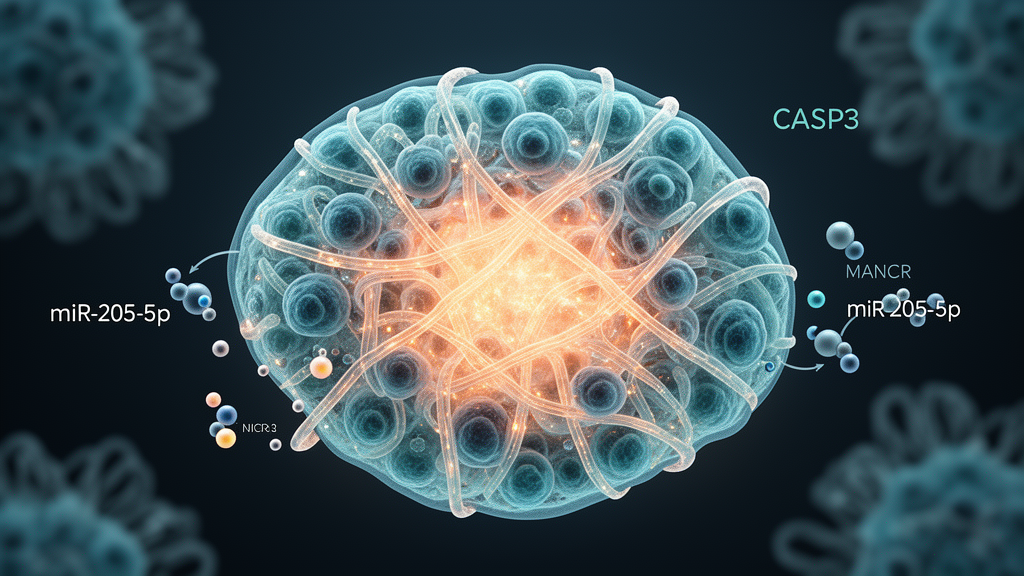
The mechanistic core of the study lies in what the authors describe as a sponging relationship. MANCR appears to bind and sequester miR-205-5p, a microRNA that would otherwise restrain caspase 3. With MANCR soaking up miR-205-5p, caspase 3 regulation shifts in a way that favors tumor cell survival and spread. RNA immunoprecipitation experiments supported this interaction, and rescue experiments strengthened the case: when the researchers inhibited miR-205-5p, they partially reversed the effects of MANCR knockdown on glioblastoma cells, indicating that the microRNA sits downstream of MANCR in the pathway.

Taken together, the findings sketch an oncogenic circuit in which MANCR promotes proliferation and invasion while suppressing apoptosis through the miR-205-5p/CASP3 axis. The authors suggest this network could represent both a potential therapeutic target and a promising biomarker for glioblastoma. However, they are careful to note the limits of the current work. The evidence comes from public datasets, cell line experiments, and in vitro functional assays, and the study has not yet been confirmed in animal models or clinical settings. The researchers state that further in vivo and clinical validation is warranted before the MANCR/miR-205-5p/CASP3 axis can be considered a validated target. The article was published open access on 27 October 2026 as a peer-reviewed, accepted manuscript shared early for faster access, with a final version of record to follow.

Subject of Research: The role of the long noncoding RNA MANCR in glioblastoma progression via the miR-205-5p/CASP3 axis

Article Title: Elevated MANCR expression promotes glioblastoma progression through miR-205-5p sponging and CASP3 regulation

Article References: Yadav, B., Patel, B., Kansara, S., Sharma, R. D., Pandey, V., & Pandey, A. K. (2026). Elevated MANCR expression promotes glioblastoma progression through miR-205-5p sponging and CASP3 regulation. Cancer Cell International. https://doi.org/10.1186/s12935-026-04485-y

Image Credits: AI Generated

DOI: 10.1186/s12935-026-04485-y

Keywords: glioblastoma, long noncoding RNA, MANCR, miR-205-5p, caspase 3, apoptosis, lncRNA, prognostic biomarker, cell invasion, sponging mechanism, Cancer Cell International, therapeutic target

Cite Scienmag News

Nathaniel Bowman. (October 27, 2026). Long noncoding RNA MANCR drives glioblastoma growth via miR-205-5p and CASP3. Scienmag. https://scienmag.com/long-noncoding-rna-mancr-drives-glioblastoma-growth-via-mir-205-5p-and-casp3/


Nathaniel Bowman. "Long noncoding RNA MANCR drives glioblastoma growth via miR-205-5p and CASP3." Scienmag, 27 October 2026, https://scienmag.com/long-noncoding-rna-mancr-drives-glioblastoma-growth-via-mir-205-5p-and-casp3/. Accessed 27 October 2026.

Nathaniel Bowman. "Long noncoding RNA MANCR drives glioblastoma growth via miR-205-5p and CASP3." Scienmag. October 27, 2026. https://scienmag.com/long-noncoding-rna-mancr-drives-glioblastoma-growth-via-mir-205-5p-and-casp3/

Tags: apoptosisCancer Cell Internationalcaspase 3 role in glioblastoma apoptosiscaspase-3cell invasionfunctional effects of MANCR silencingGlioblastomaglioblastoma cell proliferation and invasionglioblastoma tumor progressionimpact oflncRNAlong noncoding RNAlong noncoding RNA regulation in cancerMANCRMANCR expression in glioblastomamicroRNA miR-205-5p in tumor growthmiR-205-5pnoncoding RNA as cancer driversprognostic biomarkerprognostic biomarkers in glioblastomaRNA-based therapeutic targets for glioblastomasponging mechanismtherapeutic targettumor suppressor pathways involving caspase 3
Share26Tweet16
Previous Post

Plant-based meat alternatives cut land use and emissions but raise micronutrient risks

Next Post

Ant colony algorithm tunes a leaner DeepLabV3+ to segment brain tumors across three MRI cohorts

Related Posts

Experimental Compounds Curb Glioblastoma Cell Invasion in Tissue Slice Models
Cancer

Experimental Compounds Curb Glioblastoma Cell Invasion in Tissue Slice Models

October 27, 2026
Physical Limitations Shape How Hospitalized Cancer Patients Judge Their Care
Cancer

Physical Limitations Shape How Hospitalized Cancer Patients Judge Their Care

October 27, 2026
CAR-T Cytokine Release Syndrome Shows Distinct Symptom Profiles by Timing, Severity and Duration
Cancer

CAR-T Cytokine Release Syndrome Shows Distinct Symptom Profiles by Timing, Severity and Duration

October 27, 2026
Precision Brachytherapy Improves Dosimetry in Salvage Treatment for Recurrent Gynecologic Cancers
Cancer

Precision Brachytherapy Improves Dosimetry in Salvage Treatment for Recurrent Gynecologic Cancers

October 27, 2026
RNA Modifications and Metabolism: Decoding Crosstalk in Liver Cancer
Cancer

RNA Modifications and Metabolism: Decoding Crosstalk in Liver Cancer

October 27, 2026
MRI bright stripes after bisphosphonates mimic disease flare in childhood bone disease
Cancer

MRI bright stripes after bisphosphonates mimic disease flare in childhood bone disease

October 27, 2026
Next Post
Ant colony algorithm tunes a leaner DeepLabV3+ to segment brain tumors across three MRI cohorts

Ant colony algorithm tunes a leaner DeepLabV3+ to segment brain tumors across three MRI cohorts

  • Mothers who receive childcare support from maternal grandparents show more optimized

    Mothers who receive childcare support from maternal grandparents show more parental warmth, finds NTU Singapore study

    27656 shares
    Share 11059 Tweet 6912
  • University of Seville Breaks 120-Year-Old Mystery, Revises a Key Einstein Concept

    1061 shares
    Share 424 Tweet 265
  • Bee body mass, pathogens and local climate influence heat tolerance

    682 shares
    Share 273 Tweet 171
  • Researchers record first-ever images and data of a shark experiencing a boat strike

    546 shares
    Share 218 Tweet 137
  • Groundbreaking Clinical Trial Reveals Lubiprostone Enhances Kidney Function

    531 shares
    Share 212 Tweet 133
Science

Embark on a thrilling journey of discovery with Scienmag.com—your ultimate source for cutting-edge breakthroughs. Immerse yourself in a world where curiosity knows no limits and tomorrow’s possibilities become today’s reality!

RECENT NEWS

  • Scientists can predict ciprofloxacin resistance in Klebsiella pneumoniae from genome data
  • Experimental Compounds Curb Glioblastoma Cell Invasion in Tissue Slice Models
  • Research report: Non-singular cosmologies matching regular black holes
  • Ant colony algorithm tunes a leaner DeepLabV3+ to segment brain tumors across three MRI cohorts

Categories

  • Agriculture
  • Anthropology
  • Archaeology
  • Athmospheric
  • Biology
  • Biotechnology
  • Blog
  • Bussines
  • Cancer
  • Chemistry
  • Climate
  • Earth Science
  • Editorial Policy
  • Marine
  • Mathematics
  • Medicine
  • Pediatry
  • Policy
  • Psychology & Psychiatry
  • Science Education
  • Science News
  • Social Science
  • Space
  • Technology and Engineering

Subscribe to Blog via Email

Enter your email address to subscribe to this blog and receive notifications of new posts by email.

Join 5,151 other subscribers

© 2025 Scienmag - Science Magazine

Welcome Back!

Login to your account below

Forgotten Password?

Retrieve your password

Please enter your username or email address to reset your password.

Log In
No Result
View All Result
  • HOME
  • SCIENCE NEWS
  • CONTACT US

© 2025 Scienmag - Science Magazine

Discover more from Science

Subscribe now to keep reading and get access to the full archive.

Continue reading