


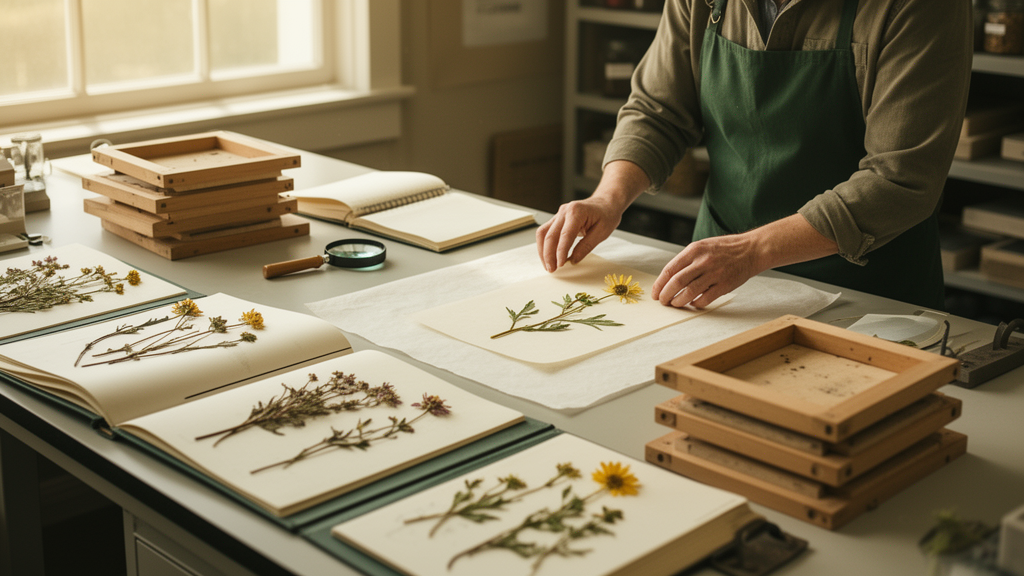
Italy’s botanical map has just been redrawn, at least in its fine details. A new contribution to the series ‘Notulae to the Italian native vascular flora’ documents a batch of new regional records, confirmations of long-doubtful species, several exclusions of plants that never truly belonged where the textbooks said they did, and two formal nomenclatural changes. Taken together, the notes show how a country’s flora is not a fixed inventory but a living document, corrected specimen by specimen, herbarium drawer by herbarium drawer.
Each entry is anchored to a preserved herbarium specimen, deposited in institutional collections such as FI in Florence, PAV in Pavia, REGGIO in Reggio Calabria, CAG in Cagliari and PESA in Pesaro, and each is accompanied by precise geographic coordinates, altitude, habitat description and collection date. The series operates under explicit editorial rules: floristic novelties are submitted to the FI Herbarium, Sezione di Botanica ‘Filippo Parlatore’ of the Natural History Museum in Florence, together with the corresponding specimen or its scan or photograph, while nomenclatural novelties and typifications of accepted names are handled through a separate channel. Each text is limited to one thousand characters including spaces, a format that keeps the corrections terse, verifiable and cumulative.
Among the genuine novelties, one of the most striking concerns the orchid Anacamptis longicornu, confirmed for Calabria. The species had been reported for Italy exclusively in Sicily and Sardinia by the standard reference floras of 2005 and 2017, and its presence in Calabria was considered doubtful in the most recent national checklist. Field surveys documented individuals at several localities in the province of Reggio Calabria, including sites near Motta San Giovanni and along the road from Reggio Calabria toward Gambarie, in Aleppo pine woodland and rocky terrain between roughly 735 and 1053 metres. Notably, fewer than ten individuals were observed at one of the sites, a reminder that confirmation of presence does not imply a thriving population.
Another regionally significant confirmation involves Trifolium saxatile, a clover endemic to the Alps and listed in Annex II of the European Habitats Directive 92/43/EEC. In Italy the species had been confirmed only for Valle d’Aosta and Trentino-Alto Adige, and it was considered possibly extinct in Piemonte, where the last collections dated from the early twentieth century in Valle Orco and Val di Susa. The new record comes from Bardonecchia, on calcschist scree between Croce Chabrière and Punta Melmise at 2190 to 2300 metres, where at least one hundred individuals were found sparsely distributed over an area of at least two hundred square metres. The authors suggest that the abundance of similar scree habitats on the same bedrock in the area, including at higher elevations, makes further searching worthwhile.
The mountains of the Marche region emerge as a hotspot of taxonomic correction, particularly for the notoriously difficult hawkweed genus Hieracium. Revisions of historical specimens collected by A. Brilli-Cattarini and L. Gubellini in the Monti Sibillini and around Monte Nerone, many of them originally filed under broader names such as Hieracium incisum or Hieracium murorum, led to several species and subspecies being added to the regional flora of Marche. These include Hieracium caesioides subsp. rionii, Hieracium hypochoeroides subsp. bifidopsis, Hieracium pallescens, Hieracium picenorum and Hieracium pseudogrovesianum subsp. amictum, all documented on calcareous or arenaceous soils in rocky woodland and scree habitats between roughly 500 and 1900 metres. The same region also yielded Rosa inodora, recorded from mesophilous woods on the northern slope of Monte Schioppettino in the Monte Catria group, a species new for the Marche flora.
Hawkweeds also produced novelties further south. Hieracium chondrillifolium subsp. boissieri was recorded on calcareous scree at 1670 metres on Campitello Matese, new for the flora of Molise, while Hieracium grovesianum subsp. luteobarbatum, an Italian endemic previously known only from Abruzzo and Marche, was found on rocky stony slopes of Monte Scuro in the Sila Mountains of Calabria. A related subspecies, Hieracium grovesianum subsp. rigoanum, was documented on Monte Alpi in Basilicata. In the north, Hieracium bifidum subsp. psammogenes was confirmed for Lombardia from roadside and lakeshore rock faces around Lake Iseo and the Grigna area; specimens collected by Pietro Rossi and determined by Zahn, preserved in PAV, show that the subspecies was once quite widespread on the Grigna massif.
Other additions span the peninsula. Alchemilla opaca, a rose family herb found in a beech-wood clearing between Passo dei due Santi and Monte Colombo at 1450 metres, is new for the flora of Emilia-Romagna. Centaurea jacea subsp. angustifolia was recorded at the edge of a Turkey oak wood in the protected area Bosco Difesa Grande near Gravina in Puglia, new for that region. Eragrostis minor subsp. minor turned up between the paving stones of town squares in Tramutola and Castelsaraceno in Basilicata, a first for the region, while Nasturtium microphyllum was found in a riparial setting on the Ema stream near Grassina in the province of Florence, new for Toscana. Carex frigida was confirmed for Liguria during an extensive survey of the priority Natura 2000 habitat 7220, petrifying springs of the Cratoneurion, in the Gerbonte forest at 1628 metres; handwritten notes by Ottone Penzig on a copy of De Notaris from 1844, together with GDOR herbarium specimens, indicate the species was also present in several localities of the Ligurian Alps in the past.
Confirmations of doubtful records carry their own historical weight. Aristolochia clematitis, first reported for Puglia by Tenore in 1820 and long regarded as doubtful there, was refound on sandy ground along the seafront at Rodi Garganico at just one metre above sea level. Carduus cephalanthus, historically reported for southern Calabria by Fiori in 1927 and by Pignatti in 1982 but subsequently treated as doubtful, was confirmed with more than one hundred individuals at the edge of a path on a burnt Aleppo pine slope near Monte S. Demetrio in the Metropolitan City of Reggio Calabria. In Sardinia, Glebionis discolor was confirmed after decades of taxonomic ambiguity: records from the 1970s by A. Scrugli had been filed under a variety of the common garland chrysanthemum, and the doubtful taxonomic value of those varietal ranks had led later checklists to drop the taxon from the island’s flora entirely, until its recent re-evaluation at species rank. Veronica scutellata, listed as Regionally Extinct in the Veneto Red List, was refound on a peaty plateau near Forcella Aurine in the province of Belluno at 1380 metres.
Exclusions are as informative as additions. Vicia melanops, reported near Vigliano in Abruzzo on the basis of a herbarium specimen in the APP collection, has been removed from the regional flora: the recent discovery of the similar Vicia laeta in the National Park of Abruzzo, Lazio and Molise allowed the old specimen to be reattributed to that species. Likewise, the black hellebore, Helleborus niger, has been excluded from Basilicata, Campania and Lazio. The trail of error traces back to the nineteenth-century botanist Nicola Terracciano, whose records for Cassino and Campoli Appennino, localities now in Lazio, were never subsequently confirmed, and whose indications for Basilicata had already been questioned in 1947. No supporting specimen could be traced in the Naples herbarium, and modern floristic portals treat the species’ presence in those regions as unsupported. A similar correction concerns Helictotrichon convolutum in Abruzzo: old reports from the Velino massif and from Pietracamela rested on identifications by Tenore and Zodda, but a revision of Zodda’s specimens preserved in the BI herbarium showed them to belong to Trisetum bertolonii instead, while the Velino record should be referred to Helictochloa praetutiana.
Alien species received attention as well. Juglans regia, the walnut, was documented as a naturalized regional alien new for the flora of Puglia from roadside and fallow sites across the Gargano, while Pinus nigra subsp. nigra was recorded as a casual regional alien near Monte Sant’Angelo. The status of Paliurus spina-christi in Valle d’Aosta was clarified as an unconfirmed regional alien: the species was recorded there from Allioni’s eighteenth-century Flora pedemontana onward, attested by a manuscript, an exsiccata and a painted plate, and probably introduced a long time ago, perhaps already by the Romans, but it has not been confirmed for more than seventy years. Not all corrections reach back centuries. Squilla numidica, a bulbous plant of the asparagus family, is newly recorded for Calabria from Mediterranean scrubland on clayey soil near Cirò in the province of Crotone. Numerous earlier Calabrian reports of Squilla maritima had already been reinterpreted as referring to S. pancration, and the new samples were assigned to S. numidica on the basis of brownish-red bulb tunics and a greenish tepal midrib, following a recent taxonomic treatment of the group.
The notula also delivers two nomenclatural novelties. The Sicilian poppy long treated as Papaver siculum is formally transferred to the genus Roemeria as Roemeria sicula, reflecting molecular phylogenetic evidence that the species of Papaver section Argemonidium belong to Roemeria rather than Papaver. Because the epithet hybrida was already occupied in Roemeria, the next earliest legitimate name at species rank, Gussone’s Papaver siculum from 1843-1844, provides the correct combination, and a lectotype was designated from a Gasparrini specimen preserved in Naples that morphologically matches Gussone’s description. In parallel, the hawkweed taxon Hieracium pseudopilosella subsp. nigrocomosum, described from the Ligurian Alps and endemic to that region, is moved into the genus Pilosella as Pilosella pseudopilosella subsp. nigrocomosa; the species itself has highly disjunct occurrences across northern Africa, the Iberian Peninsula, southern Italy, the Balkan Peninsula and western Turkey. Alongside these formal changes, the contribution compiles nomenclatural and distributional updates and corrigenda drawn from dozens of publications, feeding them into the continuously maintained Portal to the Flora of Italy, the digital infrastructure that keeps the country’s botanical inventory honest, one corrected specimen at a time.
Subject of Research: Floristic novelties, confirmations, exclusions and nomenclatural updates for the Italian native vascular flora
Article Title: Notulae to the Italian native vascular flora: 15
Article References: Bartolucci, F., Domina, G., Adorni, M., Bacchetta, G., Bajona, E., Banfi, E., Barbadoro, F., Biscotti, N., Bonsanto, D., Conti, F., Da Pozzo, M., Dagnino, D., De Fine, G., Del Guacchio, E., Forte, L., Di Gristina, E., Galasso, G., Ghillani, L., Gottschlich, G., … Lastrucci, L. (2023). Notulae to the Italian native vascular flora: 15. Italian Botanist, 15, 91-109. https://doi.org/10.3897/italianbotanist.15.105796
Image Credits: AI Generated
DOI: 10.3897/italianbotanist.15.105796
Keywords: floristics, Italy, vascular plants, herbarium specimens, Hieracium, orchids, nomenclature, regional flora, endemic species, taxonomic revision, biodiversity, Monti Sibillini
Cite Scienmag News
Drew Townsend. (October 27, 2026). New Records and Corrections Reshape the Map of Italy’s Native Flora. Scienmag. https://scienmag.com/new-records-and-corrections-reshape-the-map-of-italys-native-flora/
Drew Townsend. "New Records and Corrections Reshape the Map of Italy’s Native Flora." Scienmag, 27 October 2026, https://scienmag.com/new-records-and-corrections-reshape-the-map-of-italys-native-flora/. Accessed 27 October 2026.
Drew Townsend. "New Records and Corrections Reshape the Map of Italy’s Native Flora." Scienmag. October 27, 2026. https://scienmag.com/new-records-and-corrections-reshape-the-map-of-italys-native-flora/


