


A fresh instalment of Italy’s long-running floristic inventory has added dozens of new and confirmed records for the country’s algae, bryophytes, fungi and lichens, spanning temporary pools in Lazio, alpine lake shores in the Stelvio National Park, university botanical gardens in Calabria and serpentine outcrops in the Apennines. The new set of Notulae to the Italian flora compiles short, verifiable records contributed by specialists across the country, each anchored to a dated collection, a precise location and a named herbarium specimen, so that every claim can be re-examined by future researchers.
Each entry runs to no more than 1,000 characters including spaces, and each must state the region, the locality with WGS84 or UTM coordinates, the elevation, the collection date, the collector and determiner, and the herbarium where the specimen is stored. Records are classified as either new for the flora of a region or confirmed for a region, a distinction that matters because many Italian regional floras rest on literature citations that are decades old and sometimes impossible to verify. The editors of the series receive the records through dedicated channels for each group: algae, bryophytes, fungi and lichens each have their own curator.
Among the algae, the standout record is Nitella capillaris, a stonewort in the family Characeae, found by R. Bolpagni and determined by M.M. Azzella in a tiny temporary pool of no more than one square metre near Ceprano, in the province of Frosinone, at 130 metres elevation. Both female and male individuals were found growing sparsely at the site, which lies not far from a highway crossing. The record confirms the species for the flora of Lazio sixty years after the last reports, published in 1963. In Italy, Nitella capillaris had recently been confirmed for Sicilia, while the reports for peninsular Italy dated back more than fifty years, making the new Lazio population a significant reconnection with a species that has quietly persisted in small, ephemeral wetlands.
The bryophyte entries include several species of high conservation concern. Riccia breidleri, a liverwort endemic to the Alps that grows above 2,000 metres on acidic soil in temporary pools filled by melting snow, was found on the damp, muddy, fine sandy shores of the Oberer and Unterer Hintergratsee lakes near Sulden, within the Stelvio National Park in the Ortler Alps, at elevations of 2,596 and 2,650 metres. Collections were made in 2017 and again in September 2022, and the species is new for the flora of Trentino-Alto Adige. In Italy it was previously known only for Piemonte, Valle d’Aosta and Lombardia. The species carries real legal weight: it is included in Annex II of the EU Habitats Directive and in Appendix I of the Bern Convention, and it is assessed as Vulnerable in the European red list of bryophytes.
Another hornwort and two mosses round out the bryophyte news. Anthoceros agrestis, recorded on the edge of a stubble cornfield near hedges on siliceous soil at Walchhorn east of Reischach in Val Pusteria at 1,038 metres, is new for the regional flora; the species is very similar to A. punctatus but is distinguished essentially by the size of the mature antheridia, which are mostly about 80 micrometres long. It is assessed as Near Threatened in Europe and is rather rare in Mediterranean-Atlantic parts of the continent. Dicranodontium asperulum, a Boreal-montane moss whose main distribution lies in North America, Southeast Asia and central Europe, was found at Passo della Scalucchia on the Alpe di Succiso in Reggio Emilia at 1,346 metres, new for Emilia-Romagna; it is recognized by wide-spreading leaves standing out from the stem at 45 degrees or more when wet, serrate shoulders of the leaf bases and a long arista serrate all around. Fontinalis hypnoides var. hypnoides, an aquatic moss growing submerged on riverbed rocks, was confirmed for Sardegna at the Rio Santa Lucia near Assemini, where it had last been signalled more than a century ago from a few eastern sites.
The fungal records come from an unexpected setting: the Botanical Garden of the University of Calabria in Rende. Inocybe langei, a small straw-coloured fibrecap with broadly conical, slightly umbonate pilei less than 3 centimetres wide, was found fruiting on the ground among the litter of downy oak, Quercus pubescens. The identification rests on careful morphology: amygdaliform spores measuring 6.5 to 8.5 by 3.5 to 5 micrometres, shorter than those of the closely related I. hirtella, which also smells of almonds, a trait absent in the Calabrian samples. The species had previously been reported in Italy only from the north. In the same garden, Xerophorus donadinii appeared under a planted pedunculate oak, Quercus robur, as a group of six small gregarious basidiomata with dark brown pilei 1.0 to 2.5 centimetres wide, pale yellowish distant gills and a lemon-yellow slender stipe with white rhizomorphs. The species, first described as a variety of Callistosporium olivascens, differs from X. olivascens ecologically, associating with broadleaved trees rather than cedars, and morphologically, with smaller pilei lacking an evident umbo and a more reddish centre. In Italy it had been reported only from Emilia-Romagna, Marche and Puglia, so the Calabrian record extends its range considerably southward.
The lichen entries form the largest block, and several carry striking historical resonances. Stereocaulon incrustatum was refound on siliceous sandy-pebbly soil in the Sesia riverbed near Greggio in Vercelli, Piemonte, confirming its occurrence in the area after more than 150 years since the latest record, specimens collected in 1858, and after more than a century since the last record from the same administrative region. The analysed specimen contained only atranorin, the most widespread chemotype reported for the species. Scytinium fragrans, a small foliose to subsquamulose epiphytic cyanolichen extremely rare or extinct in northern Italy, was confirmed for Sicilia on a grey-leaved elm near Corleone in Palermo province, its last report on the island dating to the beginning of the 1900s. Biatora mendax, listed as endangered in the Red List of Italian epiphytic lichens, was confirmed for Lombardia on the bark of beech in an old-growth stand in Val Masino, extending a distribution previously known only from the neighbouring valleys of Tartano, Bitto and Malenco.
Other lichen records document first regional findings and subtle ecological preferences. Calicium denigratum, recognizable by its tall, thin, shiny black ascomata with a bell-shaped capitulum lacking pruina and coarsely cracked spores, was collected on Scots pine bark at Fiè allo Sciliar in Bolzano; remarkably, this is the first Italian collection of the species, though the authors consider it likely widespread throughout the Italian Alps, where it occurs in open canopy woodlands across Europe and Siberia and also in North America. Rhizocarpon norvegicum, a yellow-greenish crustose lichen that often begins its life on thalli of Acarosporaceae on schistose rocks, is new for Lombardia from two high-elevation ridges in the Brescia Alps at 2,170 and 2,610 metres, where it was found growing on Pleopsidium flavum. Solenopsora liparina, a Mediterranean species forming orbicular rosettes up to 2.5 centimetres across on ultrabasic rocks, is new for Lombardia on serpentine outcrops at IlGroppo in the Pavia Apennines; its distribution along the Apennine Peninsula appears strongly tied to the combination of serpentine geology and a temperate climate with warm winters, and habitat suitability maps have highlighted higher probabilities of occurrence along the Tyrrhenian side.
Two of the lichen records also carry a lesson about the value of older collections. Verrucaria endocarpoides, characterized by immersed perithecia with an involucrellum reaching down to exciple-base level, was newly documented for Marche from a holm oak wood on limestone at Monte Conero and for Toscana on an east-facing limestone cliff near Carrara, both from specimens collected by H. Mayrhofer in 1978 and 1979 that had remained unpublished for the regional floras. Similarly, Bagliettoa baldensis and Verrucaria lecideoides were documented at Campotenese east of Monte Pollino in Calabria from Mayrhofer’s 1979 collections on limestone, the former confirming a species whose only previous Calabrian record is currently not included in the national information system on Italian lichens.
Coniocarpon fallax, an oceanic crustose lichen with orange-rusty red pruina along the margins of its lirellae, was confirmed for Lombardia on grey alder bark in a moist broadleaved stand near Colere, its only previous regional record dating to 1860. Placynthium nigrum was confirmed for Valle d’Aosta from north-east facing walls in Val Veny, a species widespread in the Alps but rarely collected in that region, with only two previous records from 1910 and 1914. Lecanora subcarpinea, with strongly pruinose apothecia and a distinct bright yellow chemical reaction of the apothecial margin, is new for Sardegna, though the authors note that Italian material of this species complex would need revision. Opegrapha vermicellifera, found on holm oak above Lake Toblino, and Cladonia trassii, an arctic-alpine species confirmed in an open larch stand at Ponte di Legno, complete the set.
Subject of Research: New floristic records of algae, bryophytes, fungi and lichens in Italy
Article Title: Notulae to the Italian flora of Algae , bryophtes, fungi and lichens: 15
Article References: Ravera, S., Puglisi, M., Vizzini, A., Totti, C., Azzella, M. M., Bacilliere, G., Bolpagni, R., Breuss, O., Cogoni, A., De Giuseppe, A. B., Fačkovcová, Z., Faltner, F., Gheza, G., Giordani, P., Isocrono, D., Mair, P., Malíček, J., Marino, P., Mayrhofer, H., … Tratter, W. (2023). Notulae to the Italian flora of Algae, bryophtes, fungi and lichens: 15. Italian Botanist, 15, 35-47. https://doi.org/10.3897/italianbotanist.15.103781
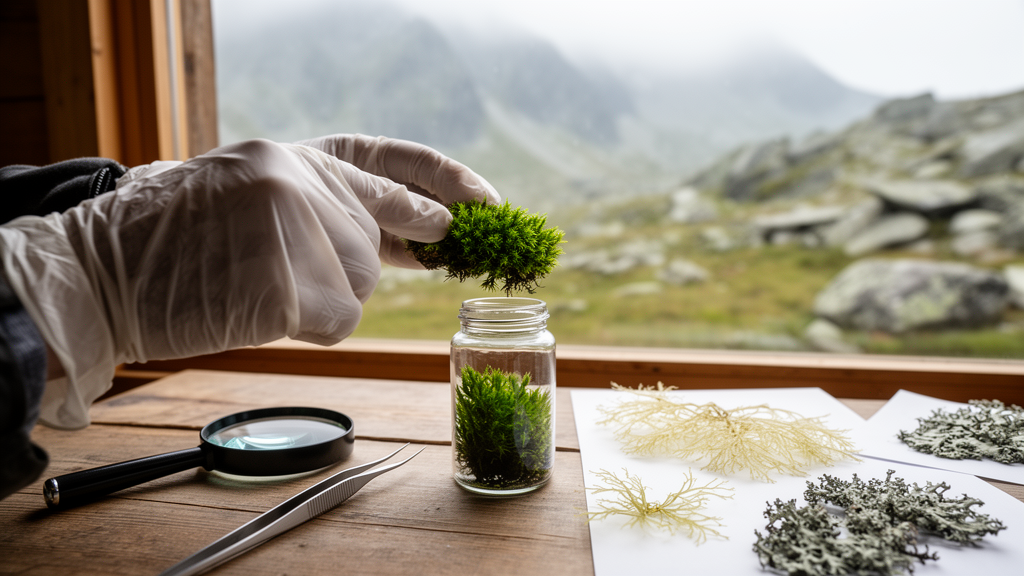
Image Credits: AI Generated
DOI: 10.3897/italianbotanist.15.103781
Keywords: floristic records, bryophytes, lichens, fungi, algae, Characeae, Riccia breidleri, Italian flora, biodiversity, herbarium specimens, conservation, Alps
Cite Scienmag News
Margaret Porter. (October 27, 2026). New Alpine Moss, Rare Stonewort and Long-Lost Lichens Refresh Italy’s Flora Records. Scienmag. https://scienmag.com/new-alpine-moss-rare-stonewort-and-long-lost-lichens-refresh-italys-flora-records/
Margaret Porter. "New Alpine Moss, Rare Stonewort and Long-Lost Lichens Refresh Italy’s Flora Records." Scienmag, 27 October 2026, https://scienmag.com/new-alpine-moss-rare-stonewort-and-long-lost-lichens-refresh-italys-flora-records/. Accessed 27 October 2026.
Margaret Porter. "New Alpine Moss, Rare Stonewort and Long-Lost Lichens Refresh Italy’s Flora Records." Scienmag. October 27, 2026. https://scienmag.com/new-alpine-moss-rare-stonewort-and-long-lost-lichens-refresh-italys-flora-records/


