

Monday, October 26, 2026
Science
No Result
View All Result
  • Login
  • HOME
  • SCIENCE NEWS
  • CONTACT US
  • HOME
  • SCIENCE NEWS
  • CONTACT US
No Result
View All Result
Scienmag
No Result
View All Result
Home Science News Technology and Engineering

Yellow Maize Cross Shows 15 Percent Heterosis in Pakistani Hybrid Trial

October 26, 2026
in Technology and Engineering
Alan Morgan
By Alan Morgan Scienmag Editorial Profile - Precision Agriculture
Reading Time: 2 mins read
0
Yellow Maize Cross Shows 15 Percent Heterosis in Pakistani Hybrid Trial

Yellow Maize Cross Shows 15 Percent Heterosis in Pakistani Hybrid Trial

65
SHARES
587
VIEWS
Share on FacebookShare on Twitter
ADVERTISEMENT

A breeding study at the Cereal Crop Research Institute in Pirsabaq, Nowshehra, Pakistan, has identified yellow maize hybrid combinations with strong yield performance, with one cross, YL-2 × YD-4, recording 15.1 percent economic heterosis and 3.30 percent commercial heterosis for grain yield. The work was carried out during the Kharif 2022 season and is published in Scientific Reports.

The research team, including Abbas Ali, Sher Aslam Khan and colleagues, crossed ten inbred maize lines with three testers in a line-by-tester mating design, producing thirty F1 hybrids. These crosses, together with two check entries, were evaluated in a randomized complete block design with three replications. The aim was to estimate general combining ability (GCA) and specific combining ability (SCA) effects, along with heterotic effects, for morphological and yield-related traits of yellow maize.

Statistical analysis showed significant differences among both parents and crosses for all traits studied, a result the authors interpret as indicating that further selection is possible. GCA and SCA estimates were significant for all studied traits except ear diameter.

Three inbred lines showed desirable negative GCA values for earliness: YL-1, YL-2 and YL-8 RC. Separately, the parental lines YL-1, YL-2 and YL-6 displayed desirable and significant positive GCA values for ear length, 100-grain weight and grain yield, which the study attributes to favorable additive genetic effects for these traits.

Among the thirty F1 crosses, three combinations delivered the highest grain yields. YL-2 × YD-4 reached 8629.5 kilograms per hectare, YL-6 × YD-4 produced 7617.5 kilograms per hectare, and YL-1 × YL-07 RC yielded 7602.8 kilograms per hectare. All three showed positive and significant SCA effects for grain yield.

The top performer, YL-2 × YD-4, recorded positive and significant economic heterosis of 15.1 percent and commercial heterosis of 3.30 percent for grain yield, and the study highlights its potential for further evaluation.

Assessment of combining ability variances revealed a predominance of SCA variance over GCA variance for most traits. Baker’s ratio values below unity likewise indicated a greater contribution of non-additive genetic effects to the expression of the traits studied in this population.

The study is a single-location trial conducted over one season at one institute, so the reported yields and heterosis values describe performance under those specific Kharif 2022 conditions. The abstract does not report multi-environment testing of the crosses.

Within the scope of the trial, the findings supply breeders with measured GCA values for individual inbred lines, significant SCA effects for specific cross combinations, and quantified heterosis for the leading hybrid, all based on the observed performance of the thirty crosses and two checks in the 2022 season.

Subject of Research: Combining ability and heterosis in yellow maize hybrids evaluated in Pakistan

Article Title: Genetic components and heterotic performance of yellow maize hybrids for morphological and yield traits

Article References: Ali, A., Khan, S. A., Khalili, A., Ali, N., Ali, S., Hussain, I., & Qayyum, A. (2026). Genetic components and heterotic performance of yellow maize hybrids for morphological and yield traits. Scientific Reports. https://doi.org/10.1038/s41598-026-75670-2

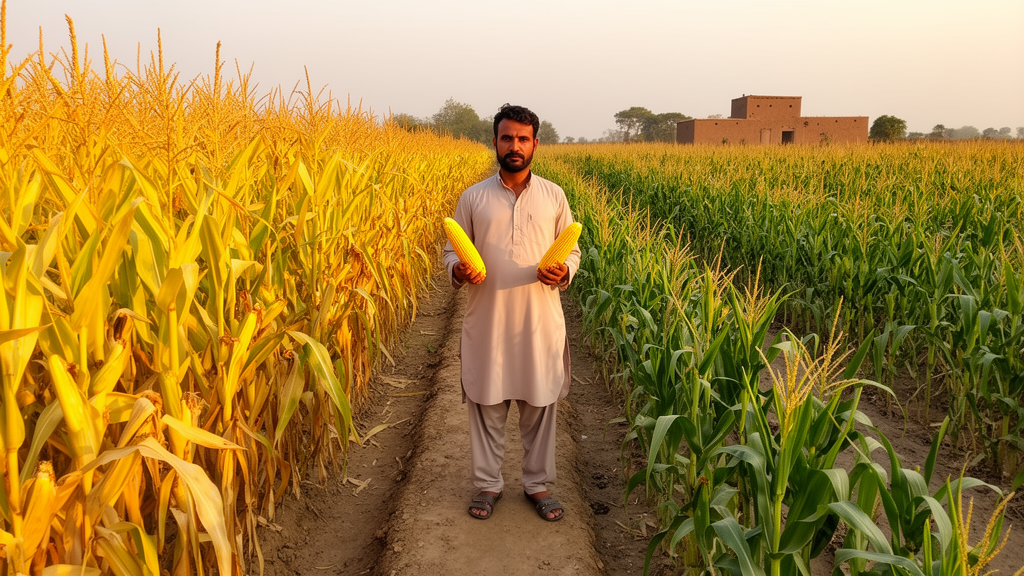
Image Credits: AI Generated

DOI: 10.1038/s41598-026-75670-2

Keywords: maize, hybrid breeding, heterosis, combining ability, GCA, SCA, grain yield, inbred lines, line-by-tester, genetics, Pakistan, plant breeding

Cite Scienmag News

Alan Morgan. (October 26, 2026). Yellow Maize Cross Shows 15 Percent Heterosis in Pakistani Hybrid Trial. Scienmag. https://scienmag.com/yellow-maize-cross-shows-15-percent-heterosis-in-pakistani-hybrid-trial/

Alan Morgan. "Yellow Maize Cross Shows 15 Percent Heterosis in Pakistani Hybrid Trial." Scienmag, 26 October 2026, https://scienmag.com/yellow-maize-cross-shows-15-percent-heterosis-in-pakistani-hybrid-trial/. Accessed 26 October 2026.

Alan Morgan. "Yellow Maize Cross Shows 15 Percent Heterosis in Pakistani Hybrid Trial." Scienmag. October 26, 2026. https://scienmag.com/yellow-maize-cross-shows-15-percent-heterosis-in-pakistani-hybrid-trial/


Tags: combining abilityeconomic and commercial heterosis in maizeGCAGCA and SCA effects in maize breedinggenetic analysis of maize yield traitsgenetic diversity in maize breedinggeneticsgrain yieldheterosisheterosis percentage in maize hybridshybrid breedinghybrid maize performance in Pakistaninbred linesline-by-testerline-by-tester mating design in maizemaizemaize breeding and hybrid performance evaluationmaize hybrid trials in Kharif seasonmaize yield-related trait improvementPakistanplant breedingSCAsignificance of heterotic effects in maizeYellow maize hybrid heterosis in Pakistan
Share26Tweet16
Previous Post

RNA Chemical Marks Emerge as Hidden Regulators of Poultry Growth and Immunity

Next Post

Blood Flow Restriction Training After Stroke Shows Modest Gains, Review Finds

Related Posts

Three Simple Rules Explain How Mollusks Grow Nearly Every Shell Shape
Technology and Engineering

Three Simple Rules Explain How Mollusks Grow Nearly Every Shell Shape

October 26, 2026
Phosphate-Loaded PVA Nanofibers Show Enhanced Bone-Like Mineralization
Technology and Engineering

Phosphate-Loaded PVA Nanofibers Show Enhanced Bone-Like Mineralization

October 26, 2026
Australian smart bedding sensors that flag falls risk win US patent
Technology and Engineering

Australian smart bedding sensors that flag falls risk win US patent

October 26, 2026
Engineered Human Cell-Derived Matrix Outperforms Recombinant Collagen, but Senescence Looms
Science News

Engineered Human Cell-Derived Matrix Outperforms Recombinant Collagen, but Senescence Looms

October 26, 2026
AI chatbots outperformed dentists and doctors on radiation safety quiz
Technology and Engineering

AI chatbots outperformed dentists and doctors on radiation safety quiz

October 26, 2026
AI pinpoints and explains smart contract flaws at function level
Technology and Engineering

AI pinpoints and explains smart contract flaws at function level

October 26, 2026
Next Post
Blood Flow Restriction Training After Stroke Shows Modest Gains, Review Finds

Blood Flow Restriction Training After Stroke Shows Modest Gains, Review Finds

  • Mothers who receive childcare support from maternal grandparents show more optimized

    Mothers who receive childcare support from maternal grandparents show more parental warmth, finds NTU Singapore study

    27656 shares
    Share 11059 Tweet 6912
  • University of Seville Breaks 120-Year-Old Mystery, Revises a Key Einstein Concept

    1061 shares
    Share 424 Tweet 265
  • Bee body mass, pathogens and local climate influence heat tolerance

    682 shares
    Share 273 Tweet 171
  • Researchers record first-ever images and data of a shark experiencing a boat strike

    546 shares
    Share 218 Tweet 137
  • Groundbreaking Clinical Trial Reveals Lubiprostone Enhances Kidney Function

    531 shares
    Share 212 Tweet 133
Science

Embark on a thrilling journey of discovery with Scienmag.com—your ultimate source for cutting-edge breakthroughs. Immerse yourself in a world where curiosity knows no limits and tomorrow’s possibilities become today’s reality!

RECENT NEWS

  • Blood Flow Restriction Training After Stroke Shows Modest Gains, Review Finds
  • Yellow Maize Cross Shows 15 Percent Heterosis in Pakistani Hybrid Trial
  • RNA Chemical Marks Emerge as Hidden Regulators of Poultry Growth and Immunity
  • Tiny RNA Cargo From Bone-Eating Cells Shields the Hip From Alcohol Damage

Categories

  • Agriculture
  • Anthropology
  • Archaeology
  • Athmospheric
  • Biology
  • Biotechnology
  • Blog
  • Bussines
  • Cancer
  • Chemistry
  • Climate
  • Earth Science
  • Editorial Policy
  • Marine
  • Mathematics
  • Medicine
  • Pediatry
  • Policy
  • Psychology & Psychiatry
  • Science Education
  • Science News
  • Social Science
  • Space
  • Technology and Engineering

Subscribe to Blog via Email

Enter your email address to subscribe to this blog and receive notifications of new posts by email.

Join 5,151 other subscribers

© 2025 Scienmag - Science Magazine

Welcome Back!

Login to your account below

Forgotten Password?

Retrieve your password

Please enter your username or email address to reset your password.

Log In
No Result
View All Result
  • HOME
  • SCIENCE NEWS
  • CONTACT US

© 2025 Scienmag - Science Magazine

Discover more from Science

Subscribe now to keep reading and get access to the full archive.

Continue reading