

Monday, October 26, 2026
Science
No Result
View All Result
  • Login
  • HOME
  • SCIENCE NEWS
  • CONTACT US
  • HOME
  • SCIENCE NEWS
  • CONTACT US
No Result
View All Result
Scienmag
No Result
View All Result
Home Science News Technology and Engineering

AI Adapts on the Fly to Sort Electronic Waste With Far Less Training Data

October 26, 2026
in Technology and Engineering
Blake Davidson
By Blake Davidson Scienmag Editorial Profile - Data Science
Reading Time: 2 mins read
0
AI Adapts on the Fly to Sort Electronic Waste With Far Less Training Data

AI Adapts on the Fly to Sort Electronic Waste With Far Less Training Data

65
SHARES
587
VIEWS
Share on FacebookShare on Twitter
ADVERTISEMENT

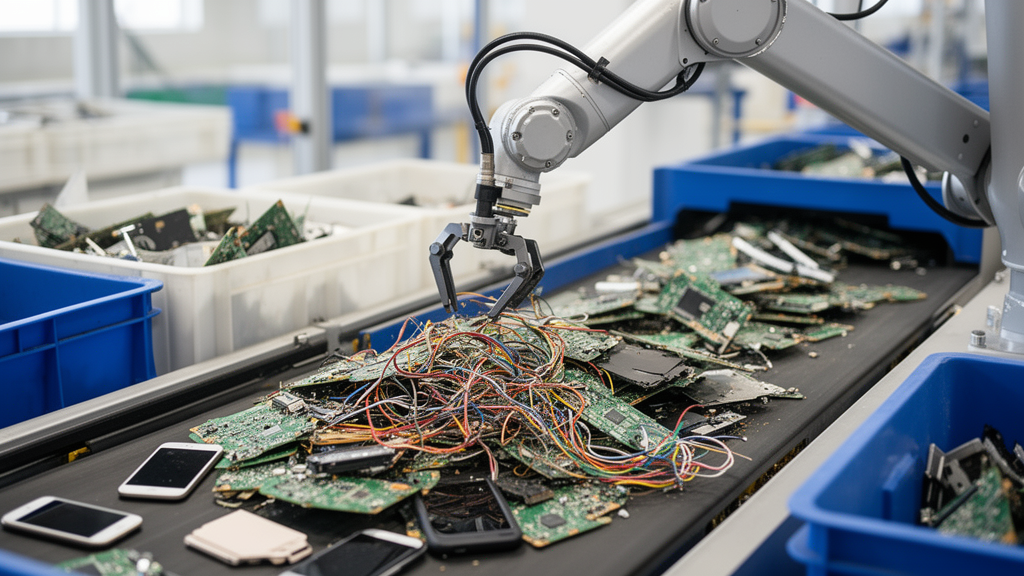
Writing in Scientific Reports, Aseni Senanayake, Mehrtash Harandi, Nilakshan Kunananthaseelan, Mehrdad Arashpour and colleagues describe a segmentation method that adapts large-scale vision foundation models at inference time, rather than requiring lengthy offline retraining on domain-specific data. Images of discarded electronics are heterogeneous and cluttered, with devices often overlapping, partially obscured and presented in unpredictable orientations. Labeled training data for such scenes is scarce, and conventional fine-tuning of large models is computationally expensive and slow.

Vision foundation models, which are pretrained on enormous image collections, generalize well across visual domains, but the authors note that applying them directly to fine-grained e-waste segmentation has remained limited. Their solution is test-time fine-tuning. Instead of permanently adjusting the model's parameters before deployment, the approach adapts the model during inference using a small, diverse and contextually relevant support set of reference images.

The key innovation is how that support set is assembled. The researchers introduce what they call active retrieval, a two-stage selection process that first preselects candidate images using cosine similarity in the model's feature space, then applies an informativeness acquisition function to pick query-specific, non-redundant examples. This ensures the support images are both relevant to the item being segmented and sufficiently varied to guide the adaptation without redundant computation.

Evaluated on a curated e-waste dataset, the method delivered its headline result: end-to-end processing time was reduced by approximately sixfold compared with parameter-efficient fine-tuning, while segmentation accuracy remained reliable despite using less domain-specific training data. The findings are model-level results on a curated dataset rather than demonstrations inside an operating recycling facility, and the authors frame the work as a scalable foundation for AI-assisted e-waste management. If such systems can be deployed at scale, they could improve resource recovery from discarded electronics, a goal the team links directly to resource conservation and environmental sustainability.

The study was published open access in Scientific Reports on 26 October 2026.

Subject of Research: Test-time fine-tuning of vision foundation models for data-efficient electronic waste image segmentation

Article Title: Test-time fine-tuning of large-scale vision foundation models for data-efficient electronic waste segmentation

Article References: Senanayake, A., Harandi, M., Kunananthaseelan, N., & Arashpour, M. (2026). Test-time fine-tuning of large-scale vision foundation models for data-efficient electronic waste segmentation. Scientific Reports. https://doi.org/10.1038/s41598-026-77031-5

Image Credits: AI Generated

DOI: 10.1038/s41598-026-77031-5

Keywords: electronic waste, deep learning, computer vision, test-time fine-tuning, vision foundation models, image segmentation, active retrieval, recycling, resource recovery, artificial intelligence, Test-time, fine-tuning

Cite Scienmag News

Blake Davidson. (October 26, 2026). AI Adapts on the Fly to Sort Electronic Waste With Far Less Training Data. Scienmag. https://scienmag.com/ai-adapts-on-the-fly-to-sort-electronic-waste-with-far-less-training-data/

Blake Davidson. "AI Adapts on the Fly to Sort Electronic Waste With Far Less Training Data." Scienmag, 26 October 2026, https://scienmag.com/ai-adapts-on-the-fly-to-sort-electronic-waste-with-far-less-training-data/. Accessed 26 October 2026.

Blake Davidson. "AI Adapts on the Fly to Sort Electronic Waste With Far Less Training Data." Scienmag. October 26, 2026. https://scienmag.com/ai-adapts-on-the-fly-to-sort-electronic-waste-with-far-less-training-data/


Tags: active retrievalactive retrieval for image selectionArtificial Intelligencecluttered electronic device imagescomputer visiondeep learningdomain-specific image segmentationefficient waste sorting AIelectronic wasteelectronic waste segmentationfew-shot learning in waste sortingfine-tuningheterogeneous electronic waste imagesimage segmentationinference-time model customizationon-the-fly model adaptationrecyclingresource recoverysupport set assembly for AITest-timetest-time fine-tuningvision foundation modelsvision foundation models for e-waste
Share26Tweet16
Previous Post

Fungal Enzyme Modification Controls Purine Metabolism in Verticillium Wilt

Next Post

Lumina simulation recreates the universe’s first 2 billion years in unprecedented detail

Related Posts

Whole-Body Cryotherapy and Light Therapy Show Consistent Effects on Post-Exercise Soreness and Damage Markers
Science News

Whole-Body Cryotherapy and Light Therapy Show Consistent Effects on Post-Exercise Soreness and Damage Markers

October 26, 2026
PMS-PZT ceramic hits 1.13 m/s vibration with only 20 °C heating
Technology and Engineering

PMS-PZT ceramic hits 1.13 m/s vibration with only 20 °C heating

October 26, 2026
Better imputation accuracy does not buy better predictions in real-world health data
Technology and Engineering

Better imputation accuracy does not buy better predictions in real-world health data

October 26, 2026
Cadmium–oxygen bonds forge fast charge channels in S-scheme photocatalyst
Technology and Engineering

Cadmium–oxygen bonds forge fast charge channels in S-scheme photocatalyst

October 26, 2026
Attention-enhanced AI detector spots incipient fires in solar plants
Technology and Engineering

Attention-enhanced AI detector spots incipient fires in solar plants

October 26, 2026
Fabricated References Spread Beyond Medicine, Audit of 500,000 Papers Finds
Technology and Engineering

Fabricated References Spread Beyond Medicine, Audit of 500,000 Papers Finds

October 26, 2026
Next Post
Lumina simulation recreates the universe’s first 2 billion years in unprecedented detail

Lumina simulation recreates the universe's first 2 billion years in unprecedented detail

  • Mothers who receive childcare support from maternal grandparents show more optimized

    Mothers who receive childcare support from maternal grandparents show more parental warmth, finds NTU Singapore study

    27656 shares
    Share 11059 Tweet 6912
  • University of Seville Breaks 120-Year-Old Mystery, Revises a Key Einstein Concept

    1061 shares
    Share 424 Tweet 265
  • Bee body mass, pathogens and local climate influence heat tolerance

    682 shares
    Share 273 Tweet 171
  • Researchers record first-ever images and data of a shark experiencing a boat strike

    546 shares
    Share 218 Tweet 137
  • Groundbreaking Clinical Trial Reveals Lubiprostone Enhances Kidney Function

    531 shares
    Share 212 Tweet 133
Science

Embark on a thrilling journey of discovery with Scienmag.com—your ultimate source for cutting-edge breakthroughs. Immerse yourself in a world where curiosity knows no limits and tomorrow’s possibilities become today’s reality!

RECENT NEWS

  • Lumina simulation recreates the universe’s first 2 billion years in unprecedented detail
  • AI Adapts on the Fly to Sort Electronic Waste With Far Less Training Data
  • Fungal Enzyme Modification Controls Purine Metabolism in Verticillium Wilt
  • Grb2 phosphorylation disrupts EGFR condensates and reshapes Ras signaling

Categories

  • Agriculture
  • Anthropology
  • Archaeology
  • Athmospheric
  • Biology
  • Biotechnology
  • Blog
  • Bussines
  • Cancer
  • Chemistry
  • Climate
  • Earth Science
  • Editorial Policy
  • Marine
  • Mathematics
  • Medicine
  • Pediatry
  • Policy
  • Psychology & Psychiatry
  • Science Education
  • Science News
  • Social Science
  • Space
  • Technology and Engineering

Subscribe to Blog via Email

Enter your email address to subscribe to this blog and receive notifications of new posts by email.

Join 5,151 other subscribers

© 2025 Scienmag - Science Magazine

Welcome Back!

Login to your account below

Forgotten Password?

Retrieve your password

Please enter your username or email address to reset your password.

Log In
No Result
View All Result
  • HOME
  • SCIENCE NEWS
  • CONTACT US

© 2025 Scienmag - Science Magazine

Discover more from Science

Subscribe now to keep reading and get access to the full archive.

Continue reading