

Monday, October 26, 2026
Science
No Result
View All Result
  • Login
  • HOME
  • SCIENCE NEWS
  • CONTACT US
  • HOME
  • SCIENCE NEWS
  • CONTACT US
No Result
View All Result
Scienmag
No Result
View All Result
Home Science News Technology and Engineering

Attention-enhanced AI detector spots incipient fires in solar plants

October 26, 2026
in Technology and Engineering
Blake Davidson
By Blake Davidson Scienmag Editorial Profile - Data Science
Reading Time: 3 mins read
0
Attention-enhanced AI detector spots incipient fires in solar plants

Attention-enhanced AI detector spots incipient fires in solar plants

65
SHARES
587
VIEWS
Share on FacebookShare on Twitter
ADVERTISEMENT

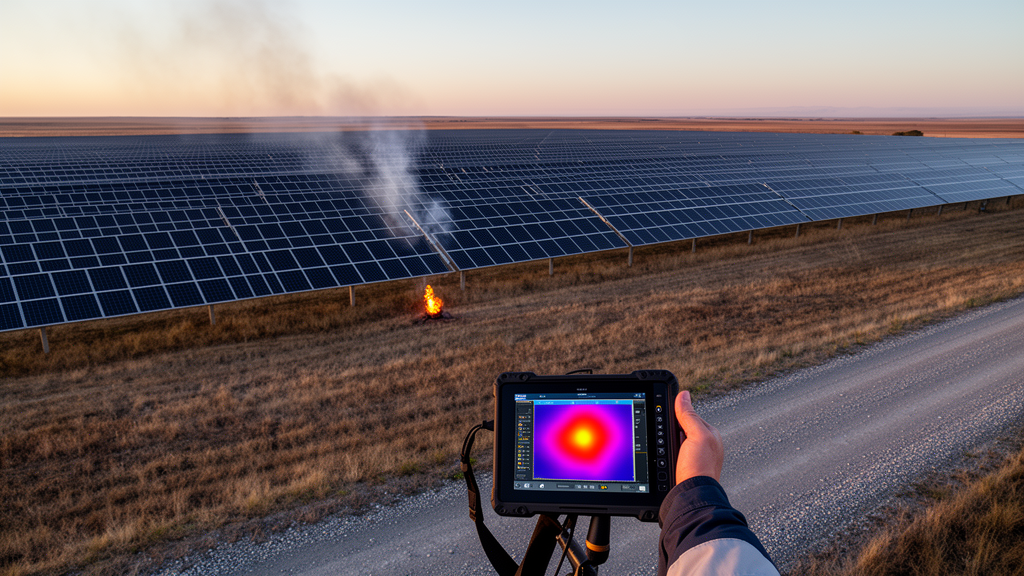
Photovoltaic power plants pack together flammable polymers and electrical components prone to arcing, which makes early fire detection a safety-critical monitoring task. A new study published in Scientific Reports presents PVFire-YOLO, a real-time neural detection framework designed to catch fires while they are still small, weakly contrasted patches of smoke or flame. The work addresses a problem that plagues conventional detectors in solar installations: the glossy surfaces of photovoltaic modules produce specular reflections that fabricate fire-like visual cues, degrading detection accuracy precisely where early warning matters most.

The framework combines three technical components. A patch-aware parallel attention block amplifies weak responses from small targets against reflective backgrounds, helping the network distinguish genuine incipient flames and smoke from mirrored light on module glass. A gather-and-distribute neck performs information fusion across four feature-pyramid levels, closing the semantic gap that limits conventional neck architectures, in which features at different resolutions carry inconsistent information. Finally, a four-scale adaptive spatial feature-fusion head learns per-pixel scale weights and adds a high-resolution branch dedicated to targets smaller than 100 pixels, the size range where incipient fires typically first appear in plant surveillance imagery.

To train and evaluate the detector, the researchers built PV-Fire, described as the first annotated flame-and-smoke corpus with a photovoltaic-specific background distribution. The dataset allows models to learn the visual statistics of solar plants, including the reflective surfaces and equipment layouts that generate false alarms in generic fire-detection systems. Evaluation was conducted both on this new corpus and on the public D-Fire benchmark, allowing comparison with detectors trained outside the photovoltaic domain.

Against fourteen baseline detectors, PVFire-YOLO reached a mean average precision of 87.4 percent at an intersection-over-union threshold of 0.5 on PV-Fire and 84.4 percent on D-Fire. On small targets specifically, the model raised average precision by 5.2 points over its own baseline architecture, indicating that the attention and fusion components contribute most where targets are hardest to see. The reflection-induced false-positive rate fell to 3.1 percent at higher recall, addressing the trade-off in which detectors that catch more real fires also flag more spurious events.

Speed figures support the real-time claim in the framework’s name. PVFire-YOLO ran at 79 frames per second on a desktop graphics card and 21 frames per second on an embedded edge device, the class of hardware typically installed at remote plant sites. The authors report the work as an applied computational-intelligence study, positioning the detector for deployment in operational photovoltaic monitoring. As with any benchmark-based evaluation, field performance across varying lighting, weather and plant geometries would need to be established through deployment experience, and the published version of the paper remains subject to further editorial updates pending the final Version of Record.

Subject of Research: Real-time small-target fire detection in photovoltaic plants using an attention-enhanced multiscale fusion neural detector

Article Title: Real time small target fire detection in photovoltaic plants using attention enhanced multiscale fusion

Article References: Guo, W., Meng, X., Wang, J., Cai, C., & Cui, H. (2026). Real time small target fire detection in photovoltaic plants using attention enhanced multiscale fusion. Scientific Reports. https://doi.org/10.1038/s41598-026-74289-7

Image Credits: AI Generated

DOI: 10.1038/s41598-026-74289-7

Keywords: photovoltaic, fire detection, PVFire-YOLO, attention mechanism, feature fusion, small target detection, computer vision, deep learning, PV-Fire dataset, real-time detection, solar plant safety, false positives

Cite Scienmag News

Blake Davidson. (October 26, 2026). Attention-enhanced AI detector spots incipient fires in solar plants. Scienmag. https://scienmag.com/attention-enhanced-ai-detector-spots-incipient-fires-in-solar-plants/

Blake Davidson. "Attention-enhanced AI detector spots incipient fires in solar plants." Scienmag, 26 October 2026, https://scienmag.com/attention-enhanced-ai-detector-spots-incipient-fires-in-solar-plants/. Accessed 26 October 2026.

Blake Davidson. "Attention-enhanced AI detector spots incipient fires in solar plants." Scienmag. October 26, 2026. https://scienmag.com/attention-enhanced-ai-detector-spots-incipient-fires-in-solar-plants/


Tags: attention mechanismattention-enhanced neural networks for fire spottingcomputer visiondeep learningearly fire detection in solar plantsfalse positivesfeature fusionfire detectionfire detection challenges in reflective solar panelsfire detection using deep learningmulti-scale feature fusion in fire detectionphotovoltaicphotovoltaic power plant fire monitoringPV-Fire datasetPVFire-YOLOPVFire-YOLO fire detection modelreal-time detectionreal-time neural fire detection frameworksafety-critical fire monitoring in photovoltaic installationssmall target detectionsmall target fire detection in solar modulessolar plant fire detectionsolar plant safetyspecular reflection interference in fire detection
Share26Tweet16
Previous Post

Maternal Obesity Reshapes Umbilical Cord Blood Adipokine Profile in Term Newborns

Next Post

Oral Microbiome Models Show Promise for Detecting Mouth Cancer, but Clinical Validation Lags

Related Posts

Whole-Body Cryotherapy and Light Therapy Show Consistent Effects on Post-Exercise Soreness and Damage Markers
Science News

Whole-Body Cryotherapy and Light Therapy Show Consistent Effects on Post-Exercise Soreness and Damage Markers

October 26, 2026
PMS-PZT ceramic hits 1.13 m/s vibration with only 20 °C heating
Technology and Engineering

PMS-PZT ceramic hits 1.13 m/s vibration with only 20 °C heating

October 26, 2026
Better imputation accuracy does not buy better predictions in real-world health data
Technology and Engineering

Better imputation accuracy does not buy better predictions in real-world health data

October 26, 2026
Cadmium–oxygen bonds forge fast charge channels in S-scheme photocatalyst
Technology and Engineering

Cadmium–oxygen bonds forge fast charge channels in S-scheme photocatalyst

October 26, 2026
Fabricated References Spread Beyond Medicine, Audit of 500,000 Papers Finds
Technology and Engineering

Fabricated References Spread Beyond Medicine, Audit of 500,000 Papers Finds

October 26, 2026
New AI model sharpens subway passenger flow forecasts across three Chinese metros
Technology and Engineering

New AI model sharpens subway passenger flow forecasts across three Chinese metros

October 26, 2026
Next Post
Oral Microbiome Models Show Promise for Detecting Mouth Cancer, but Clinical Validation Lags

Oral Microbiome Models Show Promise for Detecting Mouth Cancer, but Clinical Validation Lags

  • Mothers who receive childcare support from maternal grandparents show more optimized

    Mothers who receive childcare support from maternal grandparents show more parental warmth, finds NTU Singapore study

    27656 shares
    Share 11059 Tweet 6912
  • University of Seville Breaks 120-Year-Old Mystery, Revises a Key Einstein Concept

    1061 shares
    Share 424 Tweet 265
  • Bee body mass, pathogens and local climate influence heat tolerance

    682 shares
    Share 273 Tweet 171
  • Researchers record first-ever images and data of a shark experiencing a boat strike

    546 shares
    Share 218 Tweet 137
  • Groundbreaking Clinical Trial Reveals Lubiprostone Enhances Kidney Function

    531 shares
    Share 212 Tweet 133
Science

Embark on a thrilling journey of discovery with Scienmag.com—your ultimate source for cutting-edge breakthroughs. Immerse yourself in a world where curiosity knows no limits and tomorrow’s possibilities become today’s reality!

RECENT NEWS

  • Grb2 phosphorylation disrupts EGFR condensates and reshapes Ras signaling
  • Gum Disease Inflammation Activates Viral Entry Pathways Tied to SARS-CoV-2
  • Whole-Body Cryotherapy and Light Therapy Show Consistent Effects on Post-Exercise Soreness and Damage Markers
  • Organoids and assembloids reshape how researchers model glioblastoma

Categories

  • Agriculture
  • Anthropology
  • Archaeology
  • Athmospheric
  • Biology
  • Biotechnology
  • Blog
  • Bussines
  • Cancer
  • Chemistry
  • Climate
  • Earth Science
  • Editorial Policy
  • Marine
  • Mathematics
  • Medicine
  • Pediatry
  • Policy
  • Psychology & Psychiatry
  • Science Education
  • Science News
  • Social Science
  • Space
  • Technology and Engineering

Subscribe to Blog via Email

Enter your email address to subscribe to this blog and receive notifications of new posts by email.

Join 5,151 other subscribers

© 2025 Scienmag - Science Magazine

Welcome Back!

Login to your account below

Forgotten Password?

Retrieve your password

Please enter your username or email address to reset your password.

Log In
No Result
View All Result
  • HOME
  • SCIENCE NEWS
  • CONTACT US

© 2025 Scienmag - Science Magazine

Discover more from Science

Subscribe now to keep reading and get access to the full archive.

Continue reading