


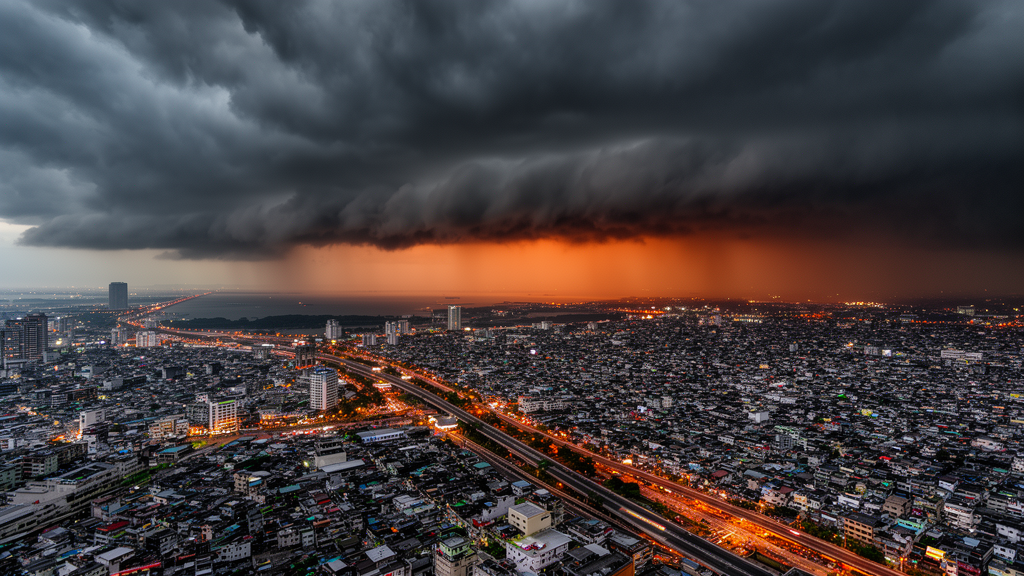
Metropolitan Manila faces a double transformation in its climate over the coming decades, according to a new modeling study published in Theoretical and Applied Climatology. Alyssa Valerio and Gerry Bagtasa used the Weather Research and Forecasting model at a convection-permitting 1-kilometer resolution, combined with a pseudo-global warming approach, to separate the influence of urbanization from that of greenhouse-gas-driven warming on the Philippine megacity’s heat and heavy monsoon rainfall. By simulating six scenarios that pair three land-use configurations—a landscape without cities, the present-day urban footprint, and a projected 2050 urban extent—across three climate regimes spanning 1900–1910, 2023–2024, and 2050–2070, the study quantifies how each forcing has shaped, and will continue to shape, conditions across one of Asia’s most densely built regions.
The historical simulations attribute most of Manila’s century-scale warming to the city itself. Urbanization, the authors find, overwhelmingly drove 76 percent of the 5.0 °C surge in nocturnal minimum temperatures observed over the past century, a signature of the urban heat island storing and releasing heat in built surfaces after sunset. That dominance, however, is not permanent. As the megacity approaches spatial saturation—meaning there is progressively less undeveloped land left to convert—the study projects that future warming will be mainly greenhouse-gas-driven rather than a product of expanding concrete.
Under the intermediate SSP2-4.5 emissions scenario, temperatures during the hottest months are projected to rise by 1.4 °C for the mean, 1.7 °C for minimum values, and 1.7 °C for maximum values. Under the high-emissions SSP5-8.5 scenario, those increases grow to 1.9 °C, 2.1 °C, and 2.4 °C, respectively. These are model-based projections for the 2050–2070 period, not observations, but they indicate that the warming Manila experiences next will come from the global climate system rather than from local land conversion—and that nighttime minimum temperatures, already elevated by a century of urbanization, will climb further on top of that baseline.
The hydrological picture is more counterintuitive. Although a warmer atmosphere holds more moisture, the projections show that increased upper-level stability in the future climate reduces total seasonal precipitation. The distribution of rainfall also shifts: the simulations skew toward more frequent light showers and fewer heavy precipitation events, a seasonal baseline change rather than a simple intensification of the monsoon. In other words, the compound forcing of a hotter, more humid climate over an impermeable urban landscape does not translate directly into more extreme downpours in the seasonal mean.
The most striking result concerns extreme events. When the team simulated the severe tropical cyclone-enhanced monsoon episode of 2024, they found that Manila’s extensive concrete sprawl physically disrupts the extreme orographic rainfall generated upwind of the city. The mechanism is turbulent, not thermal: urbanization reduces the latent heat flux at the surface, which weakens turbulent mixing, lowers the height of the planetary boundary layer, and suppresses the vertical transport of moisture. That chain of effects inhibits the intense, dispersive lee-wave rainbands that the western stratovolcanoes upwind of Manila typically produce during extreme monsoon events—bands that would otherwise deliver some of the heaviest orographic rainfall in the region.
The authors caution that a saturated urban canopy may inadvertently suppress specific localized convective bands, so the city’s sprawl is not simply amplifying every hazard. But the overarching conclusion of the study points the other way: the transition to a hotter, more humid global climate sitting atop an impermeable urban landscape indicates escalating exposure to compound thermal and rainfall hazards. Manila’s future risk, the modeling suggests, will be defined less by how much the city grows and more by how a warming atmosphere interacts with the sprawl it already has.
Subject of Research: Compound effects of land-use and climate change on future heat and heavy monsoon precipitation in Metro Manila
Article Title: Compound effects of land-use and climate change on future heat and heavy monsoon precipitation in Metro Manila
Article References: Valerio, A., & Bagtasa, G. (2026). Compound effects of land-use and climate change on future heat and heavy monsoon precipitation in Metro Manila. Theoretical and Applied Climatology, 157(11), Article 752. https://doi.org/10.1007/s00704-026-06677-y
Image Credits: AI Generated
DOI: 10.1007/s00704-026-06677-y
Keywords: Compound, effects, land-use, climate, change, future, heat, heavy, monsoon, precipitation, Metro, Manila
Cite Scienmag News
Violet Maxwell. (October 26, 2026). Urban Sprawl and Global Warming Reshape Manila’s Heat and Monsoon Rainfall. Scienmag. https://scienmag.com/urban-sprawl-and-global-warming-reshape-manilas-heat-and-monsoon-rainfall/
Violet Maxwell. "Urban Sprawl and Global Warming Reshape Manila’s Heat and Monsoon Rainfall." Scienmag, 26 October 2026, https://scienmag.com/urban-sprawl-and-global-warming-reshape-manilas-heat-and-monsoon-rainfall/. Accessed 26 October 2026.
Violet Maxwell. "Urban Sprawl and Global Warming Reshape Manila’s Heat and Monsoon Rainfall." Scienmag. October 26, 2026. https://scienmag.com/urban-sprawl-and-global-warming-reshape-manilas-heat-and-monsoon-rainfall/


