


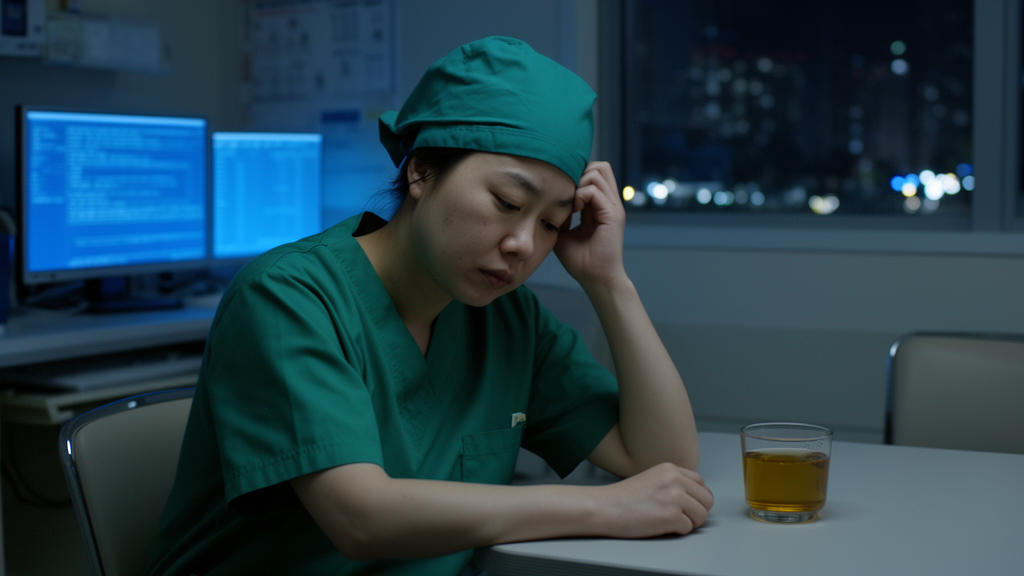
Poor sleep is not an occasional hazard for the nurses who keep operating rooms running in eastern China — it is the norm. In a multicentre cross-sectional survey published in BMC Nursing, 85.5 percent of 351 operating room nurses across six hospitals in Jiangsu Province scored above the clinical threshold on the Pittsburgh Sleep Quality Index, the standard instrument for measuring how people sleep. The mean PSQI score in the sample was 12.47, with a standard deviation of 3.22, well above the cutoff of 7 that defines poor sleep quality.
Because the study was observational and cross-sectional, it documents associations rather than causes, but the sheer prevalence of disturbed sleep among this workforce stands out on its own. The survey was conducted between January and March 2025 and deliberately spanned two tiers of the Chinese hospital system: three tertiary hospitals, which handle the most complex referrals, and three secondary hospitals. Participants completed three validated questionnaires — the Pittsburgh Sleep Quality Index, the 14-item Perceived Stress Scale, and a validated Chinese Nurse Job Satisfaction Scale.
The researchers then used theory-driven hierarchical multiple linear regression to test whether perceived stress and job satisfaction were each independently associated with sleep quality, applying cluster-robust standard errors to account for the fact that nurses were nested within hospitals rather than sampled as fully independent individuals. The statistical picture that emerged was consistent. In the fully adjusted model, higher perceived stress was associated with poorer sleep quality, with a standardized coefficient of 0.297, and lower job satisfaction was likewise associated with poorer sleep quality, with a standardized coefficient of −0.307; both associations were statistically significant at p < 0.001.
Neither psychosocial variable absorbed the other's contribution, suggesting that stress and satisfaction each carry distinct information about how these nurses sleep. Together, the full model explained 33.8 percent of the variance in PSQI scores, and the psychosocial variables added 18.3 percentage points of explained variance beyond the variables already in the model — a substantial increment for two self-reported workplace perceptions. The study also probed a possible indirect pathway.
Using an exploratory mediation analysis with 5,000 bootstrap resamples, the researchers tested whether job satisfaction relates to sleep quality partly through perceived stress. The indirect association was significant, with an unstandardized estimate of −0.747 and a bootstrapped 95 percent confidence interval running from −1.079 to −0.452, and it accounted for 30.1 percent of the total association between job satisfaction and sleep quality. In plain terms, nurses who reported lower job satisfaction also tended to report higher perceived stress, and that stress in turn tracked with worse sleep.
The authors frame this as an exploratory finding, and sensitivity analyses were performed to check its robustness, but the pattern is consistent with stress acting as a conduit between how satisfied nurses feel at work and how badly they sleep. The study's authors note that sleep problems are common among nurses broadly, but that evidence on the independent roles of perceived stress and job satisfaction specifically in operating room nurses has remained limited — the gap this survey was designed to address. The multicentre design, spanning both secondary and tertiary hospitals, offers a broader view of this workforce than single-site surveys typically provide.
The methodological choices matter for interpreting the numbers. Because all three instruments are self-reported and were collected at the same time, the study cannot establish which perception came first, whether stress disrupts sleep, whether poor sleep erodes satisfaction and amplifies stress, or whether unmeasured factors drive all three. That limitation is inherent to the cross-sectional design, and the authors are explicit that the findings describe associations.
Still, the effect sizes are large enough to be practically meaningful: psychosocial perceptions explained nearly one-fifth of the variance in sleep quality beyond the baseline model, and the indirect pathway through perceived stress accounted for roughly one-third of the job satisfaction association. The researchers also note that the study involved no intervention assignment or treatment allocation, so no clinical trial registration was required. The authors conclude that poor sleep quality is highly prevalent among operating room nurses and that the findings support the need for occupational interventions addressing psychosocial factors in this group.
Any such interventions would need to be tested in future studies, since this survey measured perceptions rather than evaluating programs. What the data do establish is a clear empirical target: in a workforce where nearly nine in ten nurses report poor sleep, perceived stress and job satisfaction are each independently associated with sleep quality, and perceived stress appears to carry a significant share of the link between how satisfied nurses feel and how well they sleep.
Subject of Research: Associations of perceived stress and job satisfaction with sleep quality among operating room nurses in China
Article Title: Sleep quality among operating room nurses across secondary and tertiary hospitals in China: associations with perceived stress and job satisfaction in a multicentre cross-sectional study
Article References: Zhao, S., Ma, B., Zhang, L., Shu, J., & He, Y. (2026). Sleep quality among operating room nurses across secondary and tertiary hospitals in China: associations with perceived stress and job satisfaction in a multicentre cross-sectional study. BMC Nursing. https://doi.org/10.1186/s12912-026-05562-3
Image Credits: AI Generated
DOI: 10.1186/s12912-026-05562-3
Keywords: sleep quality, operating room nurses, perceived stress, job satisfaction, cross-sectional study, Pittsburgh Sleep Quality Index, occupational health, nursing, China, psychosocial factors, Sleep, quality
Cite Scienmag News
Ophelia Keating. (October 26, 2026). Poor Sleep Affects Most Chinese Operating Room Nurses, Linked to Stress and Job Satisfaction. Scienmag. https://scienmag.com/poor-sleep-affects-most-chinese-operating-room-nurses-linked-to-stress-and-job-satisfaction/
Ophelia Keating. "Poor Sleep Affects Most Chinese Operating Room Nurses, Linked to Stress and Job Satisfaction." Scienmag, 26 October 2026, https://scienmag.com/poor-sleep-affects-most-chinese-operating-room-nurses-linked-to-stress-and-job-satisfaction/. Accessed 26 October 2026.
Ophelia Keating. "Poor Sleep Affects Most Chinese Operating Room Nurses, Linked to Stress and Job Satisfaction." Scienmag. October 26, 2026. https://scienmag.com/poor-sleep-affects-most-chinese-operating-room-nurses-linked-to-stress-and-job-satisfaction/


