


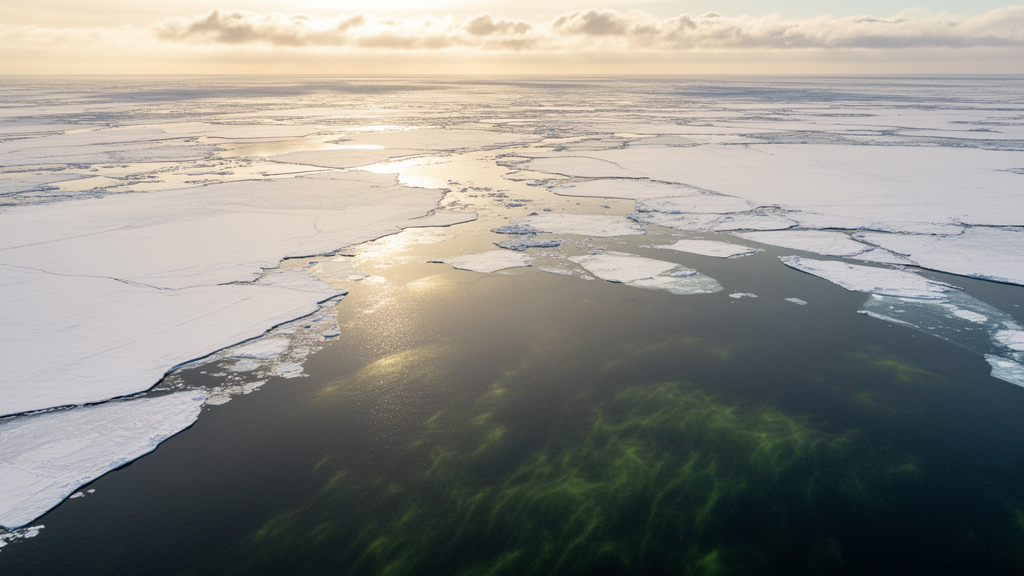
Spring primary production in the nitrate-limited Barents Sea ice zone has declined by 45 percent between 1998 and 2023, according to a satellite-based analysis published in Nature Communications. The study, led by Chao Zhang and colleagues, used satellite ocean color data to quantify the trend and found an average reduction of 90.43 milligrams of carbon per square meter per day for each decade, a statistically significant decrease reported at p < 0.05.
The finding stands out against the broader picture of the Barents Sea, where long-term greening and increased annual production under anthropogenic climate forcing are well documented. The authors note that seasonal differences in production trends have been less clear, and their results reveal that the spring bloom, a critical pulse of food for Arctic ecosystems, is moving in the opposite direction to the annual average.
The researchers attribute the decline primarily to reduced nitrate availability during spring. Three linked processes appear responsible: slower replenishment of nitrate over winter, increased consumption of nitrate upstream of the ice zone, and a net export of nitrate out of the region. These mechanisms are linked to Atlantification, which the study identifies as reshaping the region’s nutrient environment.
Light availability has also diminished. The study identifies a North Atlantic-Arctic atmospheric wave train, together with reduced freshwater input, as factors that have deepened the surface mixed layer, lowering light availability and further limiting spring production on top of the nutrient constraint.
Because the analysis is based on satellite ocean color observations, it captures large-scale changes in surface production rather than direct measurements throughout the water column, and the reported trend applies specifically to the nitrate-limited ice zone during April and May. Within that scope, the signal is clear enough for the authors to draw a forward-looking conclusion: continued warming will likely suppress spring production in the Barents Sea ice zone further.
The ecological stakes are considerable. A weakened spring bloom reduces the seasonal pulse of carbon that underpins Arctic marine food webs, and the authors warn that nutrient-driven cascading effects on food webs and biodiversity could follow if the trend continues. The Barents Sea ice zone thus offers a clear illustration of how climate forcing can reverse productivity in a season even while annual production in the region increases overall.
Subject of Research: Declining spring primary production in the Barents Sea ice zone under climate-driven nutrient and light limitation
Article Title: Declining spring production in the Barents Sea ice zone under climate forcing
Article References: Zhang, C., Duan, A., Liang, M., Fu, G., & Achterberg, E. P. (2026). Declining spring production in the Barents Sea ice zone under climate forcing. Nature Communications. https://doi.org/10.1038/s41467-026-79272-4
Image Credits: AI Generated
DOI: 10.1038/s41467-026-79272-4
Keywords: Barents Sea, primary production, spring bloom, nitrate limitation, Atlantification, satellite ocean color, mixed layer, Arctic food webs, climate change, biodiversity, Declining, spring
Cite Scienmag News
Violet Maxwell. (October 26, 2026). Spring plankton production in the Barents Sea ice zone has fallen 45 percent. Scienmag. https://scienmag.com/spring-plankton-production-in-the-barents-sea-ice-zone-has-fallen-45-percent/
Violet Maxwell. "Spring plankton production in the Barents Sea ice zone has fallen 45 percent." Scienmag, 26 October 2026, https://scienmag.com/spring-plankton-production-in-the-barents-sea-ice-zone-has-fallen-45-percent/. Accessed 26 October 2026.
Violet Maxwell. "Spring plankton production in the Barents Sea ice zone has fallen 45 percent." Scienmag. October 26, 2026. https://scienmag.com/spring-plankton-production-in-the-barents-sea-ice-zone-has-fallen-45-percent/


