


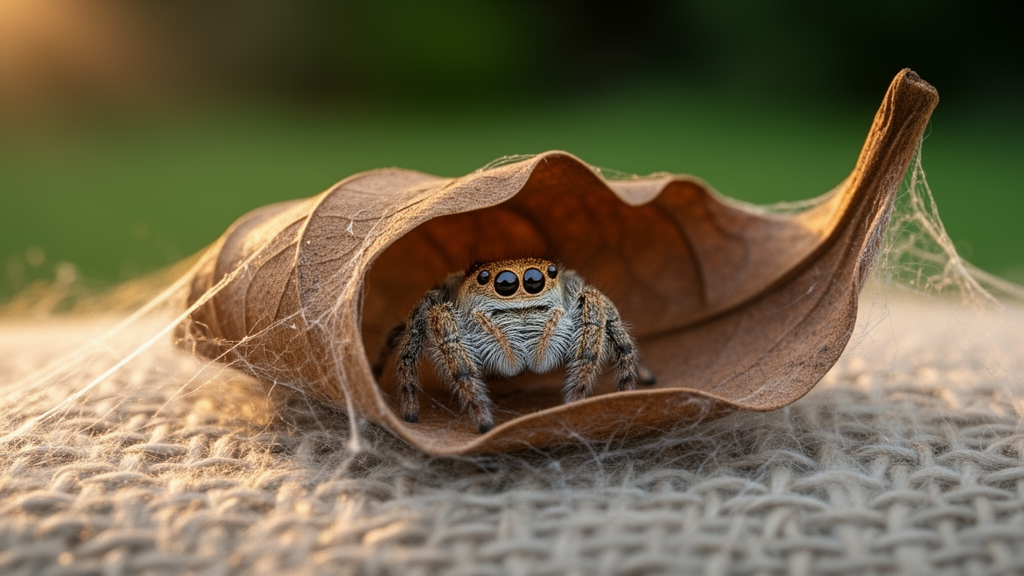
The Australian jumping spider Portia fimbriata, a species barely larger than a one-euro coin that hunts other spiders with strategies often read as signs of intelligence, exhibits true, regulated sleep with two clearly distinguishable sleep stages, including a REM-like state marked by eye movements and muscle twitches. That is the central conclusion of a study by researchers at the Institute of Organismic Biology at the University of Bonn, published in the Proceedings of the National Academy of Sciences. The work provides the first comprehensive confirmation of sleep behavior in a spider, a group in which experimental evidence for genuine sleep had been lacking until now. What is known about sleep comes almost exclusively from vertebrates, which pass through stages including rapid eye movement (REM) sleep characterized by quick eye movements and muscle twitches. Establishing a comparable state in an animal with a radically different nervous system bears directly on questions of how sleep evolved and how widespread REM-like states may be across the animal kingdom.
The team recorded individual Portia fimbriata in small plastic dishes, each twelve centimeters in diameter, under varying lighting conditions over several days and nights to capture day-night rhythms. For nighttime documentation, the researchers used infrared cameras to record sleep positions, resting phases, and REM-like phases in detail. Because spiders perceive the world very differently from humans, finding a stimulus for arousal experiments to which the animals would respond reliably was described as the biggest challenge. The researchers verified whether the animals were actually in a sleep state by applying an acoustic stimulus and measuring their reaction times. They also tested whether the spiders showed sleep rebound, meaning they made up for lost sleep after sleep disruption. The authors emphasized that they had to remain cautious not to overinterpret the REM-like movements, but rather to test step by step whether they really meant what the team suspected. All of this had to be done without measuring brain activity, relying solely on the animals’ behavior, which required very detailed and lengthy video documentation and produced enormous amounts of data, itself a further challenge.
The choice of species was deliberate. Species of the genus Portia feed on other spiders, and their diverse hunting strategies are often interpreted as a sign of intelligence: they mimic the vibrations of wriggling insects caught in a web to attract web-building spiders. Their sophisticated hunting behavior suggests special learning abilities, which makes the spider interesting for sleep research. In the published photographs, the animals hang upside down beneath their self-spun webs in a sleeping position. The researchers recommend studying sleep not only in classic model organisms or vertebrates, but broadening the field taxonomically, in particular by studying sleep in animals with vastly different nervous systems or extreme adaptations. This, they argue, can help identify universal principles and a potentially primordial function of sleep. Despite intensive research on the topic, there are still a surprising number of gaps in the understanding of sleep, even in humans.
In terms of application, the researchers point to basic research: the results help explain how sleep has evolved and how widespread REM-like states are in the animal kingdom, opening perspectives for comparative behavioral biology, neuroscience, and chronobiology, as well as research into simpler nervous systems. The next steps are already underway. The team is investigating how sleep, particularly REM-like sleep, has evolved across the entire diversity of spiders, and comparing the sleep behavior of spiders in the wild and in the laboratory. Further studies aim to clarify how sleep relates to cognitive abilities and what happens in the brains of arachnids and insects during sleep. The researchers also want to understand how climate change and other anthropogenic influences, particularly artificial light at night, affect the sleep behavior of these animals. The study, titled Behavioral evidence for two-stage sleep in spiders, was authored by Nadja Geiger, Maxim Q. Capelle, Phillip Rosentreter, Marie E. Herberstein, Armin Bahl, Massimo De Agrò, Barrett A. Klein, and Daniela C. Rößler, and was supported by the Emmy Noether Program of the German Research Foundation.
Subject of Research: Two-stage sleep and a REM-like state in the Australian jumping spider Portia fimbriata
Article Title: How deeply do spiders sleep?
Article References: How deeply do spiders sleep?. Original publication (Bibliographic details unavailable.)
Image Credits: AI Generated
DOI: Not provided
Keywords: spiders, sleep, REM sleep, jumping spider, Portia fimbriata, University of Bonn, PNAS, sleep evolution, chronobiology, artificial light at night, deeply, scientific research
Cite Scienmag News
Gavin Prescott. (October 26, 2026). Jumping spider shows two-stage sleep with REM-like state, study finds. Scienmag. https://scienmag.com/jumping-spider-shows-two-stage-sleep-with-rem-like-state-study-finds/
Gavin Prescott. "Jumping spider shows two-stage sleep with REM-like state, study finds." Scienmag, 26 October 2026, https://scienmag.com/jumping-spider-shows-two-stage-sleep-with-rem-like-state-study-finds/. Accessed 26 October 2026.
Gavin Prescott. "Jumping spider shows two-stage sleep with REM-like state, study finds." Scienmag. October 26, 2026. https://scienmag.com/jumping-spider-shows-two-stage-sleep-with-rem-like-state-study-finds/


