

Monday, October 26, 2026
Science
No Result
View All Result
  • Login
  • HOME
  • SCIENCE NEWS
  • CONTACT US
  • HOME
  • SCIENCE NEWS
  • CONTACT US
No Result
View All Result
Scienmag
No Result
View All Result
Home Science News Chemistry

Ultrasound produces faster-dissolving simvastatin particles in laboratory study

October 26, 2026
in Chemistry
Bethany Barker
By Bethany Barker Scienmag Editorial Profile - Catalysis
Reading Time: 3 mins read
0
Ultrasound produces faster-dissolving simvastatin particles in laboratory study

Ultrasound produces faster-dissolving simvastatin particles in laboratory study

65
SHARES
587
VIEWS
Share on FacebookShare on Twitter
ADVERTISEMENT

Ultrasound-assisted precipitation produced submicron simvastatin particles that dissolved 6.6 times faster in laboratory testing than particles from a commercially available formulation, according to a study published in the peer-reviewed journal Current Topics in Chemistry. The best-performing formulation, designated F2, had particles measuring 874 nanometres. Simvotin served as the commercial comparison. The experiment assessed dissolution in vitro; it did not test absorption, blood concentrations, treatment effects or safety in people.

Simvastatin is a widely used cholesterol-lowering medication that dissolves poorly in water. The news release reports that only about 5% of an oral dose remains available to the body after much of the dissolved drug is broken down in the liver and intestines before it can act. Dissolution can therefore limit the amount of a poorly water-soluble medicine available for absorption, although a faster laboratory dissolution test does not by itself demonstrate improved clinical benefit. Rather than chemically modifying simvastatin, the researchers pursued a physical formulation strategy: reducing the size of its particles so that more solid drug is exposed to the surrounding fluid.

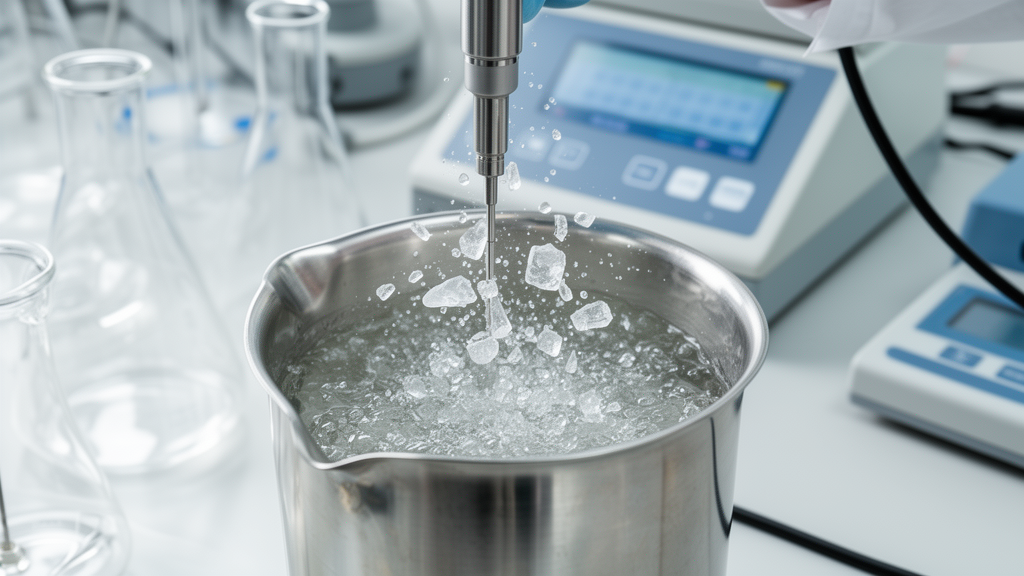
The technique, called sono-precipitation, combined a solvent-antisolvent process with ultrasound. Raw simvastatin was first dissolved in a solvent and filtered to remove impurities. The resulting solution was introduced into an antisolvent—a liquid in which simvastatin does not dissolve—inside a device called a sonoreactor. At the same time, the mixture was exposed to ultrasonic energy at different voltage strengths for five minutes. The sudden change in solubility caused the drug to precipitate, while the physical action of the ultrasound helped generate fine particles instead of larger crystals. The particles were subsequently filtered and dried for 12 hours at 50°C.

Among the formulations evaluated, F2 produced the strongest reported result, with its particles measuring 874 nanometres and its in vitro dissolution rate reaching 6.6 times that of Simvotin. The researchers also checked whether preparation had altered the drug or its crystal structure. Fourier-transform infrared spectroscopy showed no evidence of unwanted interaction between simvastatin and the formulation’s other ingredients. X-ray diffraction detected no change in the drug’s crystal structure. On the basis of these measurements, the researchers attributed the improved dissolution to the reduction in particle size rather than chemical modification or a detectable change in crystal form. Smaller particles present more surface area to the fluid, which supports faster dissolution of the solid drug.

The authors describe sono-precipitation as a comparatively straightforward option because it produces submicron particles directly without requiring lipid- or polymer-based nanocarriers of the kind used in some other nanoformulation approaches. They also propose that the method could be applied to other poorly water-soluble drugs. That wider application is a proposed potential advantage, not an outcome demonstrated in the reported experiment. The study was limited to simvastatin and laboratory dissolution measurements. The supplied report does not indicate testing in animals or humans, and it provides no evidence that the faster-dissolving formulation would produce higher blood concentrations, require different doses or improve cholesterol management. What the study establishes is a laboratory improvement in dissolution for a submicron formulation, while its relevance to clinical use remains to be evaluated in further research.

Subject of Research: In vitro enhancement of simvastatin dissolution through ultrasound-assisted submicron particle production

Article Title: Sound waves help shrink a cholesterol drug's particles, boosting how well it dissolves

Article References: Sound waves help shrink a cholesterol drug's particles, boosting how well it dissolves. Original publication (Bibliographic details unavailable.)

Image Credits: AI Generated

DOI: Not provided

Keywords: simvastatin, cholesterol, sono-precipitation, ultrasound, drug dissolution, submicron particles, drug formulation, bioavailability, nanomedicine, Sound, waves, help

Cite Scienmag News

Bethany Barker. (October 26, 2026). Ultrasound produces faster-dissolving simvastatin particles in laboratory study. Scienmag. https://scienmag.com/ultrasound-produces-faster-dissolving-simvastatin-particles-in-laboratory-study/


Bethany Barker. "Ultrasound produces faster-dissolving simvastatin particles in laboratory study." Scienmag, 26 October 2026, https://scienmag.com/ultrasound-produces-faster-dissolving-simvastatin-particles-in-laboratory-study/. Accessed 26 October 2026.

Bethany Barker. "Ultrasound produces faster-dissolving simvastatin particles in laboratory study." Scienmag. October 26, 2026. https://scienmag.com/ultrasound-produces-faster-dissolving-simvastatin-particles-in-laboratory-study/

Tags: accelerated drug dissolutionbioavailabilitycholesteroldrug absorption enhancementdrug dissolutiondrug formulationhelplaboratory drug testingNanomedicinenanometer-scale drug particlespharmaceutical particle size reductionphysical formulation strategiespoorly water-soluble medicationssimvastatinsolubility and bioavailabilitysono-precipitationsono-precipitation techniquesoundsubmicron particlessubmicron simvastatin particlesultrasoundultrasound in pharmaceutical manufacturingultrasound-assisted drug formulationwaves
Share26Tweet16
Previous Post

ADHD and borderline personality symptoms linked in Malaysian adolescents

Next Post

Bundled payments modestly reduced Dutch joint-replacement spending, study finds

Related Posts

Spaceborne laser reveals how monsoon storms and winds shape cirrus clouds over the Arabian Sea
Athmospheric

Spaceborne laser reveals how monsoon storms and winds shape cirrus clouds over the Arabian Sea

October 26, 2026
Two Isocyanurate Resins, One Lesson: Strongest Binding Is Not Best Column Performance
Chemistry

Two Isocyanurate Resins, One Lesson: Strongest Binding Is Not Best Column Performance

October 26, 2026
Chromium Additive Boosts Sensitivity of 1,1-ADEQUATE NMR Fourfold
Chemistry

Chromium Additive Boosts Sensitivity of 1,1-ADEQUATE NMR Fourfold

October 26, 2026
Investigation on the effect of parametric factors for synthesis of hydrogenated HTPB using a Pd-Zr-activated charcoal catalyst
Chemistry

Investigation on the effect of parametric factors for synthesis of hydrogenated HTPB using a Pd-Zr-activated charcoal catalyst

October 26, 2026
Massive Phosphoproteomics Sweep Maps the Hidden Regulatory Switches on a Key Metabolic Enzyme
Chemistry

Massive Phosphoproteomics Sweep Maps the Hidden Regulatory Switches on a Key Metabolic Enzyme

October 26, 2026
Thermal Activation Enhances Bentonite Copper Removal
Chemistry

Thermal Activation Enhances Bentonite Copper Removal

October 26, 2026
Next Post
Bundled payments modestly reduced Dutch joint-replacement spending, study finds

Bundled payments modestly reduced Dutch joint-replacement spending, study finds

  • Mothers who receive childcare support from maternal grandparents show more optimized

    Mothers who receive childcare support from maternal grandparents show more parental warmth, finds NTU Singapore study

    27656 shares
    Share 11059 Tweet 6912
  • University of Seville Breaks 120-Year-Old Mystery, Revises a Key Einstein Concept

    1061 shares
    Share 424 Tweet 265
  • Bee body mass, pathogens and local climate influence heat tolerance

    682 shares
    Share 273 Tweet 171
  • Researchers record first-ever images and data of a shark experiencing a boat strike

    546 shares
    Share 218 Tweet 137
  • Groundbreaking Clinical Trial Reveals Lubiprostone Enhances Kidney Function

    531 shares
    Share 212 Tweet 133
Science

Embark on a thrilling journey of discovery with Scienmag.com—your ultimate source for cutting-edge breakthroughs. Immerse yourself in a world where curiosity knows no limits and tomorrow’s possibilities become today’s reality!

RECENT NEWS

  • Zambian HIV records expose data gaps that can distort AI
  • Graph features boost short-term urban CO forecasting, not full-day prediction
  • Benefits of private hospital management on the quality of health care within a value-based system: a controlled cohort analysis of tertiary Spanish hospitals
  • Finnish register study links assisted reproduction in single mothers by choice to comparable birth outcomes

Categories

  • Agriculture
  • Anthropology
  • Archaeology
  • Athmospheric
  • Biology
  • Biotechnology
  • Blog
  • Bussines
  • Cancer
  • Chemistry
  • Climate
  • Earth Science
  • Editorial Policy
  • Marine
  • Mathematics
  • Medicine
  • Pediatry
  • Policy
  • Psychology & Psychiatry
  • Science Education
  • Science News
  • Social Science
  • Space
  • Technology and Engineering

Subscribe to Blog via Email

Enter your email address to subscribe to this blog and receive notifications of new posts by email.

Join 5,151 other subscribers

© 2025 Scienmag - Science Magazine

Welcome Back!

Login to your account below

Forgotten Password?

Retrieve your password

Please enter your username or email address to reset your password.

Log In
No Result
View All Result
  • HOME
  • SCIENCE NEWS
  • CONTACT US

© 2025 Scienmag - Science Magazine

Discover more from Science

Subscribe now to keep reading and get access to the full archive.

Continue reading