


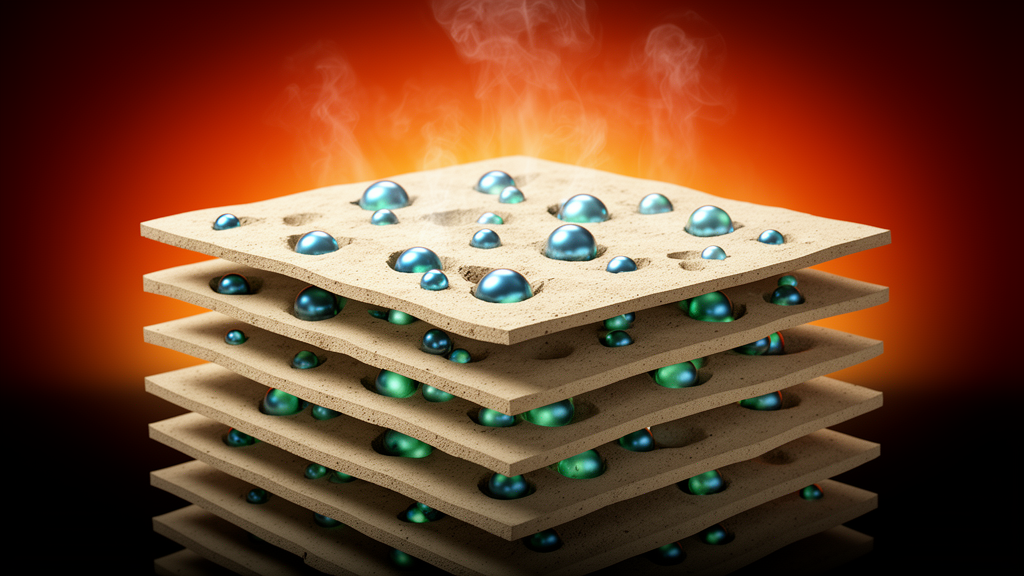
Natural clay minerals have emerged as a significant class of sustainable functional materials, driven by their natural abundance, low cost, and environmental compatibility. Among these, bentonite, primarily composed of the 2:1-layered aluminosilicate montmorillonite, has attracted considerable scientific interest due to its unique layered crystal structure and surface chemistry. The permanent negative layer charge within bentonite is generated by isomorphic substitution in the tetrahedral and octahedral sheets, which is compensated by exchangeable interlayer cations such as sodium, calcium, and magnesium. This configuration results in a high cation-exchange capacity, while the clay surface is further enriched with oxygen-containing functional groups like silanol and aluminol. These groups serve as chemically active sites for interactions with dissolved ionic species, making bentonite an attractive platform for tailoring adsorption-related physicochemical properties through controlled material modification.
The adsorption behavior of bentonite is governed not only by the abundance of adsorption sites but also by the physicochemical environment within the interlayer galleries. Exchangeable cations are stabilized by hydration shells that influence electrostatic interactions with dissolved metal ions, while the hydrated interlayer region regulates ion diffusion and accessibility to internal adsorption sites. Consequently, the adsorption performance of bentonite is closely associated with the hydration state and chemical environment of its layered structure rather than solely with its intrinsic mineral composition. This suggests that modifying the interlayer environment represents a rational strategy for improving adsorption behavior while preserving the inherent ion-exchange and surface complexation capabilities of the clay.
Various modification strategies have been developed to enhance the adsorption performance of bentonite, including acid and alkali activation, ionic liquid and surfactant functionalization, and composite formation with inorganic or carbonaceous materials. Although these approaches generally improve adsorption capacity, they frequently require additional chemical reagents, multiple synthesis steps, and more complex preparation procedures. In comparison, thermal activation represents a simple, reagent-free, and environmentally benign modification strategy that primarily alters the hydration environment of the interlayer region by removing physically adsorbed and interlayer water. Such changes are expected to influence the accessibility of exchangeable cations and oxygen-containing surface functionalities while preserving the intrinsic layered aluminosilicate framework, offering a simple modification route for developing clay-based adsorbents with reduced chemical requirements.
Among heavy metals, Cu(II) is a frequently encountered contaminant in industrial effluents, particularly those from electroplating, mining, metal finishing, battery manufacturing, and printed circuit board production. Although copper is an essential micronutrient, excessive Cu(II) concentrations can pose environmental and health risks because of its toxicity and persistence in aquatic environments. Adsorption is an attractive treatment approach for Cu(II)-contaminated water because of its operational simplicity, flexibility, and compatibility with low-cost adsorbents. However, the practical performance of an adsorbent cannot be determined solely from its maximum adsorption capacity. In treatment systems, removal efficiency is influenced by operating conditions such as pH, adsorbent dosage, initial Cu(II) concentration, and contact time, while coexisting metal ions may compete for available adsorption sites, thereby affecting Cu(II) uptake.
In a recent study, researchers systematically evaluated thermally activated bentonite for Cu(II) removal by linking its physicochemical properties to adsorption performance under different operating conditions. The natural bentonite was thermally activated at 300 degrees Celsius under a continuous nitrogen atmosphere to remove residual moisture and interlayer water. Characterization using scanning electron microscopy and energy-dispersive X-ray spectroscopy revealed that the thermally activated bentonite consisted of irregularly shaped particles forming compact agglomerates with rough and heterogeneous surfaces. Transmission electron microscopy analysis provided direct nanoscale evidence of the lamellar organization, showing distinct parallel fringes with a local interlayer spacing of approximately 1.34 nanometers. X-ray diffraction confirmed the preservation of the layered aluminosilicate structure, with the primary changes occurring within the hydrated interlayer environment rather than through extensive alteration of the aluminosilicate framework.
The adsorption experiments demonstrated that thermal activation significantly improved the Cu(II) adsorption performance of bentonite. At the highest dosage tested, the thermally activated bentonite achieved nearly complete Cu(II) removal, whereas the natural bentonite exhibited only a modest increase in removal efficiency. The adsorption capacity was found to be highly dependent on the solution pH, increasing from 117.7 milligrams per gram at pH 3 to a maximum of 190.0 milligrams per gram at pH 7.5. This increase is attributed to the progressive deprotonation of silanol and aluminol groups as the solution pH approaches and exceeds the point of zero charge, which generates a more negatively charged surface and facilitates electrostatic attraction and cation exchange with Cu(II) ions. Kinetic studies indicated that adsorption occurred rapidly during the first 10 minutes, followed by a gradual approach to equilibrium after approximately 30 minutes, with the pseudo-second-order model providing the best agreement with the experimental data.
Further investigation into the adsorption mechanism revealed that the process is predominantly governed by weak interfacial interactions rather than strong chemical bond formation. The negative enthalpy change indicated that Cu(II) adsorption onto the thermally activated bentonite is an exothermic process, while the negative Gibbs free energy values confirmed that adsorption proceeds spontaneously over the investigated temperature range. The expansion of the basal spacing after Cu(II) adsorption, observed through X-ray diffraction, supports a modification of the interlayer environment and is consistent with Cu(II) uptake through the interlayer region. These findings suggest that the enhanced adsorption performance is not due to an increase in surface area, which remained relatively unchanged after thermal treatment, but rather involves changes in surface chemical characteristics and the accessibility or reactivity of adsorption sites induced by the thermal process.
To assess the practical applicability of the adsorbent, the study evaluated the effect of coexisting metal ions on Cu(II) uptake in a multimetal system containing Fe(III), Pb(II), and Cd(II). Under these competitive conditions, the adsorption capacities followed the order Fe(III) > Cd(II) > Cu(II) > Pb(II). Notably, Cu(II) maintained a substantial uptake of 80.688 milligrams per gram despite simultaneous competition from three other metal ions, although this was 46.52% lower than the corresponding single-metal value. The competitive adsorption behavior was governed by the combined effects of ion-specific and adsorbent-related properties, including metal speciation, hydration characteristics, and surface-site heterogeneity. This result highlights the importance of competitive-ion evaluation when assessing practical adsorbent performance, as adsorption performance determined from single-component systems may overestimate Cu(II) uptake under chemically complex conditions.
The reusability of the thermally activated bentonite was evaluated over four consecutive adsorption-desorption cycles using ethylenediaminetetraacetic acid as the desorbing agent. The adsorbent maintained a high Cu(II) removal efficiency, decreasing from 100.00% initially to 88.47% after four reuses. The relatively high retention of removal performance indicates good regeneration stability, with the gradual decline in efficiency likely attributed to incomplete desorption of Cu(II) and the progressive loss or reduced accessibility of some adsorption sites during regeneration. Response surface methodology was also employed to optimize the Cu(II) adsorption process, identifying initial Cu(II) concentration and adsorbent dosage as the most influential factors governing adsorption capacity. The optimized conditions predicted a maximum adsorption capacity of 311.89 milligrams per gram, demonstrating the potential of thermal activation as a simple strategy for producing a reusable bentonite adsorbent with high Cu(II) affinity without additional chemical modification.
Subject of Research: Thermal activation of bentonite for enhanced copper(II) adsorption
Article Title: Thermally activated bentonite for Cu(II) removal: Adsorption behavior, process optimization, and reuse stability
Article References: Fadilah, S. N., Setiawan, W., Fanani, Z., Faizal, M., Prastika, A., Asranudin, & Gulo, F. (2026). Thermally activated bentonite for Cu(II) removal: Adsorption behavior, process optimization, and reuse stability. Case Studies in Chemical and Environmental Engineering, 14, Article 101505. https://doi.org/10.1016/j.cscee.2026.101505
Image Credits: AI Generated
DOI: 10.1016/j.cscee.2026.101505
Keywords: bentonite, copper removal, thermal activation, adsorption, water treatment, heavy metals, clay minerals, environmental science, industrial effluents, regeneration stability, Thermally, activated
Cite Scienmag News
Bethany Barker. (October 26, 2026). Thermal Activation Enhances Bentonite Copper Removal. Scienmag. https://scienmag.com/thermal-activation-enhances-bentonite-copper-removal/
Bethany Barker. "Thermal Activation Enhances Bentonite Copper Removal." Scienmag, 26 October 2026, https://scienmag.com/thermal-activation-enhances-bentonite-copper-removal/. Accessed 26 October 2026.
Bethany Barker. "Thermal Activation Enhances Bentonite Copper Removal." Scienmag. October 26, 2026. https://scienmag.com/thermal-activation-enhances-bentonite-copper-removal/


