


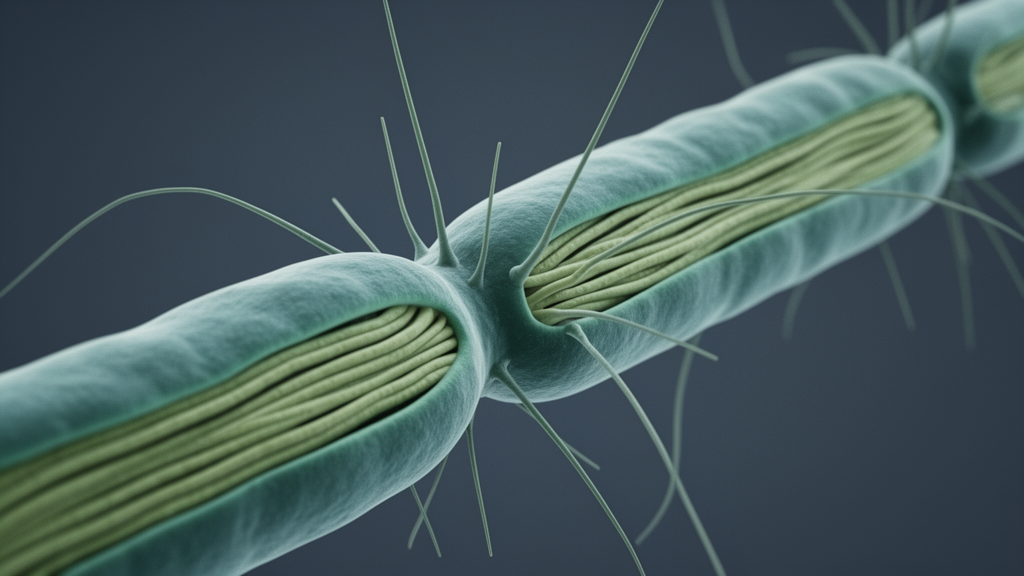
Cyanobacteria do not rely on a single multipurpose pilus, according to a study of the model strain Synechocystis sp. PCC 6803. Instead, the research shows that these microbes use one shared type IV pilus assembly system to construct two morphologically distinct filaments, each initiated by its own set of minor pilin proteins and each tailored to a different biological task: DNA uptake and surface motility.
Type IV pili are built from a major pilin, but genomes typically encode many additional minor pilins whose functions are poorly understood. To bring order to this repertoire, the team applied structural phylogenomics across 90 cyanobacterial genomes, sorting pilins into six conserved families. These families group into two distinct putative core priming complexes, which the researchers demonstrate initiate the assembly of two different filaments: short, hyper-dynamic pili used for natural competence, the process of taking up extracellular DNA, and long, adhesive pili that drive motility and phototaxis.
Structural analysis added a mechanistic detail. PilX subunits carry a conserved beta-solenoid domain that the authors propose fulfills the capping function usually associated with PilY1 homologs, positioning this domain as a priming element at the filament tip. Proteomic data further indicate that the minor pilin PilX2 facilitates the assembly of the motility pili, linking a specific minor pilin to the construction of the adhesive filament.
The study also connected motility pilus assembly to signaling. According to the findings, PilX2-dependent assembly is required to maintain levels of the DnaJ3 co-chaperone and to trigger cAMP-dependent surface sensing, suggesting that building the motility filament is coupled to the cell’s ability to detect and respond to surfaces. Together, these results establish that cyanobacteria prime two specialized type IV filaments with distinct core minor pilin complexes, meeting the conflicting biophysical requirements of DNA uptake and surface motility with a shared machinery rather than a single versatile pilus.
Subject of Research: Minor pilin complexes priming specialized type IV pilus filaments in cyanobacteria
Article Title: Distinct core minor pilin complexes prime specialized type IV filaments in cyanobacteria
Article References: Schuergers, N., Wittig, L., Enomoto, G., Herz, J., Sivabalasarma, S., Ruoff, K., Drepper, F., Albers, S.-V., Huesgen, P. F., & Wilde, A. (2026). Distinct core minor pilin complexes prime specialized type IV filaments in cyanobacteria. PLOS Genetics, 22(10), e1012337. https://doi.org/10.1371/journal.pgen.1012337
Image Credits: AI Generated
DOI: 10.1371/journal.pgen.1012337
Keywords: cyanobacteria, Synechocystis sp. PCC 6803, type IV pili, minor pilins, natural competence, motility, phototaxis, structural phylogenomics, PilX2, surface sensing, Distinct, core
Cite Scienmag News
Gregory Coleman. (October 26, 2026). Cyanobacteria Build Two Specialized Pili from One Shared Assembly Machinery. Scienmag. https://scienmag.com/cyanobacteria-build-two-specialized-pili-from-one-shared-assembly-machinery/
Gregory Coleman. "Cyanobacteria Build Two Specialized Pili from One Shared Assembly Machinery." Scienmag, 26 October 2026, https://scienmag.com/cyanobacteria-build-two-specialized-pili-from-one-shared-assembly-machinery/. Accessed 26 October 2026.
Gregory Coleman. "Cyanobacteria Build Two Specialized Pili from One Shared Assembly Machinery." Scienmag. October 26, 2026. https://scienmag.com/cyanobacteria-build-two-specialized-pili-from-one-shared-assembly-machinery/


